
The Alaska Gasline Development Corporation announced Wednesday its chosen route for moving the Kenai Spur Highway around the natural gas liquefaction plant and export terminal it plans to build in Nikiski. The choice — which AGDC calls the “west LNG route” — is a shortened and less expensive version of a route the state-owned corporation had previously considered.
Around 2015 the gasline project began considering 26 possible reroutes for the Spur Highway, whose existing path between roughly mile 19.5 and mile 21 passes through the approximately 900-acre footprint of the planned LNG plant, meant to liquify and export gas sent in an 800-mile pipeline from the North Slope. In January, AGDC, which has lead the project since late 2016, narrowed the possibilities to two: a 5.4 mile “west alternative” that would branch from the existing highway around Mile 19 and pass inside Miller Loop Road, and a “east alternative” that would leave the existing highway around Mile 18 and run outside Miller Loop to the east.
After Nikiski residents commented on the two routes in a Feb. 12 meeting, AGDC Communications Manager Jesse Carlstrom said the corporation created a variant for each “taking into account community feedback, environmental impact mitigations, and cost considerations.” AGDC also began considering another route proposed by Nikiski resident Richard McGahan, which would follow Kenai’s Marathon Road north of the Kenai Municipal Airport, cross vacant land mostly owned by the Alaska Mental Health Trust, and follow the edges of some Nikiski residential neighborhoods before joining North Miller Loop.
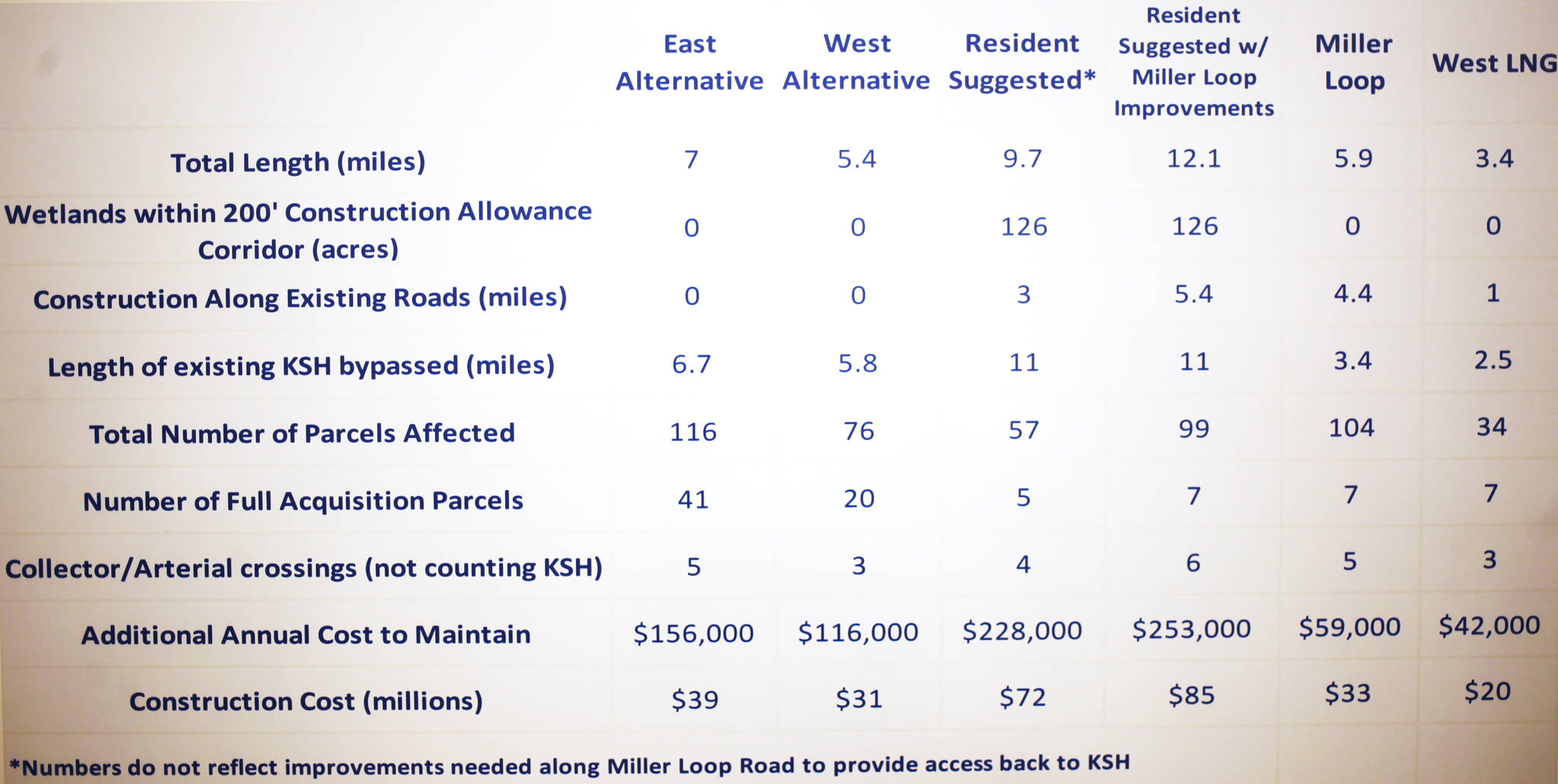
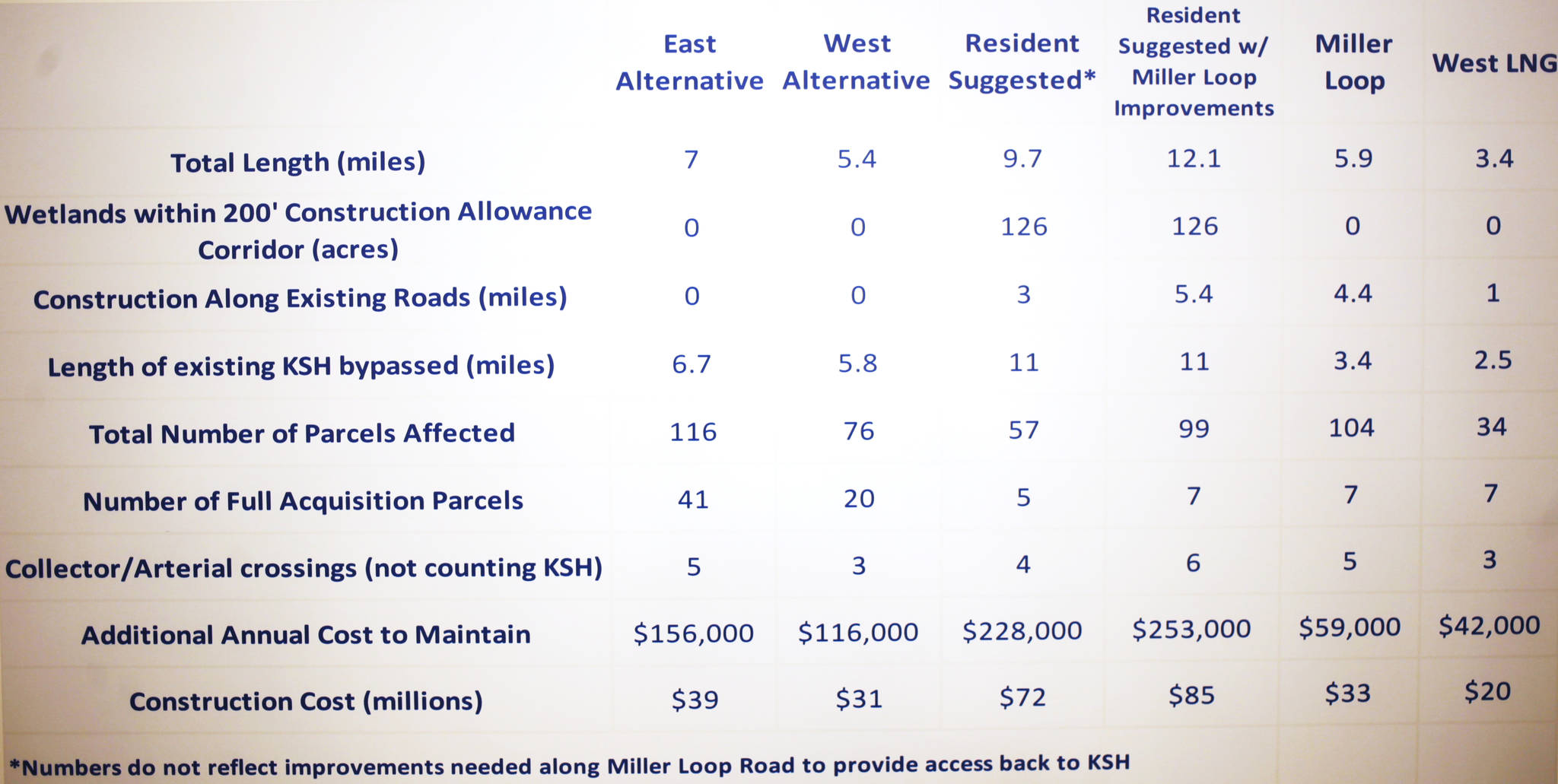
The chosen path is the shortest of these five options at 5.4 miles and has the lowest construction estimate at $31 million. It’s a truncated version of the west alternative, made two miles shorter by joining the present route of North Miller Loop Road to run along the planned LNG plant’s northern boundary back to the existing Spur highway. The shortened version is estimated to cost $11 million less to construct and to affect 42 fewer properties.
Under Alaska Department of Transportation standards, AGDC’s choice will require it to purchase parts of 76 affected properties, as well as totally purchasing five residential properties and two commercial properties . This is the lowest purchase requirement of AGDC’s four routes, though McGahan’s route would require 57 partial purchases and five full acquisitions. As of Wednesday night, AGDC Senior Vice President Frank Richards said he’d phoned five of the seven property-owners who will be totally bought out.
Several speakers at Wednesday’s meeting were property owners close enough to the new highway to be bothered by its noise but far enough to be outside the “affected property” category that requires a purchase by AGDC. One of these was Dave Phedley, who said he lives near the planned highway’s curve into what’s presently North Miller Loop.
“Your definition of impact and my definition of impact are two different things,” Phedley said. “…I’m going to have to listen to every truck downshifting going around that curve. We’re impacted, but you’ve got nothing for us — you’re not going to buy our property or compensate us for anything. You’ve got a handful of people there, and it really isn’t fair. What about those people? What’s this project going to do to those people on Cabin Lake and places that are different from the definition of ‘impacted’ that you guys have?”
Richards said that for “homeowners who may not be directly impacted by the right of way taking their property, but who are going to have a change in the environment,” AGDC may put sound barriers around the highway. This will depend on the noise levels the project will be required to measure for its environmental permitting with the Federal Energy Regulatory Commission.
“We’re not going to be able to compensate you for the change of your visual impact at this point, if you’re seeing the road,” Richards said.
Another selection criterion was annual maintenance cost to the Alaska Department of Transportation, which will take control of the road from AGDC after its construction. The chosen road was again the cheapest at $42,000. How the road fits into the overall LNG project schedule was also “a major, major driver,” Richards said.
“With the LNG plant we have a window of opportunity to provide LNG to our customers — that is the 2025 timeframe,” Richards said. “In order to do that we have to have a project that is executable and constructable so it’s not impacting the overall LNG project.”
Likely schedule delays due to environmental permitting are among the reasons Richards gave for rejecting McGahan’s proposed route, which would cover 126 acres of wetlands by AGDC’s count, requiring environmental permitting from the U.S Army Corps of Engineers, which Richards said could take up to two years.
McGahan’s suggestion would be 9.7 miles long from the start of Marathon Road to where it joins Miller Loop, and by AGDC’s estimate would cost $72 million to construct and $228,000 in annual maintenance. Including Miller Loop’s expansion to meet highway standards, it would be 12.1 miles long.
McGahan said Wednesday a contractor had estimated a 13-mile five lane version of his road proposal at between $50 million and $55 million. Advocating for Nikiski residents to continue organizing in favor of his road plan, McGahan said AGDC’s choice would make traveling difficult for people living to the north.
“For (AGDC) to think they’ll get by with this west road because it’s shorter and easier for the plant, they’re not talking about the folks who are beyond that or beside it,” McGahan said. “That’s what we need to talk about.”
Richards said AGDC plans to start the highway’s permitting and design this summer. Beyond that, the road’s future timeline depends on when and whether AGDC finds funding for the estimated $43 billion project pipeline project.
Several audience comments were about possible threats from the eroding bluff west of the Spur Highway near the new highway’s branching from the old at Mile 19. The Alaska Department of Transportation’s measurements at Mile 19.5 put the bluff edge 110 feet from the road’s centerline, and show the bluff lost 4 feet between October 2011 and February 2018.
“At this time, it doesn’t look like we’re going to have a full blown project to fix the bluff erosion,” said Joe Kemp, DOT’s liason with AGDC. “It’s just in monitoring phase right now.”
Reach Ben Boettger at bboettger@peninsulaclarion.com
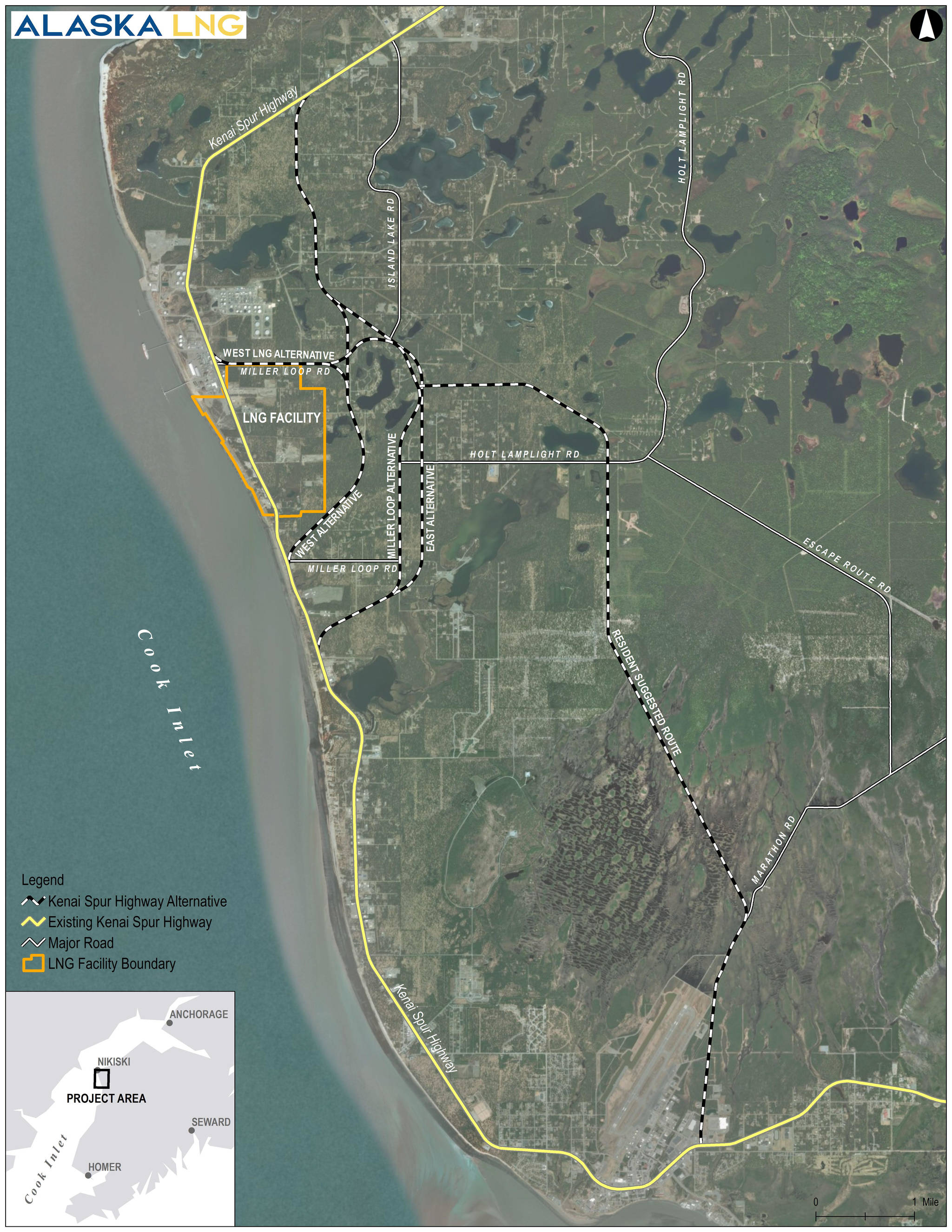
This map shows the five possible routes from which the Alaska Gasline Development Corporation selected the final path of their Kenai Spur Highway reroute, announced Wednesday at a public meeting in Nikiski. (Courtesy Alaska Gasline Development Corporation)
This map shows the five possible routes from which the Alaska Gasline Development Corporation selected the final path of their Kenai Spur Highway reroute, announced Wednesday at a public meeting in Nikiski. (Courtesy Alaska Gasline Development Corporation)
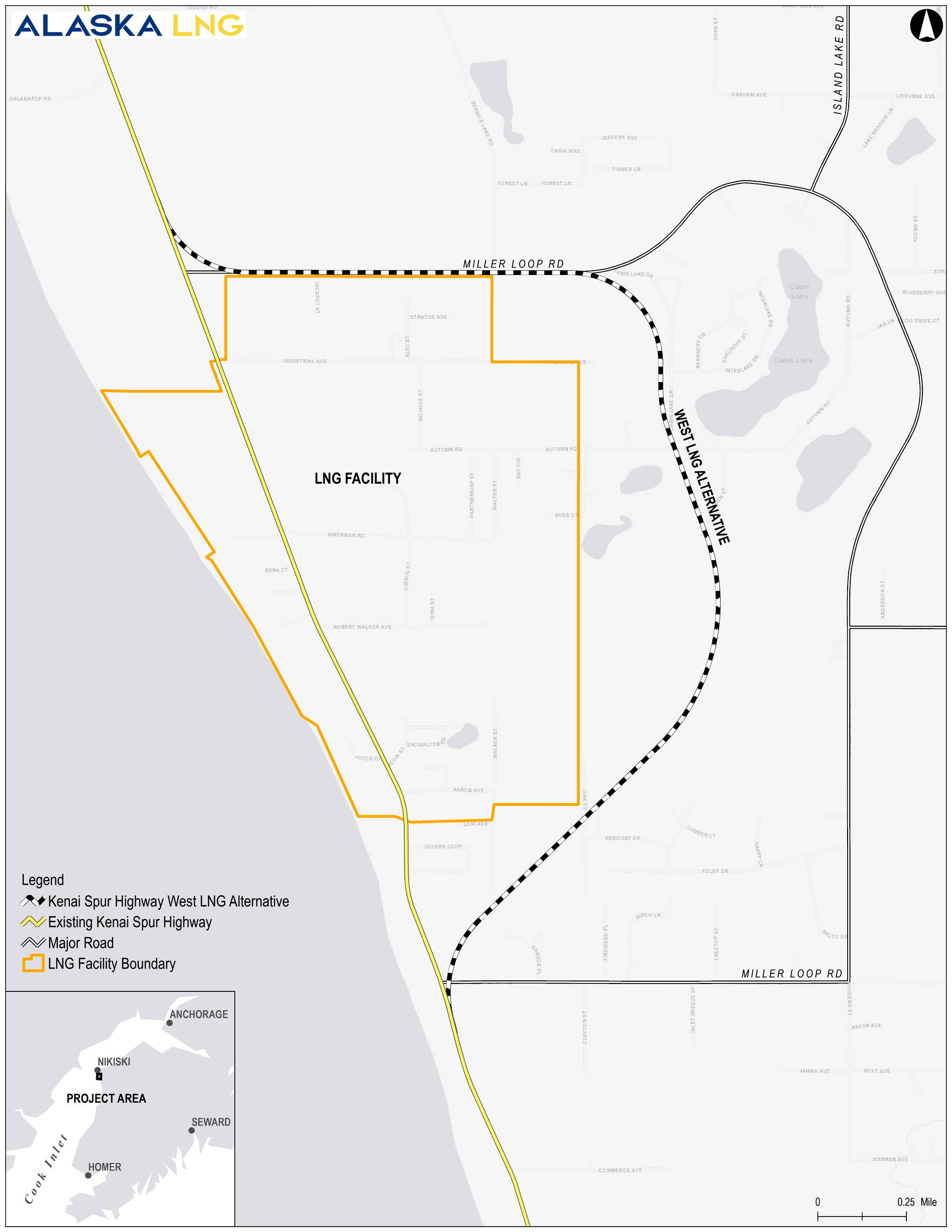
This map shows the five possible routes from which the Alaska Gasline Development Corporation selected the final path of their Kenai Spur Highway reroute, announced Wednesday at a public meeting in Nikiski. (Courtesy Alaska Gasline Development Corporation)
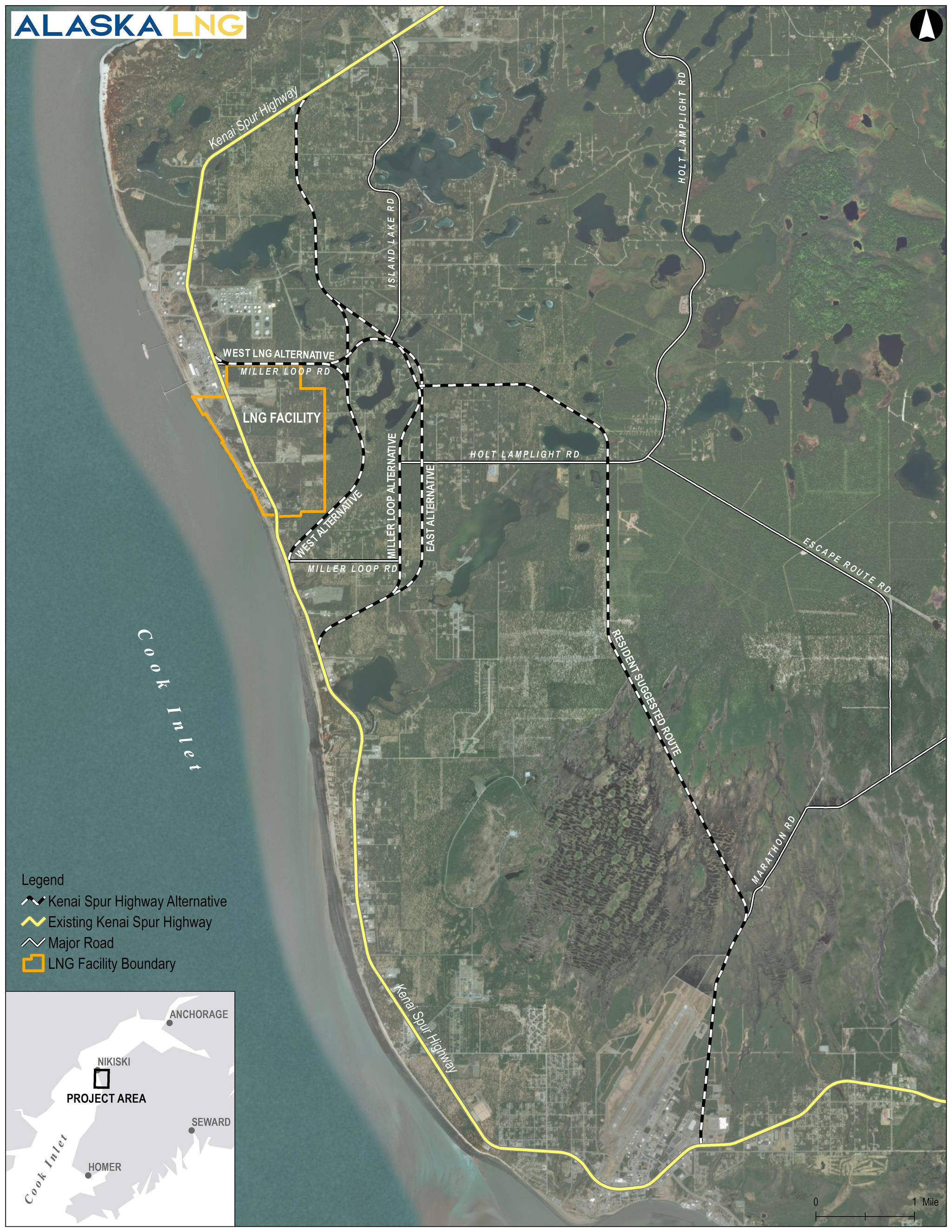
This map shows the five possible routes from which the Alaska Gasline Development Corporation selected the final path of their Kenai Spur Highway reroute, announced Wednesday at a public meeting in Nikiski. (Courtesy Alaska Gasline Development Corporation)
