
Sitting at a desk covered with dried bull kelp, pencils, tape, salmon skin, bits of fabric, bleached-white bones, coffee cups, scissors, images cut from printed material, cardboard, a measuring tape and box cutter, Emily Schubert, Bunnell Street Arts Center’s current artist in residence, looks like a child surrounded by favorite toys. Her exhibit, “Between a Rock and a Soft Place,” which features a multimedia presentation of puppetry, makes sense of the seemingly disparate items.
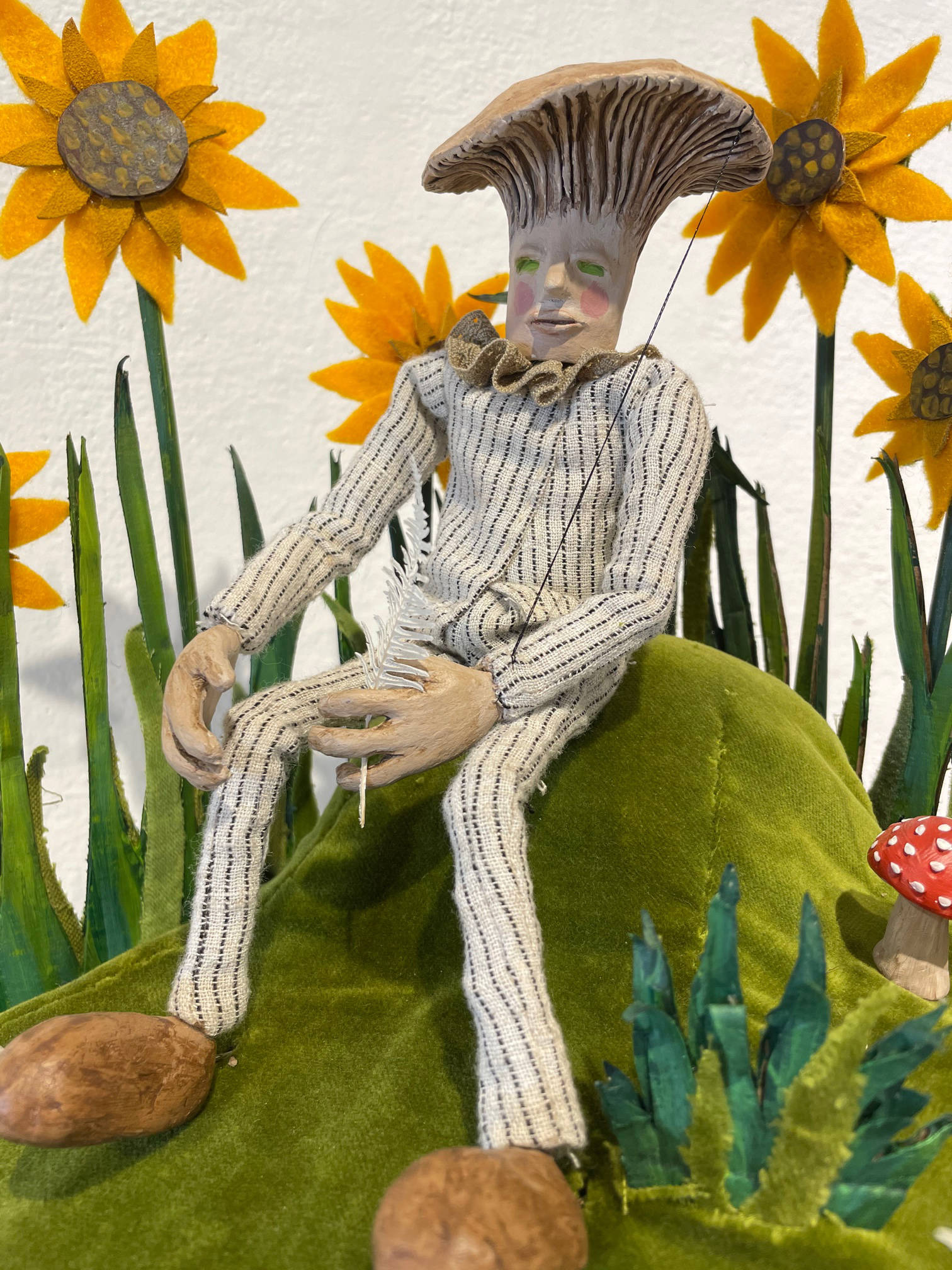
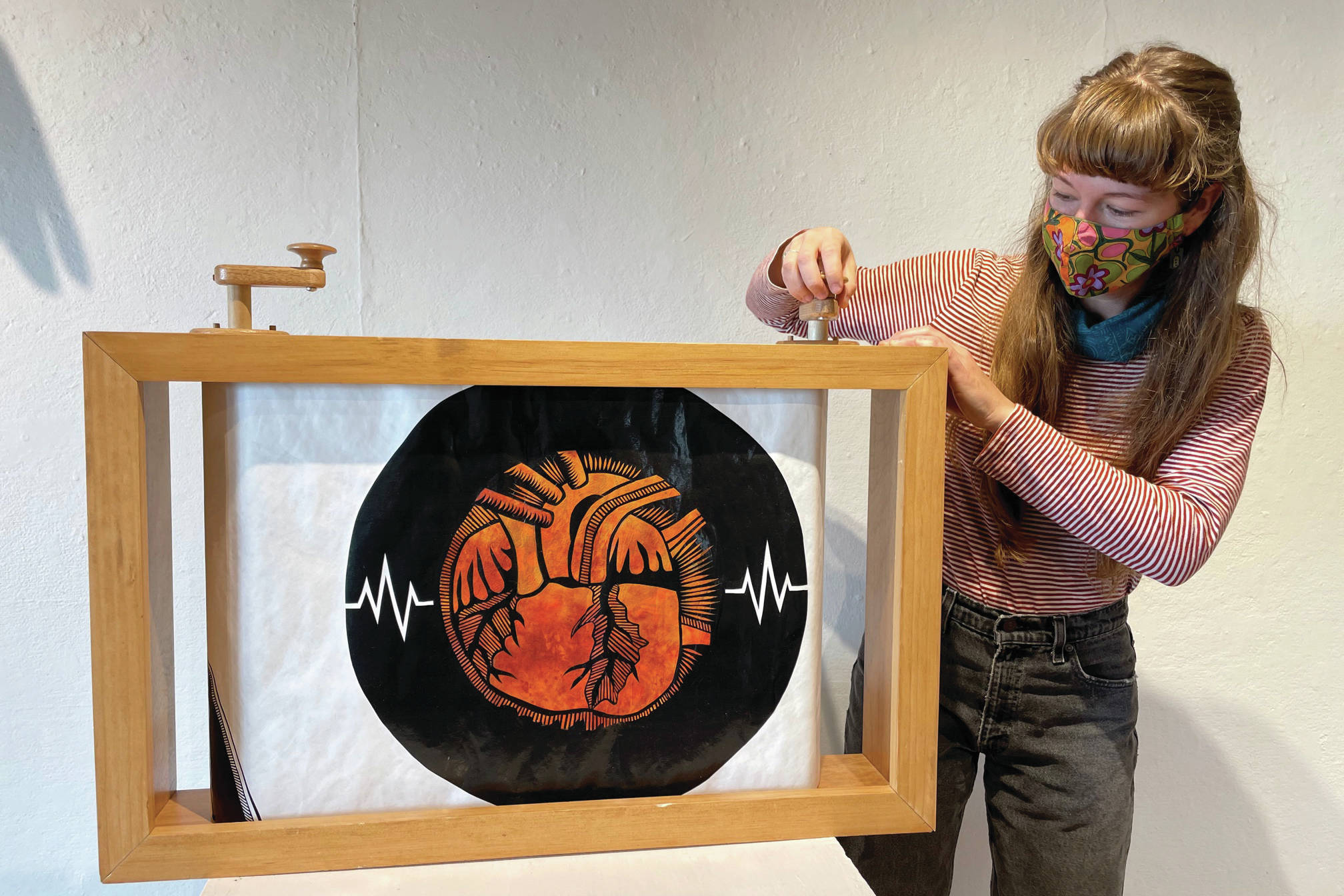
Near Schubert’s desk is a three-dimensional backdrop for puppetry performances known as “dogugaeshi,” which literally translates as “set change” and comes from 17th century Japanese puppetry. Also nearby is a “crankie,” named for the cranking effort needed to wind a scroll that also provides background for Schubert’s performances. Beside the crankie, one of Schubert’s puppets with a mushroom-like head sits motionless, waiting for Schubert to bring it to life.
At first glance, her piece “Weltschmerz” looks like a detailed painting or maybe a sketch, its three dimensional qualities intensified by varying patterns. But it is neither paint nor pencil. It is, instead, a seamlessly pieced collage worthy of close inspection.
In the center of the gallery, one of Schubert’s small “rooms” or houses balances perfectly on taxidermied bird feet — its construction and interior a treasure chest of found objects, items collected from the natural world by Schubert, and some gifts from friends.
“This is the first time since the pandemic hit that I’ve left the bubble of where I was. I got to come to this super, magical, natural place, meet interesting people. … I’m feeling super inspired, super lucky,” said Schubert, most recently from Baltimore, Maryland.
The daughter of two artists, Schubert directed her creative energy away from the technology-dependent graphic design business of her parents.
“I started getting interested in puppets and performative storytelling in college,” Schubert said, crediting a professor who recognized that Schubert’s wide-ranging artistic interests fit nicely under the umbrella of puppetry. The professor introduced Schubert to Black Cherry Puppet Theater, a Baltimore nonprofit of artists and performers that hold puppet slams to give people an opportunity to give puppetry a try.
“I had no idea this even existed,” Schubert said.
After that, she knew she was bitten by the puppetry bug and advanced from performing to coordinating the puppet slams.
“I think you’re able to get messages and feelings across through puppetry that you can’t convey the same way having a conversation with somebody,” she said. “Through animating and creating a magical world, people are more ready to put themselves there. With puppets, there’s no history, no preconceived notion of what might go on. No baggage. So you’re more readily able to project what you want to get out of it. It’s a heightened, emotional, magical experience because you’re able to suspend your disbelief that this thing that is not alive is alive.”
Creating collages began at a time when Schubert lacked a studio but still felt compelled to make something. Distancing required by the pandemic brought new challenges to puppet performances, making it difficult to coordinate shows and find places where it was safe to perform. It also led to a new expression of Schubert’s creative spirit.
“I have these tiny little shrine houses that I started making during the pandemic,” she said of a medium she believes is adjacent to puppetry. “I’m definitely convinced that as humans, it’s the story that propels us. I know that’s what propels and compels me. I’m always looking for the tidbit of a story to put in my pocket.”
Clearly, stories are built into the shrine houses in Schubert’s Bunnell exhibit. Open to view, the rooms contain items that piece the stories together. Seeming to hover overhead with the outstretched wings of a goose, furnishings in the “House of Days Gone By” reflect times past, while the interior of “House of Perpetual Solitude” remains a secret, its four walls intact, its door closed.
When asked to define her art, Schubert used the phrase “multi-potentialities.”
“That’s me. I like to dabble, experiment and try different things. I’m material-based, but I also like the meditative processes,” she said.
While in Homer, Schubert has held two in-person and one Zoom workshops.
“Bunnell’s artist residency program exists to generate artistic inquiry, innovation and equity to strengthen the physical, social and economic fabric of Alaska,” Adele Person, Bunnell’s executive director, said.
Artists are chosen by a panel of local artists and community members, represent all disciplines and come from around the world. The residencies incorporate community involvement through exhibits, artist talks, performances, workshops, public art and other projects. Schubert applied for the residency in 2019, but the pandemic postponed her arrival in Homer until this year.
“Her time at Bunnell has been wonderful,” Person said. “She has the energy of spring bursting forward after a particularly long winter.”
A showcase of Schubert and her workshop participants’ projects is scheduled for May 2 and will be shared on Bunnell Street Arts Center’s Facebook page.
After Homer, Schubert has been accepted for another residency in Montana.
Bunnell’s next artist-in-residence will be visual artist Sheryl Maree Reall in June.
For more information, visit Schubert’s website at emily-schubert.com or visit her Instagram account at schubertemily. For more information about the Bunnell Street Arts Center, visit bunnellarts.org or call 907-235-2662.
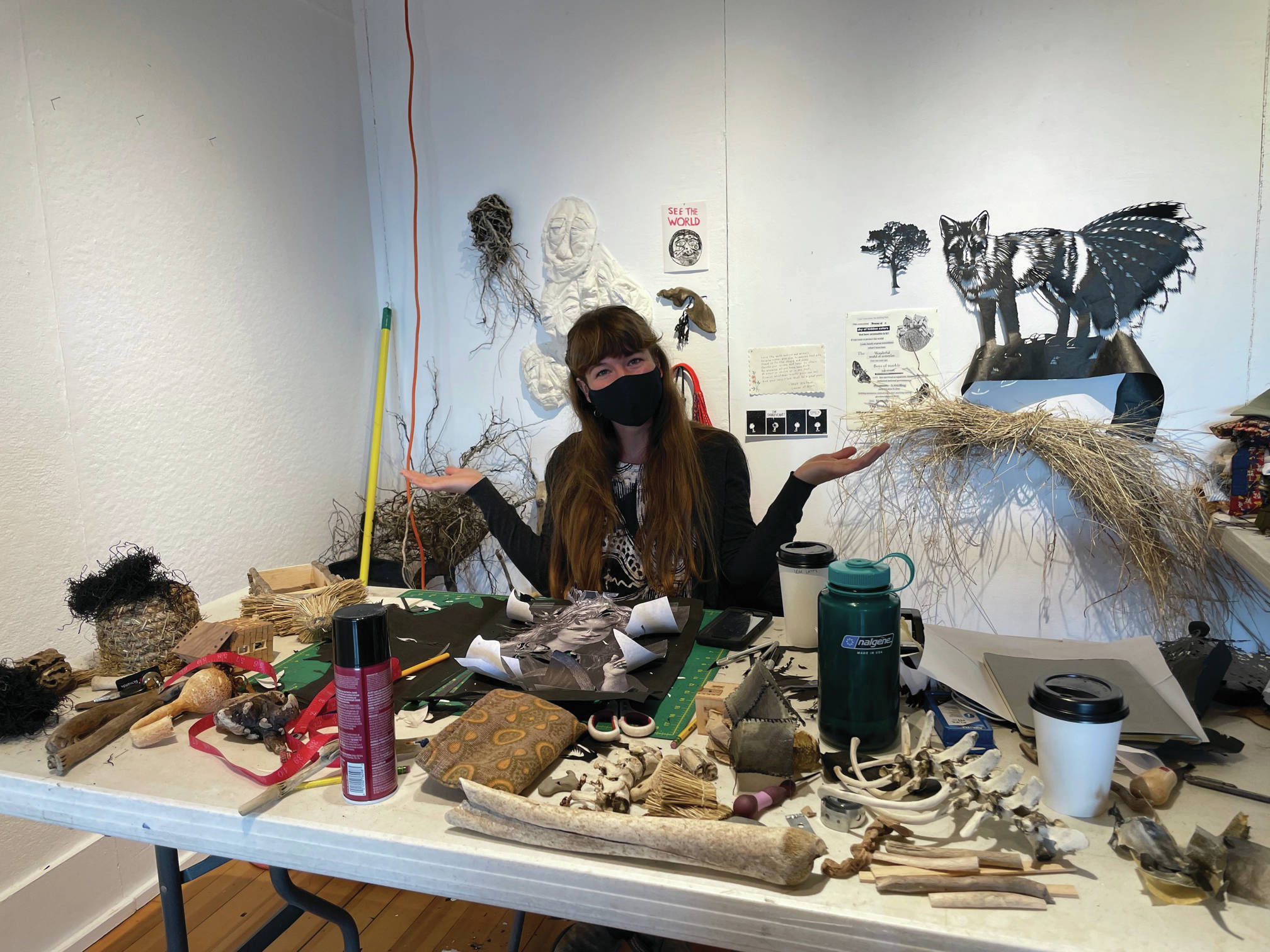
Artist-in-residence Emily Schubert makes sense out of her materials-covered desk on April at Bunnell Street Arts Center.
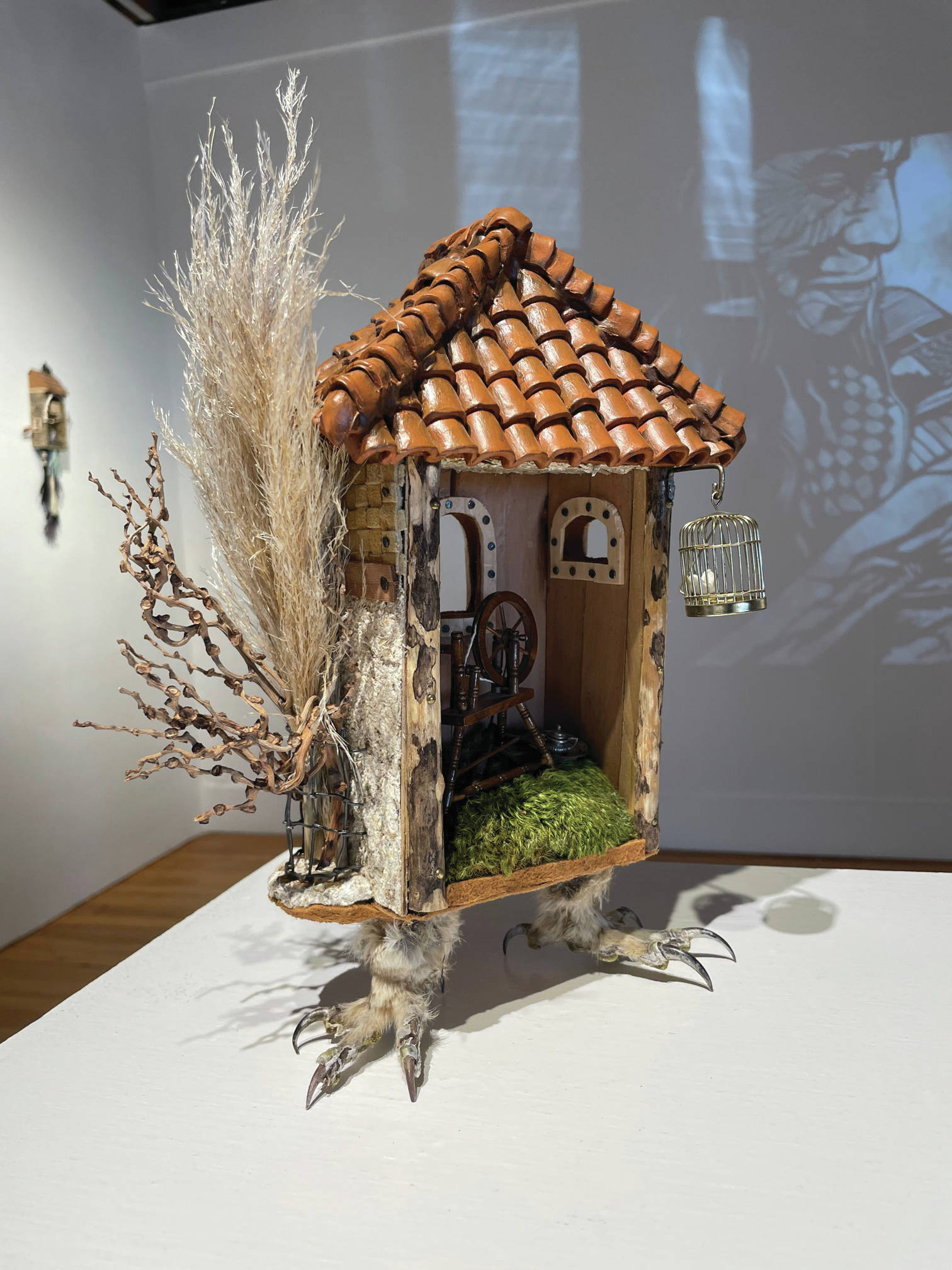
Artist Emily Schubert’s “The House of Spinning Dreams,” balanced on two bird feet, incorporates numerous techniques including taxidermy, as seen here on Saturday, April 17, 2021, at Bunnell Street Arts Center in Homer, Alaska. (Photo by McKibben Jackinsky.)
Artist Emily Schubert’s “The House of Spinning Dreams,” balanced on two bird feet, incorporates numerous techniques including taxidermy, as seen here on Saturday, April 17, 2021, at Bunnell Street Arts Center in Homer, Alaska. (Photo by McKibben Jackinsky.)
