

AUTHOR’S NOTE: In the first two parts of this tale about the rise and dramatic fall of Cliff House on Tustumena Lake, I introduced diarist Bob Huttle, who spent an April night at the cabin in 1934 and pondered one of its former occupants, Dr. John Aiken “Doc” Flanders, and the possibility that Flanders had murdered a man named Jack Harney there and then disposed of his body.
I set out to learn more about Doc Flanders. Documents suggested he was a World War I veteran who had come from Chicago to Alaska in the early 1920s, apparently with Harney. In the winter of 1923-24 they were living in Cliff House as they worked to build a hunting lodge near the head of the lake.
As I do often when fishing for clues, I began with genealogical websites.
A brief summary of Doc Flanders’ life
The eldest of the five sons of John James and Alicia Aiken Flanders, John Aiken Flanders was born in Chicago in 1883 and died in Chicago in 1960, at the age of 77.
He completed his undergraduate work in 1906 at Columbia University in New York City, where he belonged to the Rowing Club, King’s Crown, the Chemical Society and the Christian Association. He graduated from Loyola University Medical School in Chicago in 1917.
In Chicago in 1930, Flanders was working as a physician in private practice and married to a woman named Rachel Walker. From suspect in a disappearance case in Alaska in 1924 to happily married man and respected physician in Illinois six years seemed quite the feat.
As it turned out, almost none of that mattered ….
What’s in a name?
On Nov. 25, 1925, the Anchorage Daily Times published a lengthy page 7 article with a multi-deck headline that began this way: “KENAI DOCTOR ADMITS NAME, FAME STOLEN. German Medical Student Uses Name of Real Doctor.”
The article opened: “The story of Rudolph Greiss, alias ‘Dr. John A. Flanders,’ as revealed in the court proceedings at Valdez recently, reads like fiction and [is] probably the only case of its kind recorded in Alaska court history.
“It is the story of a German, said to have been interned during the war, who has been masquerading in Alaska for nearly four years as a reputable physician, having stolen the name and reputation of a doctor of high standing in Chicago medical circles.
“[Greiss] is not a graduate of any medical college, insofar as the authorities have been able to learn. He attended some sort of a medical school in Germany and later, in the United States, is said to have made the acquaintance of the real Dr. Flanders, learning enough about him that he was able to impersonate him ….”
According to the Times, Rudolph Greiss had traveled to San Francisco in 1921. There, pretending to be John Aiken Flanders, secured for himself a job as doctor for the cannery at Chignik and later at plants operated by Northwest Fisheries and Libby, McNeil & Libby in Bristol Bay and Kenai.
“He is said to have had papers in his possession when he [was hired], bearing out his claim that he was … Flanders,” the article said. “How he obtained the papers is not known at this time.”
A month before the trial in Valdez, some Kenai residents had taken Greiss into custody on a “statutory charge” — sodomy, as revealed in a separate article. The U.S. commissioner in Seldovia sent Greiss to the grand jury in Valdez. Although Greiss was acquitted in early November “due to the lack of corroborative evidence,” he was subsequently indicted on nearly a half-dozen drug-related charges.
At this time, Greiss admitted his true identity and the fraud he had perpetrated. To the other charges, then, was added “the practice of medicine and surgery in Alaska without a license.”
He pleaded guilty to a charge of selling narcotics to cannery workers and was sentenced to one year in prison.
“No attempt was made to prosecute him for the impersonation, however,” stated the newspaper, “because of the cost of bringing needed witnesses from the states. The authorities were content to secure a conviction on a charge of violation of the [Harrison Narcotics Act]…. When that sentence has been completed, additional charges will be preferred in the states, enough of them, it is thought, to keep the imposter behind bars the rest of his natural life.”
But wait! There’s more
A closer examination of news articles about the case — plus a copy of Greiss’s prison-intake paperwork at McNeil Island federal penitentiary in Washington state, and a handful of other documents — revealed further contradictions and posed additional, crucial questions.
Greiss, or Prisoner #3596, was arrested Oct. 22, 1925, and sentenced Nov. 18. He was received at the prison Dec. 9. On the line beneath “Rudolph Greiss” in the prison log book was written “alias: John A. Flanders (True Name).”
According to the log, he was 47 years old, stood just over 5-foot-9, weighed 183 pounds, and had brown hair and green eyes.
Nothing was mentioned of a physical feature noted prominently in the Times article: “a long scar across his face which he is alleged to have said was made by a trench knife during the war while he was fighting with American forces. As a matter of fact, according to information said to have been obtained by the authorities, the scar is the result of a duel fought while he was attending a German school.”
The prison listed Greiss as a physician and a Protestant whose home was in Kenai. He claimed that his arrest in Kenai had been his first ever. He also claimed that he had been born in Meherrin, Virginia — not in Germany — on March 1, 1878.
According to several newspaper accounts, Greiss also claimed to have been the mayor of Kenai, although the village of Kenai had no mayoral system at that time.
Authorities had asserted that Greiss had not graduated from medical school, but he appeared to have true medical skills. Numerous documents showed him tending to the sick at Tustumena Lake and performing surgeries at the canneries where he had been employed. He had even helped exhume and analyze the remains of a murder victim in Bristol Bay and then testified in court about his findings.
So many oddities. So many contradictions. So many holes in the story.
In fact, it turned out that “Greiss” was not even the correct spelling of his name.
According to “Medic ’17,” the 1917 edition of the yearbook for Loyola University Medical School, the imposter was actually Rudolph Albert Gries, born in Solingen, Germany, on Dec. 1, 1883 — exactly nine months after John Aiken Flanders. He had attended four German universities, earning degrees in law and medicine.
He had immigrated to the United States in August 1909, according to his naturalization record, even though his yearbook biography claimed he had arrived a year later.
Gries was naturalized in Chicago on Dec. 16, 1915, and graduated from Loyola’s medical school in 1917. A photo of Dr. Gries, wearing his graduate’s mortarboard, appears above his bio on page 58 of the yearbook, three pages after a photo of Dr. Flanders. So they were, indeed, classmates, although not in 1919, as the Anchorage Daily Times story had said Gries had claimed.
Beauty, drugs and lingering questions
So many “facts” about Gries had been fudged here and there that I’d begun to wonder just what to trust. In fact, I wondered whether Gries had been a pathological liar, especially when I discovered a January 1921 article in the Chicago Tribune.
The headline read, “Doomed to Die, Art Lure Makes Savant a Thief.” Next to a photo of Chicago detectives examining numerous stolen art objects, the article explained that Dr. Rudolph Albert Gries, “for years one of the most prominent north side physicians,” had been arrested for shoplifting.
In a fabulous display of storytelling after detectives raided his apartment, Gries asserted that he’d been compelled to steal all of that art because an infection he had received while conducting scientific research some time before was slowly killing him, forcing him to turn to morphine and the beauty of fine art to bring him a surcease of pain.
“I knew my case was hopeless,” he was quoted as saying. “Under the influence of morphine, I could enjoy respite from my thoughts. Death always menaced me like a Damoclean sword.”
Only a few months later, according to Alaska officials, Gries was in San Francisco, impersonating Flanders to gain a cannery doctor job in Alaska. Two years later, he was with Jack Harney, living in Cliff House and supposedly building a hunting lodge at the head of Tustumena Lake.
Meanwhile, many questions remain: Was Gries ever convicted for stealing all that artwork in Chicago? What really happened to Jack Harney? What became of Gries after he was released from prison for good behavior in September 1926? Was he ever re-indicted, as Alaska authorities claimed he would be? Did he ever serve more time?
Can some of Gries’s erratic behavior and his possession of a hypodermic syringe at Tustumena Lake be attributed to a long-term addiction to morphine?
And which “Dr. J.A. Flanders” was it that the Anchorage Daily Times reported as a guest at the Hotel Parsons in Anchorage on Nov. 8, 1926?
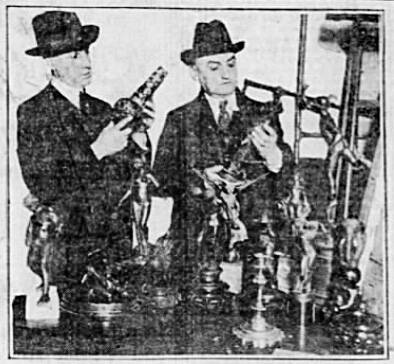
In January 1921, these Chicago detectives arrested Dr. Rudolph Albert Gries for shoplifting and then discovered a hoard of stolen art objects in the doctor’s apartment. (Photo from the Chicago Tribune)
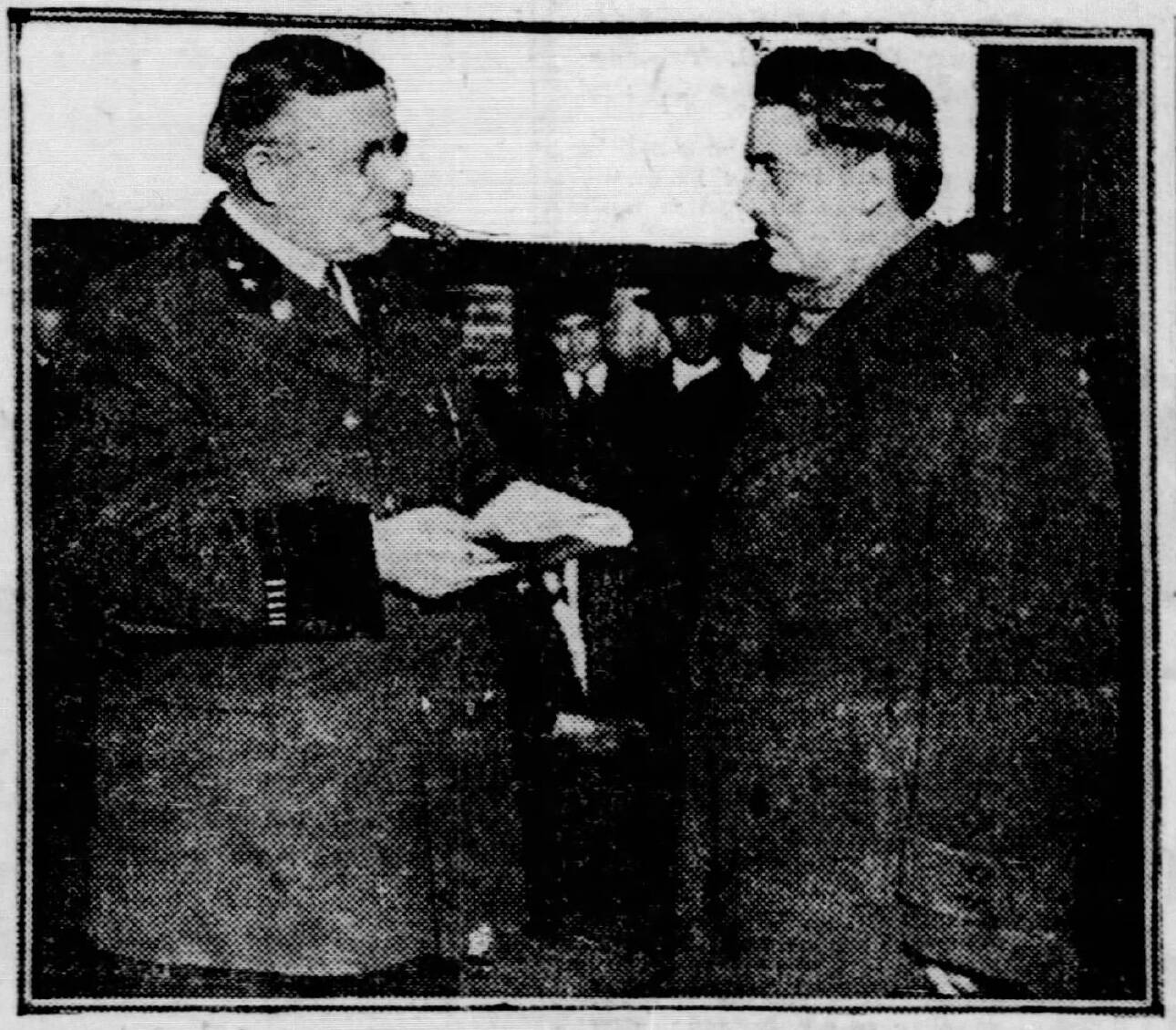
Dr. Rudolph Gries (right) is confronted by Despaines (Illinois) Police Capt. Max Danner after his arrest in January 1921. (Photo from the Chicago Tribune)
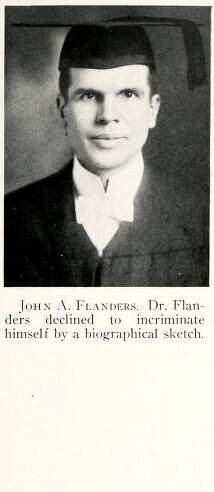
The “Medic ’17,” the yearbook for the 1917 graduating class of the Loyola University Medical School, in Chicago, featured (on separate pages) classmates John Aiken Flanders and Rudolph Albert Gries. Their histories would intertwine for several more years.
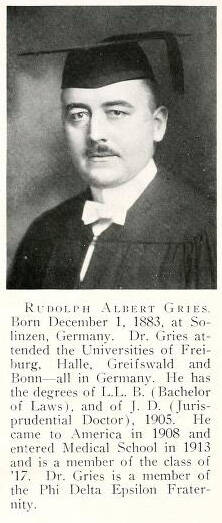
The “Medic ’17,” the yearbook for the 1917 graduating class of the Loyola University Medical School, in Chicago, featured (on separate pages) classmates John Aiken Flanders and Rudolph Albert Gries. Their histories would intertwine for several more years.
