
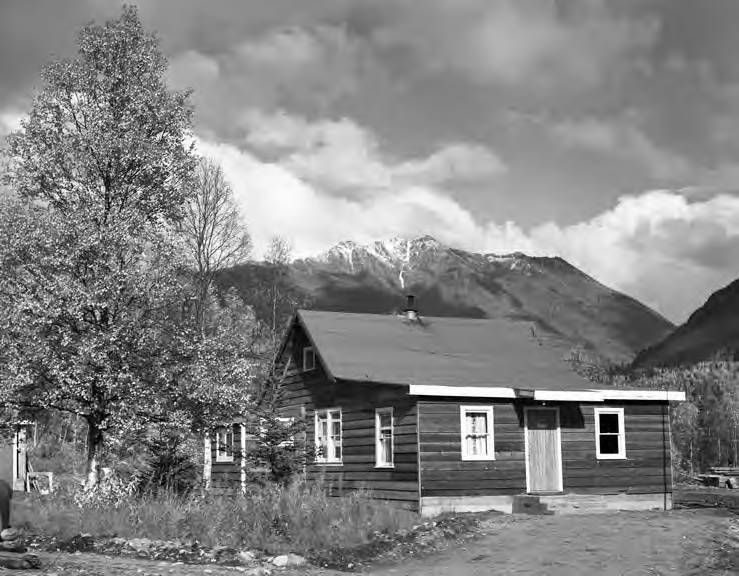
AUTHOR’S NOTE: This is the second part of a two-part story about an escape from the federal jail in Seward on Sept. 27, 1952. Prisoners Frank Charles Oliver and Chester LeRoy Oughton had been foiled in their attempt to reach the central Kenai Peninsula, and a large posse had been assembled to find them and bring them to justice.
End Game
On Oct. 6, 1952, nine full days after their escape from Seward, Oliver and Oughton were driven by hunger to risk capture. They emerged from the woods south of Moose Pass, having apparently remained in that vicinity during their entire time on the run, and began walking along the highway in the direction of the recently opened Wolf Trail Lodge.
Truck driver Fred Pinson was motoring from Seward to Anchorage just before 7 p.m. when he recognized the fugitives and suspected their destination. He stopped at the lodge to alert its owner and operator, Millie Wilder. She then called Seward Chief of Police Floyd Evans to inform him that Oughton and Oliver were heading her way.
Evans and highway patrolman Tommy Roberts immediately drove north while Wilder prepared to welcome two unwanted visitors.
At about 7:30, Frank Oliver entered the lodge alone while Chester Oughton waited outside. Oliver made a to-go order of four hamburgers and two cans of beer. Wilder took her time preparing the food, apologizing for the delay because she was the only worker on duty.
Oliver took the burgers and brews out to Oughton. About 20 minutes later, Oliver reentered the lodge and ordered four more burgers. Wilder took the order but said she was running out of burger meat so the fourth sandwich would have to be ham. Again, Oliver exited with the food, and the men quickly ate.
Then, perhaps confident that the lodge was safe, both Oliver and Oughton ventured indoors. Oughton immediately went to the bar and ordered a whiskey. Wilder had just finished pouring the drink when Evans and Roberts arrived.
According to the Anchorage Daily Times, the rest of the action played out this way:
“Oliver was standing by the juke box and sensed somehow that the safety of the place had vanished. He made a break for the door but was met there by Patrolman Roberts, who leveled his revolver at him. ‘Put your hands up,’ Roberts ordered. Oliver surrendered.
“Oughton had started around the edge of the bar in an attempt to get away, but Chief Evans stopped him with the point of his shotgun. He ordered Oughton to ‘reach,’ and the prisoner did. Oughton’s gun, a .38 Smith-Weston [sic] revolver, slipped from under his belt, down his trouser leg and onto the floor.
“Officers said the two men had lost so much weight since their escape that their clothes hung loosely on them…. [They] said the two men had … holed up in a makeshift trail camp in the [Falls] Creek mine region. Oughton, who had been a trailman for the Fish and Wildlife Service at one time, fixed up a hideaway under a clump of spruce trees. He said members of the posse had come within 10 feet of their ‘camp’ at one time during the search … .
“The prisoners lived on bouillon cubes and tea, officers learned, and were probably ‘starved down’ from their hideaway.”
On Dec. 17, Chester LeRoy Oughton received a life sentence for his crimes. After a brief stay at the prison on McNeil Island, Wash., he was transferred to the federal penitentiary on Alcatraz Island, near San Francisco.
Newspapers reported Oughton had been well dressed and cooperative at his sentencing, and his court-appointed attorney stated, “Mr. Oughton has made peace with himself.”
Meanwhile, five days after the Oughton sentencing came the Oliver sentencing: three and a half years in a federal prison. Kenneth Pitman, Oliver’s accomplice in the attempted sale of stolen weapons, received two and a half years, and a third man, Clayton Bloomfield, who apparently had cooperated with the FBI, received a two-year suspended sentence.
Coda
Frank C. Oliver appears to have gone straight after emerging from prison. He moved back to his hometown of Dallas, and a 1967 city directory shows him working at Lobello’s Charcoal Burger BBQ. By 1969, he had a job as a custodian with the Dallas Independent School District.
On May 23, 1979, after many years of cigarette smoking, 64-year-old Frank Oliver died from complications of lung cancer in Mesquite, Texas, just east of Dallas,. He was buried in Laurel Land Memorial Park in Dallas.
Chester L. Oughton also died in 1979, about five months after Oliver.
Despite his lawyer’s assertion at his sentencing, Oughton was not at peace in 1952. He spent more than a decade fighting his conviction, with one of his appeals going all the way to the U.S. Supreme Court in January 1965.
“Oughton has appealed for a hearing of his case more than 20 times,” wrote the Anchorage Daily Times. “His file is thick with lengthy, handwritten appeals.”
According to the Times, Oughton claimed that he had pleaded guilty to the Perlovich murder only because “he was afraid of being hung by a tough judge if he stood trial.” He petitioned the high court in 1965 to review and overturn the decision on his case from the U.S. Court of Appeals. The Supreme Court denied his request.
By 1965, Oughton had also requested and received two prison transfers — to Leavenworth in 1958 and back to McNeil Island in 1965. He would later be transferred — also by request — to Leavenworth again in 1969 and back to McNeil Island in 1972.
The 1958 transfer came, according to prison records, after “another inmate had assaulted him with a one-pound circular scale weight placed in a sock.” Prison officials just prior to this time had assessed Oughton this way: “He is egocentric, opportunistic, deficient in empathy and is felt to be a potentially dangerous type of individual.”
Nevertheless, in May 1974, he was released from prison into a halfway house in Arizona. He was 65 years old, and prison medical officials were cognizant of some mental impairment, likely, they believed, due to the residual effects of the head injury he’d received in the attack at Alcatraz. Officials wrote, “Oughton may require medical supervision when he is released because of early senility.”
Gladys Mae Oughton, the woman Chester had wed in 1933, died in Washington in 1997. Despite Chester’s assertions to the contrary, her obituary implied that she had remained married to Chester until the bitter end.
And in March 1956, the four-year-old Wolf Trail Lodge, site of Oughton and Oliver’s last stand and closed since the previous October, burned mysteriously to the ground.
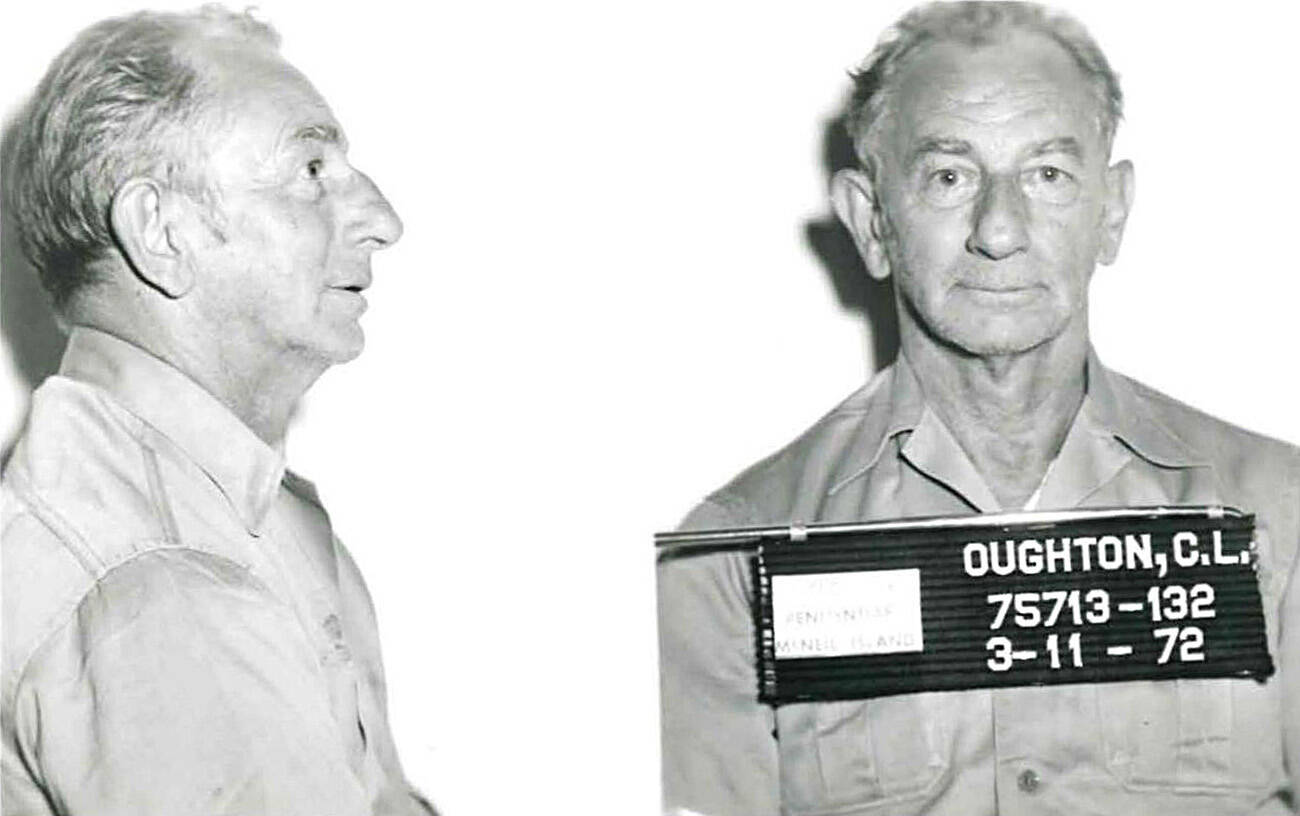
Image courtesy of the National Archives in San Francisco Chester LeRoy Oughton was in his mid-60s and still serving a life sentence for first-degree murder in Alaska when these photos were taken at McNeil Island federal penitentiary in Washington in 1972.
