
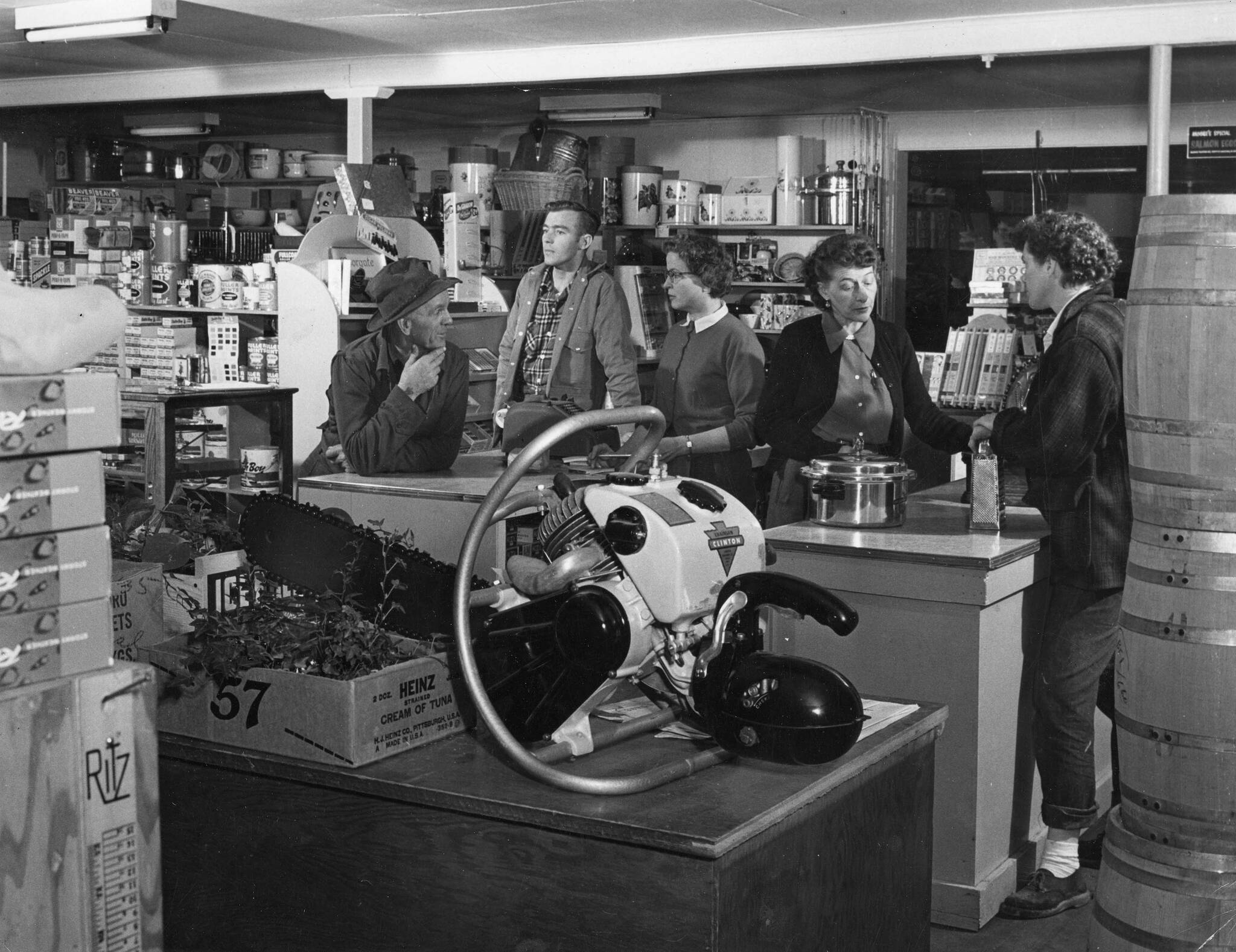
AUTHOR’S NOTE: From almost the very beginning of their lives on the Kenai Peninsula, Larry and Rusty Lancashire involved themselves in their adopted community. They came north from the Midwest in 1948 and made a home on Pickle Hill, between Kenai and Soldotna, for five decades.
In the earliest days of the Sterling Highway and the adjoining Kenai Spur, the roads were lifelines between communities and among neighbors. When spring breakup occurred, the roads sometimes shut down for weeks.
In the spring of 1949, Ralph Soberg, local head honcho for the Alaska Road Commission, encouraged locals to stay off the roads for a while and give them a chance to defrost, dry out and firm up. The main road was so bad, he said, that “only the Lord himself could use (it).”
But it took more than bad roads or heavy dumps of winter snow to keep most residents at home. People traveled the Kenai River when it was open, or they walked, skied, snowshoed — in short, did whatever they had to do to work on their homesteads, pick up their weekly mail or go to the store in Kenai, attend church services, visit with neighbors, deliver their children to school, and so forth.
Locals liked to congregate — at places such as Soldotna Creek, where they got fresh water, fished and did laundry. They enjoyed sharing gossip and news. They used human interactions to break up the stretches of isolation.
They also liked to gather in people’s homes or in a bar, in the Kenai Commercial Company store or in community centers, such as the school in Kenai. Whenever possible, they danced, they shared meals and holidays, conversation and home brew.
Residents of the central Kenai Peninsula also knew that there was always business to be taken care of, and it wasn’t wise to assume that someone else would handle it. A wide base of community involvement was key, and Larry and Rusty Lancashire, from the beginning of their homesteading venture in 1948, stepped in to help out.
Larry joined the local school board. Rusty began serving on the board of directors for the Kenai Community Library. Later, she joined the Kenai Homemakers Club, which, among other activities, advocated for better local health, sanitation and education.
Although Rusty was a Democrats and Larry was a Republican — a difference that generated many arguments and, as they liked to joke, cancelled each other out at the ballot box — both pushed for Alaska statehood. Rusty hoped to end Alaska’s use of fish traps and what she saw as overfishing by area canneries.
Most of Larry’s work early on centered on the homestead, particularly his farming efforts and his sawmill. Rusty, meanwhile, became a mail carrier in 1949, earning $1.40 for each round of letters and packages she delivered. Later, she began working as a clerk at the Kenai Commercial store in Kenai.
When the Kenai school finally acquired a school bus, the Lancashires bid on the contract to drive it. They were underbid by a Kenai preacher and expressed their unhappiness with this fact in letters to family back in the States.
Larry also attended a meeting of the rural electrification board. Both he and Rusty supported Soldotna taking control of its own mail and local efforts to build a community center. In fact, community members, in an effort probably spearheaded by Maxine Lee, threw the Lancashires a housewarming party (in their own just-finished cabin) and used the opportunity, between sips of old Pa Keeler’s fig wine, to discuss local affairs.
The agenda included a petition from Jack Irons to create a post office. (Some locals recall that the petition drive was begun by Marge Mullen.) Enough people signed the form to initiate action from the Postal Service. The first list of postal customers contained 15 names — Lee and her husband Howard, Rusty and Larry Lancashire, Marge and Frank Mullen, Dolly and Jack Farnsworth, Jack and Margaret Irons, Jesse and Nina Robinson, Bob Murray, Lyle Edgington and Penrod Buchanan.
Maxine Lee earned $14 a month as Soldotna’s first postmaster. “It wasn’t a really high-paying job,” she said, “but when you’re homesteading, 14 bucks is 14 bucks.”
Years later, Rusty would own the first travel agency in Kenai. She would also become a member of the Kenai Art Guild, the local VFW and the Elks Club. She was secretary of the Kenai Civic League and the president of the Parent Teacher Association.
In 1955, according to Dorothy Enzler’s remembrance in “Once upon the Kenai,” Rusty, in her role with the Homemakers Club, was also instrumental in putting on a show, involving can-can girls, for the general public. “We didn’t import our entertainment in those days,” Enzler wrote. “We made it ourselves…. I can’t remember all the women who took part in it, but it was a real entertainment event for the year.”
After Alaska statehood in 1959, Rusty became an alternate to the Constitutional Convention, and she was a member of Gov. William Egan’s reapportionment and health boards.
Larry, in addition, to his efforts at home, worked for a while in a general store in Kenai. Like Rusty, he belonged to the VFW and the Elks. Unlike Rusty, he was also an enthusiastic supporter of local horse racing and rodeos.
In 1961, Larry was appointed to the Kenai-Area Farmer Home Administration Committee. In 1962, as a member of the Alaska Agricultural Stabilization and Conservation board, he traveled to Washington, D.C., for a national meeting. And in 1963, he was named chairman of the Soldotna Progress Days committee.
When both Kenai and Soldotna incorporated in 1960, a swath of land between the two cities remained unincorporated. Residents of this area sought to provide an official name for their unaffiliated home turf. Both Rusty and Larry attended a meeting to select the name, and Rusty had a definite idea what it should be.
“Mom really wanted it to be called ‘Turnbuckle,’” said the Lancashires’ eldest daughter, Martha. “A turnbuckle is something that holds things together. But it was voted down.” Ridgeway was selected, instead.
Rusty was so “irritated” by the rejection of her idea, said Martha, that she used the name for a pottery business she was just starting up — Turnbuckle Enterprises.
In addition to all the boards, committees and organizations the Lancashires were a part of, they were also hosts of and participants in numerous private social gatherings over the years.
At most such get-togethers, according to Rusty, the talk among neighbors usually began as friendly, helpful and cooperative. Later, she said, gossip and grievances emerged. Fights erupted occasionally.
At a wedding reception during their first autumn on the Kenai, Rusty reported, “I danced with everyone that asked me and, man, to dance with them was really something. They really kick up their heels and cut loose…. I danced till ten o’clock—and when you dance with these characters up here you have danced. It’s a cross between sawing a tree and skinning a bear.”
On the night before Christmas — after a school performance and a visit from Santa (via costumed homesteader Marvin Smith), and after one man beat up another man for allegedly making a pass at his wife — a number of locals gathered for holiday festivities at the Ironses’ home.
Then, to assuage potential problems with late-arriving gifts due to a shipping strike, Rusty and Larry got inventive: “We told the girls that Santa would leave only a few things on Christmas being as he lives so close (to Alaska) he might run out of toys if he left a lot here at first. So he’d mail the rest later. It satisfied them—and really I believe they enjoyed it more by having packages to open on so many different days.”
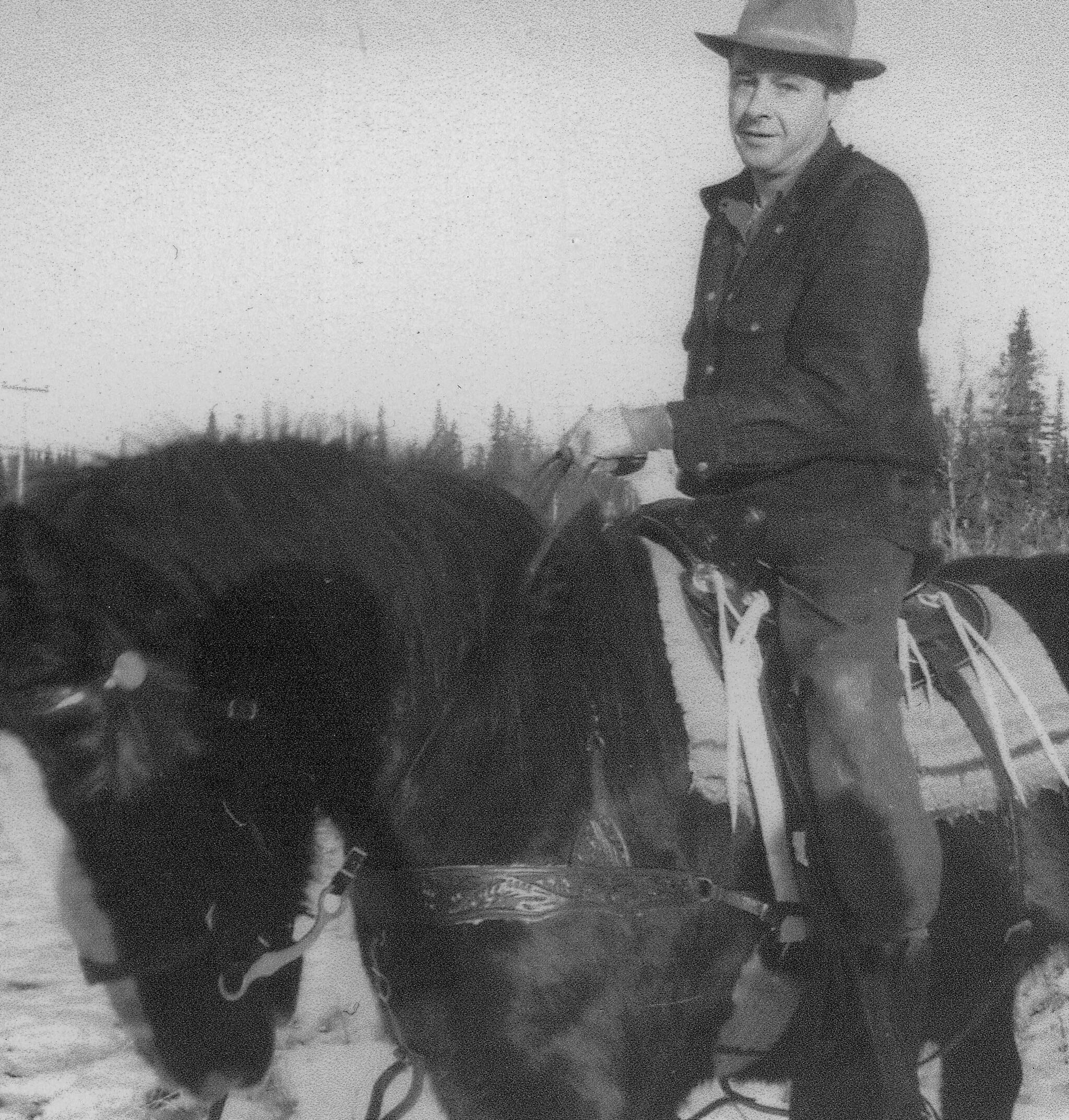
Photo courtesy of the Lancashire Family Collection Larry Lancashire on horseback, probably on the family homestead.
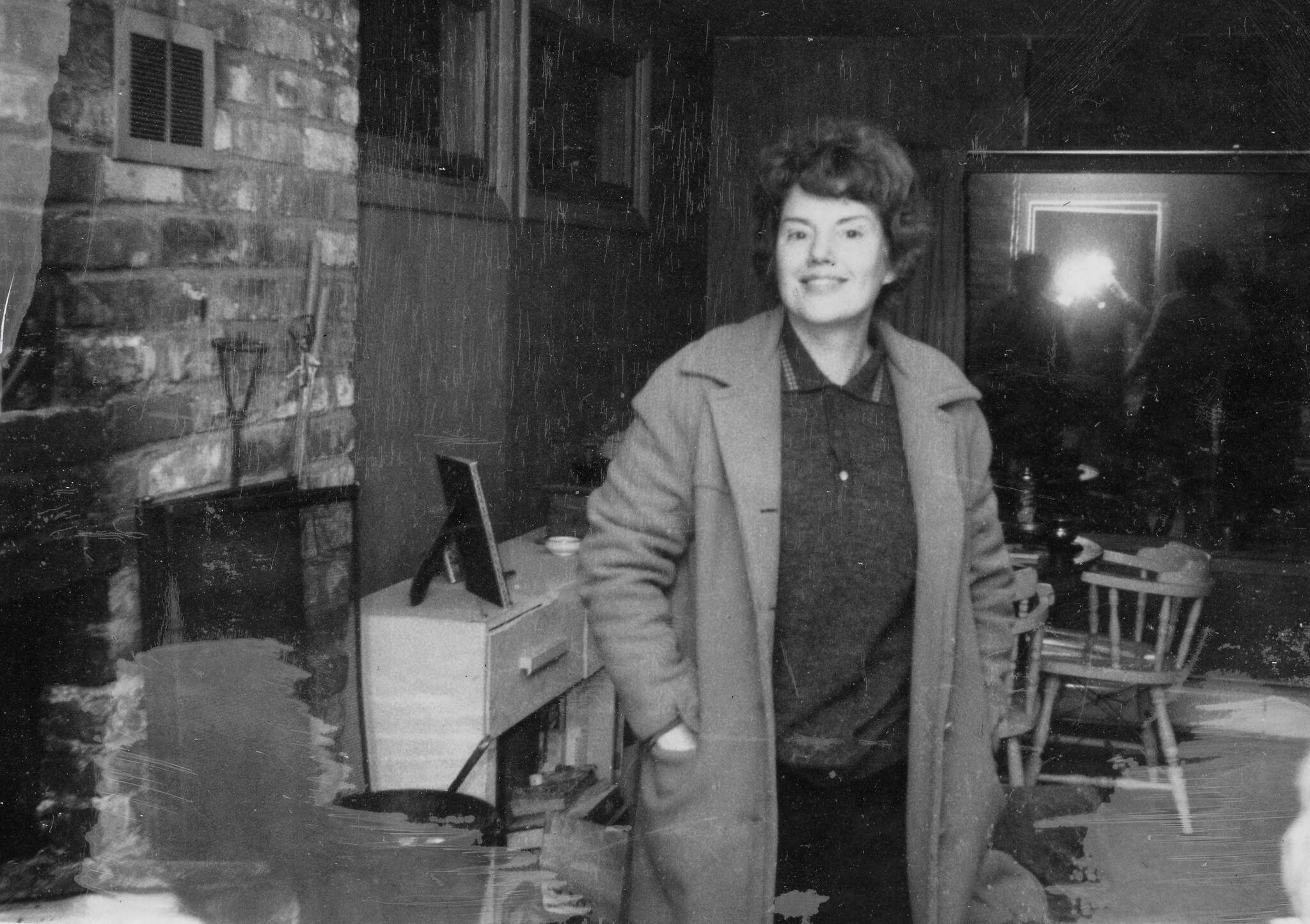
Photo courtesy of the Lancashire Family Collection Rusty Lancashire smiles for the camera in the frame house that in the late 1950s replaced the Lancashires’ original homestead log cabin.
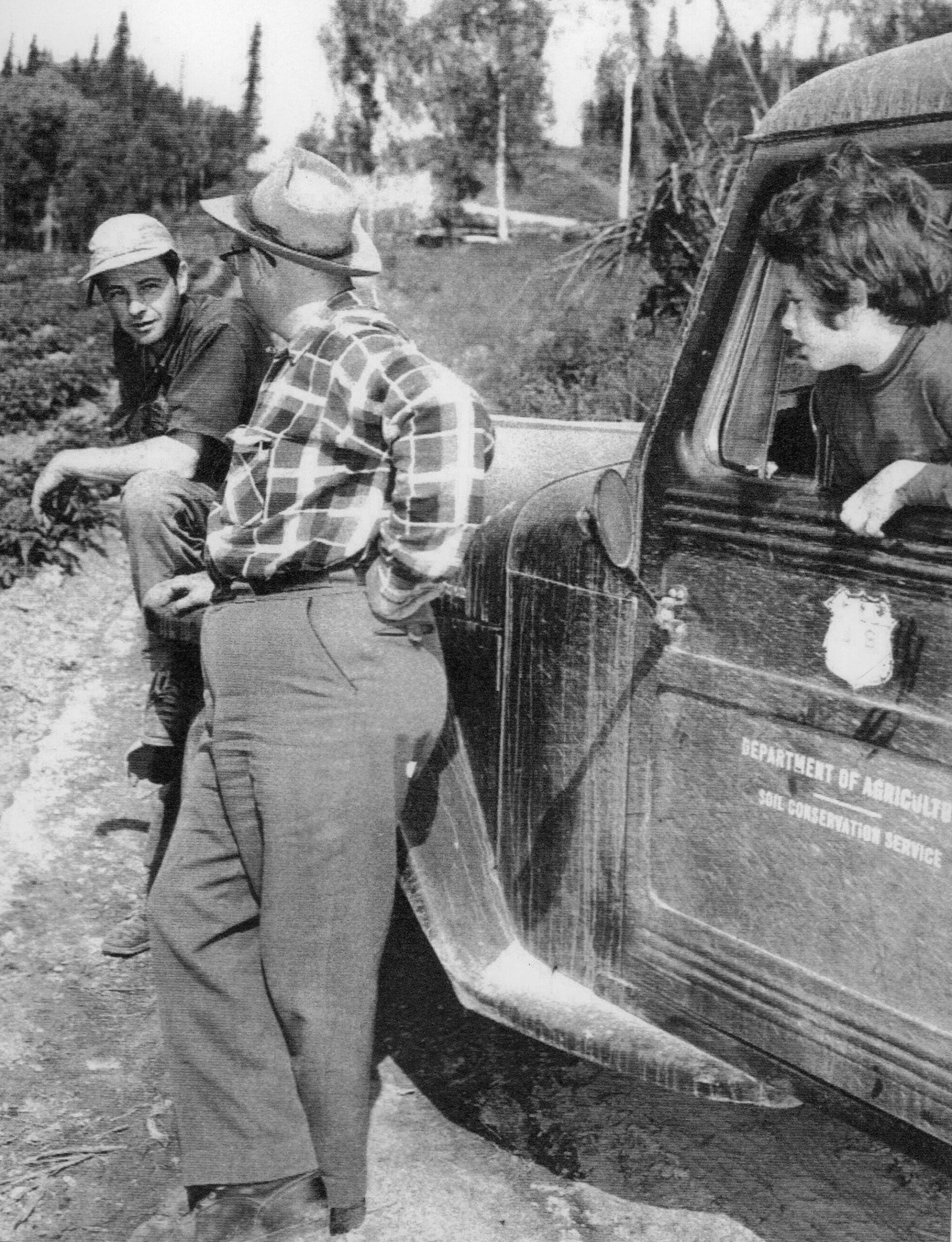
1954 photo by Bob and Ira Spring for Better Homes & Garden magazine Larry Lancashire (far left) chats with a representative from the Department of Agriculture’s Soil Conservation Service, as daughter Abby listens in.
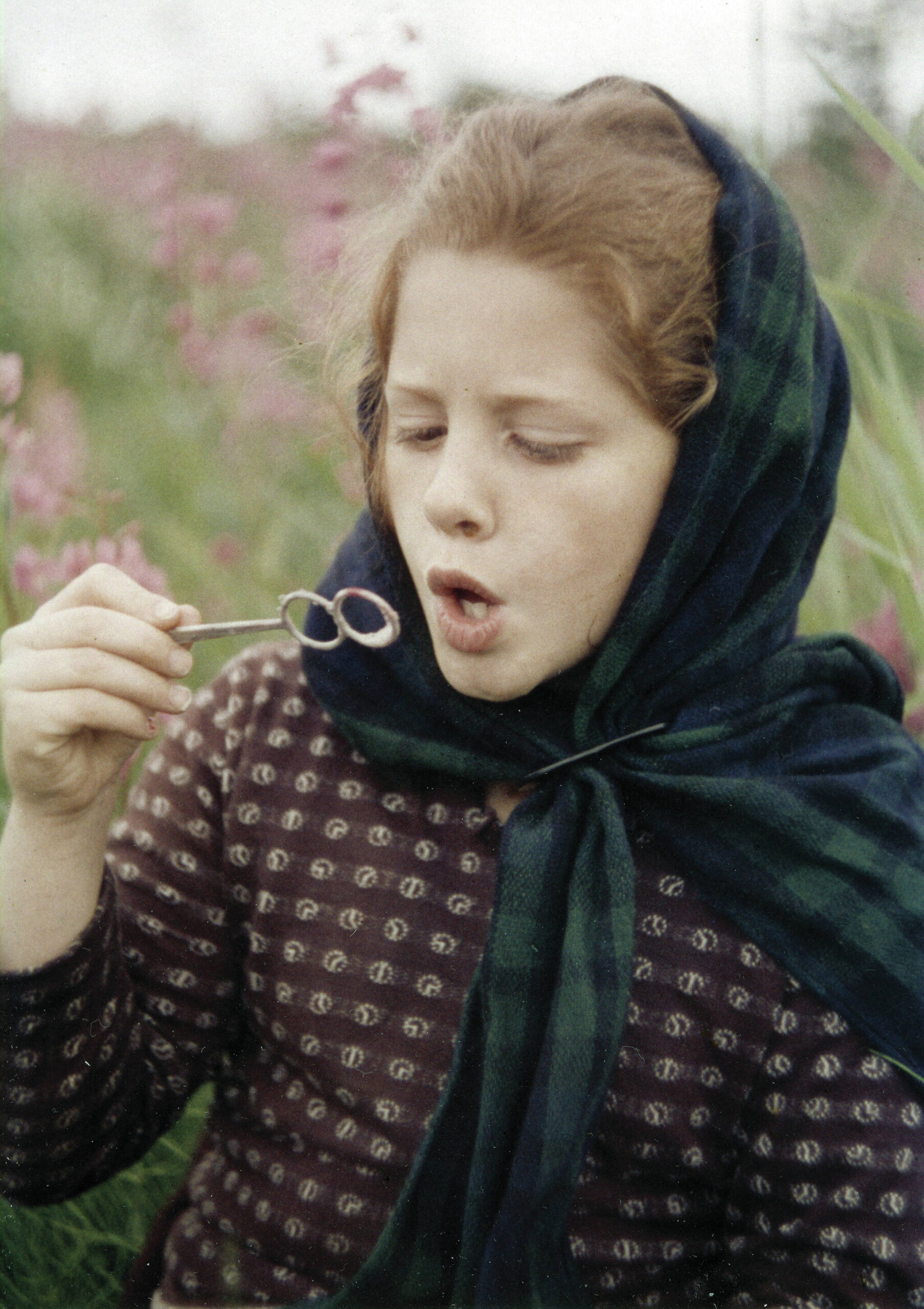
Abby Lancashire, probably in her early teens, blowing bubbles on the family homestead. (Photo courtesy of the Lancashire Family Collection.)
