
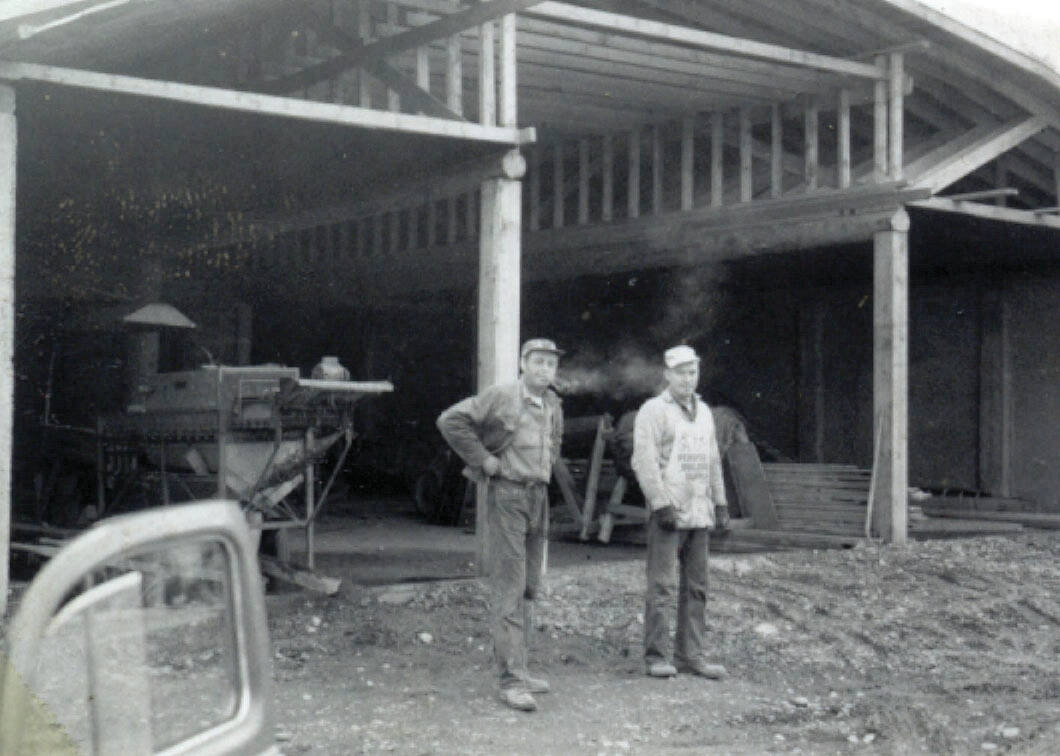
AUTHOR’S NOTE: Most of the people who came to homestead and stayed long term on the central Kenai Peninsula created a circle of friends and acquaintances and found ways to contribute to the greater society around them. This was true of Larry and Rusty Lancashire, who came to make themselves a home on Pickle Hill in Ridgeway in 1948. In almost no time at all, they were integrating themselves into their newfound community.
Having friends is a good thing. Sometimes having friends in high places can be even better.
Ridgeway homesteader Larry Lancashire was reminded of the value of such friendship in December 1950 when he shot another illegal moose. Lancashire had killed game illegally before — as had many homesteaders who needed the meat to feed their families — but this was the first time he had been caught.
On Jan. 2, 1951, the Seward Seaport Record reported Lancashire’s crime — killing a cow moose within the Kenai National Moose Range and transporting it to his house for consumption— and his conviction in the court of Paul Wise, U.S. Commissioner in Kenai. Lancashire was fined $200, received a six-month suspended sentence, and forfeited his rifle, his hunting license and the moose meat.
His wife, Rusty, in a letter to family Outside, added more detail, beginning with the sudden appearance of game wardens while the Lancashires were busy butchering: “Larry was in the barn when they shoved a search warrant under his nose — and we hadn’t had time to hide (the meat). … Tears came to my eyes as they hauled away all my work and meat that was so good. I finally asked that they leave enough for dinner, and they left me more than they usually do (in such cases).”
Larry’s fate could have been worse.
In court, Commissioner Wise, a good friend of the Lancashires, had dropped the number of charges from six to four, decreased the possible fine to a more manageable amount, and suspended all the jail time. “We could have lost our shirt,” Rusty wrote. “As it is, Larry has to go to Anchorage and get a job to pay the fine. He is going to stay and get some much-needed cash.”
During the homesteading boom of the late 1940s and early 1950s, residents realized that there was the letter of the law, and then there was the spirit of the law. There was also a tendency for people to look out for each other as much as possible.
Spirit of Generosity
When 63-year-old Miriam Mathers had ridden into Kenai astride a western bronco in the autumn of 1946, she had been viewed with amazement for her many accomplishments and with astonishment because of her hard-luck story.
Mathers, known widely by the moniker “The Old Goat Woman,” had traveled to Alaska alone, bringing with her a small menagerie and a homemade, horse-drawn wagon carrying all her worldly possessions.
On her journey, she had overcome numerous delays and obstacles, the last being that the horse pulling her wagon along the winter mail route from Cooper Landing had sickened and died. Neither of her two other horses had been broken to a wagon harness, so she had been forced to abandon her wagon and belongings at a remote shelter cabin and hope she could find a way to return there soon to retrieve them.
Mathers had come to the Kenai Peninsula to homestead. Over the next year or so, she staked 160 acres between Kenai and what would someday be Soldotna. On her own, she constructed a small log cabin near Mink Creek, and she sought a job, eschewing public assistance as long as possible while continuing to hope to regain her possessions.
But the immense 1947 Kenai Burn swept through the mail-route area and destroyed both the shelter (called the Middle Cabin) and her wagon. By the time, she was able to hike there during the winter after the fire, nothing remained but charred debris, and Mathers became disoriented by the jumbled, flame-altered terrain.
In late summer 1948, Mathers, a divorcee who appeared to generally mistrust most men, encountered one of her female neighbors down the road — Rusty Lancashire. Although Mathers’ odd nature had prompted Larry Lancashire to warn Rusty against fraternizing with her, Rusty, who referred to Mathers as “a funny duck,” liked her right away. They quickly became friends.
Soon, Larry was helping Mathers harvest salmon for a winter’s supply and giving her portions of illegal moose meat. The Lancashires invited her to a social gathering at their home and later to Thanksgiving and Christmas dinners.
Because Rusty and Larry had a vehicle and Mathers did not, they also offered her rides and helped transport heavy goods or groceries to her home.
Unfortunately, Mathers health began to worsen as the winter of 1949-50 set in. Rusty checked on her — as did Marshal Allan Petersen and some others. Friends and neighbors worked to help her get welfare money, despite her resistance to doing so, and they assisted with her cleaning and general needs.
When Mathers died in May 1950, the Lancashires and others made the funeral arrangements and helped to finish proving up on her homestead and to settle her estate for her relatives out in the States.
Such times in such wide-open spaces brought together disparate souls who might otherwise have little motivation to seek outside themselves.
Making Connections from the Start
Although his eldest daughter, Martha, said Larry Lancashire was not an especially sociable man, he certainly wasted little time making friends after his arrival on the Kenai in March 1948. Many of those early friends were, like himself, former aviators during World War II.
“This country is being settled almost exclusively by old Army pilots,” he wrote later to family Outside, “and it’s a joke to hear us hash over the war again.”
Frank Mullen, who flew a B-26 Martin Marauder, helped Larry erect the wall tent in which he and the rest of his family lived until they had completed their cabin. Larry and Howard Lee, a former Navy pilot, helped each other harvest house logs and erect each other’s respective homes.
Larry also worked with another ex-pilot, Dick Wilson. At one point, the two men agreed to trade sections of their property; Wilson owned land on the flats close to the Kenai River but wanted some property higher up, near where the Lancashires were living atop Pickle Hill. Eventually, Larry and Rusty would hire Pappy Walker to clear the lowland parcel, and that land, now a hayfield, is still in the family.
Rusty, too, continued making new friends — some of whom came and went, and others who came to stay. She befriended Howard Lee’s wife, Maxine, who became Soldotna’s first postmaster and suggested the name of the town when she applied for the position.
She enjoyed the company of Eloise Spencer, who lived up the road by Beaver Creek and who was the wife of the moose ranger manager. And one of the local women with whom she grew closest was Ruth Connelly, who, along with her husband “O.C.,” was a school teacher in Kenai.
The Lancashires also enjoyed the collection of other characters inhabiting their world: Charles “Windy” Wagner, known for his generosity and narrative embellishments; Art Frisbie, another military veteran who had lived for many years on Skilak Lake before moving into Soldotna; Marge Mullen, whom Rusty claimed that Larry viewed as an ideal homestead woman “because she (did) everything so well”; and brothers Alex and Marcus Bodnar, a pair of New Yorkers who were two of the first people to settle in the Soldotna area.
Rusty visited with the Bodnars at one of their cabins on the Kenai River shortly after she arrived on the peninsula. “It about broke my heart,” she said afterward. “They work so hard, and Alex is such a terrible cook. They eat just like Larry use to—a loaf of bread (as long as their supply lasts), jelly, coffee and beans.”
There was also the trio of “Sergei Pete” Peteroff, Howard Binkley and Alfred Trettevick, known for lending a hand where needed and renowned for their drinking prowess.
Sergei Pete once traded Larry house logs for sawmill “slabs,” essentially scraps that he could burn to keep his woodstove going. Binkley was nicknamed “Soldotna’s First Realtor” because he sold so many pieces of his homestead in what is now the business center of town. And Trettevick, when not drinking his way through another winter, was known as a top “ax man” clearing roadways for the Alaska Road Commission.
It took many different personality types to form a community, and the central Kenai Peninsula offered up plenty of variety.
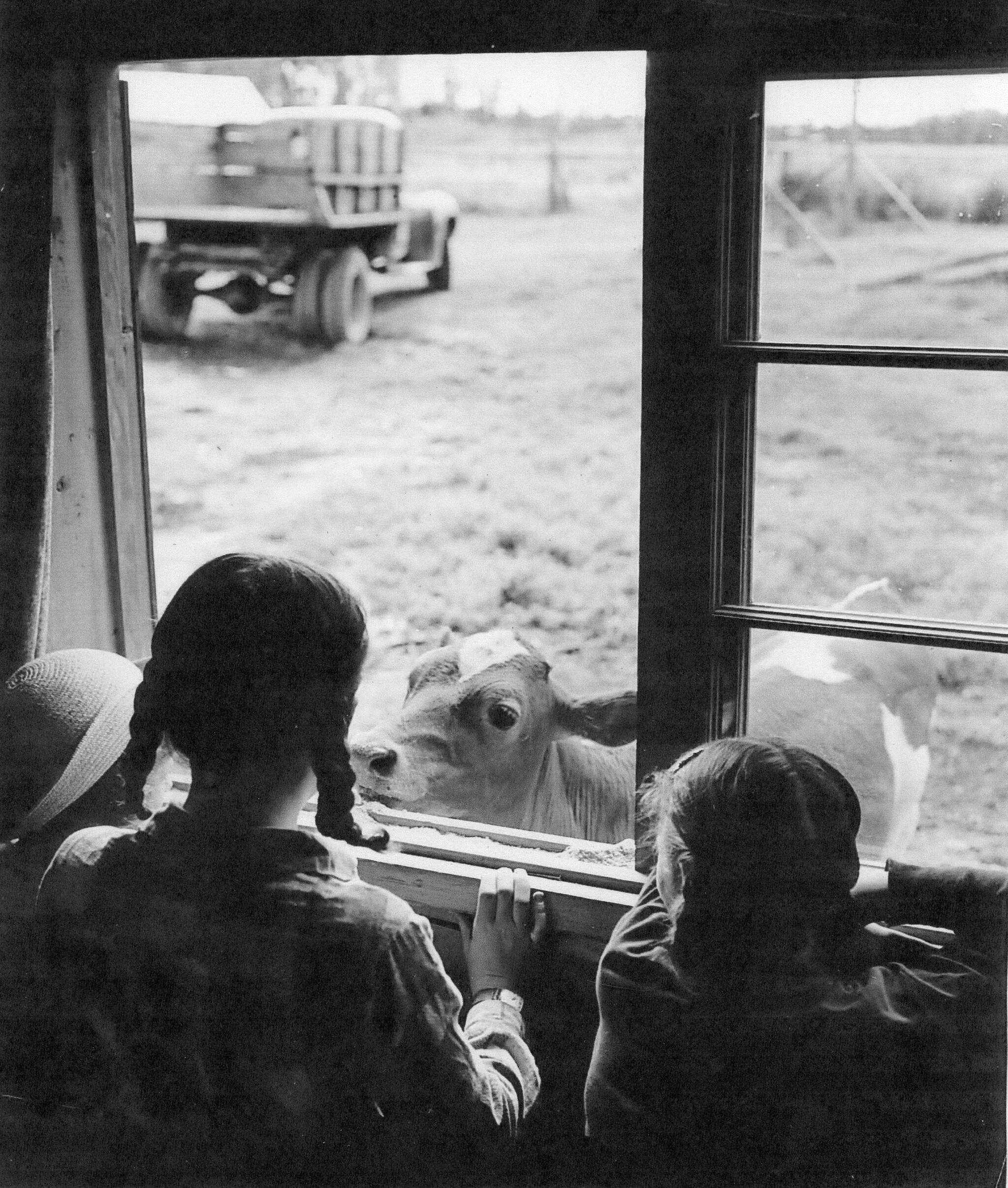
1954 photo by Bob and Ira Spring for Better Homes & Garden magazine The three Lancashire daughters (L-R: Abby, Martha, Lori) say hello to the curious family cow.
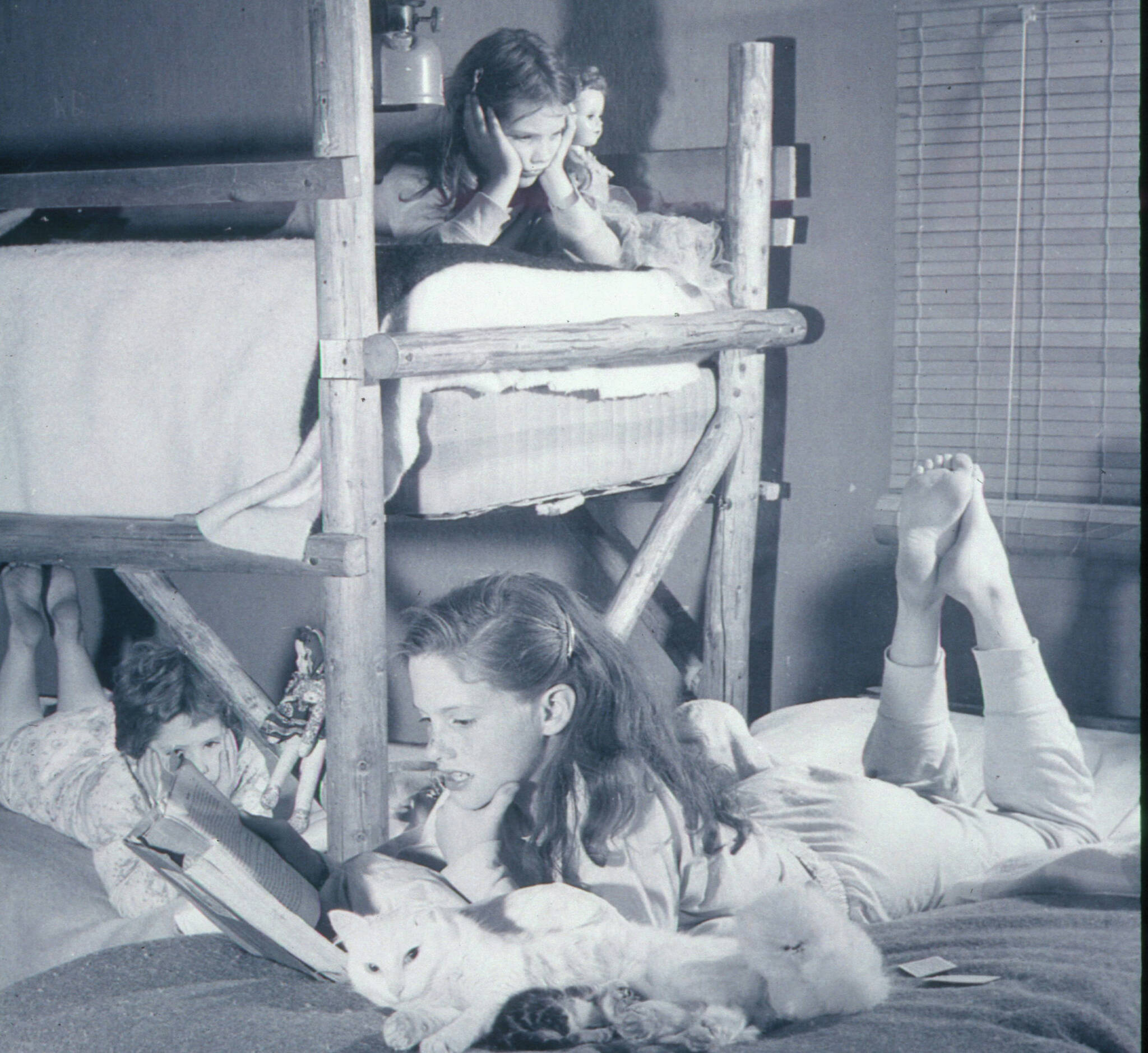
1954 photo by Bob and Ira Spring for Better Homes & Garden magazine Eldest daughter Martha (foreground) reads to her sisters Lori (top bunk) and Abby.
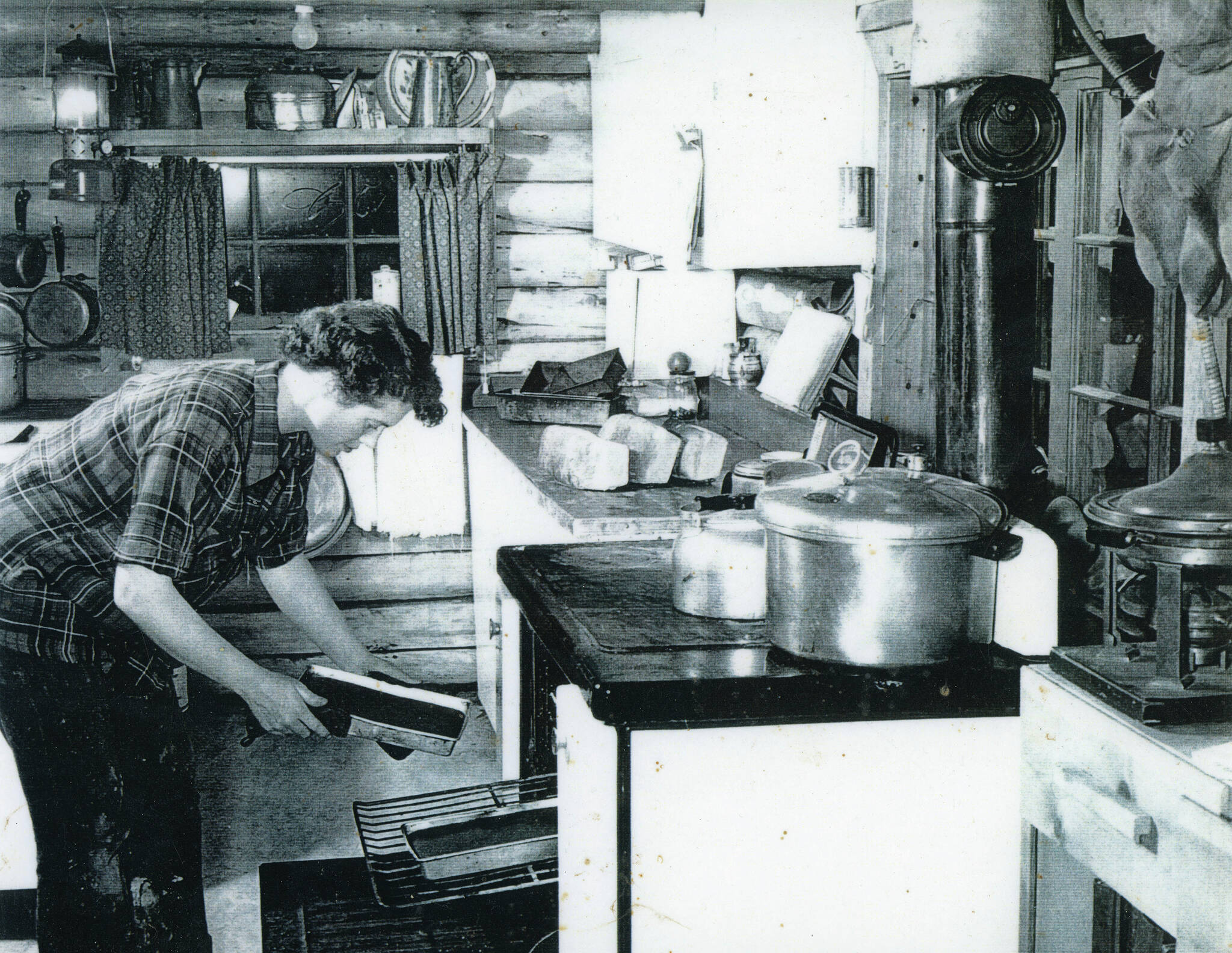
1954 photo by Bob and Ira Spring for Better Homes & Garden magazine Rusty Lancashire does some baking.
