
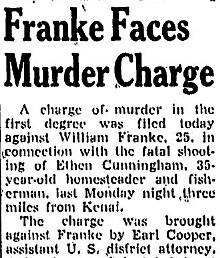
AUTHOR’S NOTE: During the evening of Jan. 19, 1948, in Kenai, William Franke shot dead Ethen Cunningham near Cunningham’s home along the lower Kenai River. Franke never denied doing the killing, but prior to the trial scheduled for March, local residents were rehashing the events of that night — as they understood them, mostly via hearsay — and were trying to make sense of the violence.
Capture and Confinement
On Jan. 19, 1948, U.S. Deputy Marshal Allan Petersen led an impromptu posse, flashlights stabbing at the darkness, down the trail toward the home of Charles “Windy” Wagner (off present-day Beaver Loop, in Kenai). The men — Petersen, Henning Johnson, Odman Kooly, Jimmy Minano and Al Munson — had been told that a killer was holed up at Wagner’s place.
The suspect was homesteader William Henry Franke. His alleged victim was a homesteader neighbor named Ethen Schulen Cunningham, whose gunshot body apparently lay in the snow between Wagner’s house and Cunningham’s.
But when the armed posse reached Wagner’s two-story home, there were no fireworks. Franke surrendered without incident and, without coercion, confessed to the crime. Wagner had earlier persuaded him to give up his rifle, and he had then sent his friend Minano to track down the marshal.
Marshal Petersen officially arrested Franke and told him to remain upstairs in Wagner’s house. He assigned Johnson and one of the other men to stand guard. The marshal then led the remaining posse members back into the night to assess the crime scene and retrieve Cunningham’s body.
Sometime after the marshal’s crew departed, Franke asked for something to drink. “Can I come down and get a drink of water?” he said, according to Johnson. “Okay,” Johnson responded and raised his gun to train it on the captive. Franke descended, got his water and then retreated upstairs.
Out in the darkness, according to the Seward Polaris & Kenai Peninsula-Aleutian Chain News, the marshal located the body. “All indications were that a struggle had taken place before the shooting,” said the paper. Upon examination of Cunningham’s corpse, it was determined that he had been shot three times — once in the left hip, once in the abdomen, and once behind the left ear.
When questioned later, residents in the area recalled hearing three shots at about 6:30 p.m. Spent cartridges recovered at the scene revealed that Cunningham had been shot with .32-caliber rounds called Winchester Specials.
A Winchester Special cartridge was most often used in a lever-action hunting rifle called the Winchester Model 94; its killing power was roughly equivalent to a more modern .30-30 Winchester. The Model 94 had long been considered an excellent deer-hunting weapon, but it was capable of stopping a moose or a bear. Probably, such a rifle was what Franke had been using in his hunting and trapping business.
The posse transported Cunningham’s body into Kenai and formally took Franke into custody.
An undated, unsigned and partially complete death certificate prepared by the U.S. Commissioner listed Cunningham as a writer and commercial fisherman who died of “gun shot wounds inflicted by Bill Frank.”
By Jan. 24, Marshal Petersen and FBI agents from Anchorage had wrapped up their investigation. Franke had been moved to the federal jail in Anchorage and was expected to be charged with murder in the first degree. Funeral services for Cunningham were held in Anchorage two days later, and then his wife Martha accompanied the body to Cunningham’s birthplace in Penrose, Wyoming, for burial.
Cunningham was survived only by his wife and his older brother Bryan, as Ethen and Martha, who had been married since the spring of 1945, had no children.
The Cheechakos
Back in the late summer or early fall of 1946, Alaska newcomers William Henry Franke and his brother-in-law, Dean Ripley Swift, had arrived in Kenai. On the advice and encouragement of Kenai resident Ethen Cunningham, they examined a 40-acre parcel of land adjacent to Cunningham’s (and that of Charles “Windy” Wagner) at about Mile 6 of the Kenai River.
If Franke decided to file on the parcel, Cunningham told the two men, he could give them a place to stay while they began building a home suitable for Franke’s wife Nancy, and the Frankes’ infant daughter, Gale. By mid-September, Franke had filed for a homestead patent.
The place that Cunningham offered the men was a roughly 10-by-12-foot, low-roofed cabin, built many years earlier, almost certainly as a moose-hunting shelter. The structure, owned previously by Otto Schroeder, had been on Cunningham’s property when he filed for his homestead in 1941. According to Windy Wagner, Cunningham had agreed to pay Schroeder $25 for the old cabin but never did so.
In court nearly two years later, Franke testified that Cunningham “gave us to understand we could have that little cabin, rent free, so that I would be able to bring my wife up that winter (1946-47).”
Franke and Swift lived in a wall tent during October and part of November while they made improvements to the cabin. Franke purchased a horse and used it to haul logs for the project. They added a second room, raised the walls and constructed a new roof.
Cunningham, said Franke, “told us … that when I had my own house built, I could bring that (old) cabin … to my place if I wanted it. ‘No,’ I said, ‘I will live in it, and when mine is done, then I will move away.’”
Nancy and Gale arrived in November. Dean likely returned to Massachusetts at about this same time.
Then, sometime before Christmas, Cunningham changed his mind about the cabin arrangement. According to a statement from FBI special agent Wallace F. Estill, “Cunningham suggested that to make it legal, they sign a piece of paper showing that Franke was living there temporarily and had paid $2 rent for the year of 1947 and had (also) paid the rent for 1948.”
William Franke had too much to do to argue. After he finished with the improvements to the cabin — including making it as tight as possible against the winter cold — he hauled and chopped firewood for the woodstove to make sure his family would stay warm.
It was March of 1947 before Franke found time to begin hauling and cutting more logs for his own place. He spent that spring hewing the logs in preparation for his new two-story cabin, then stopped for the summer so he could earn additional cash fishing commercially. When the fishing season ended in the fall, he returned to his construction project, but as Christmas 1947 approached, the cabin was still unfinished.
And the real trouble with Cunningham was about to begin.
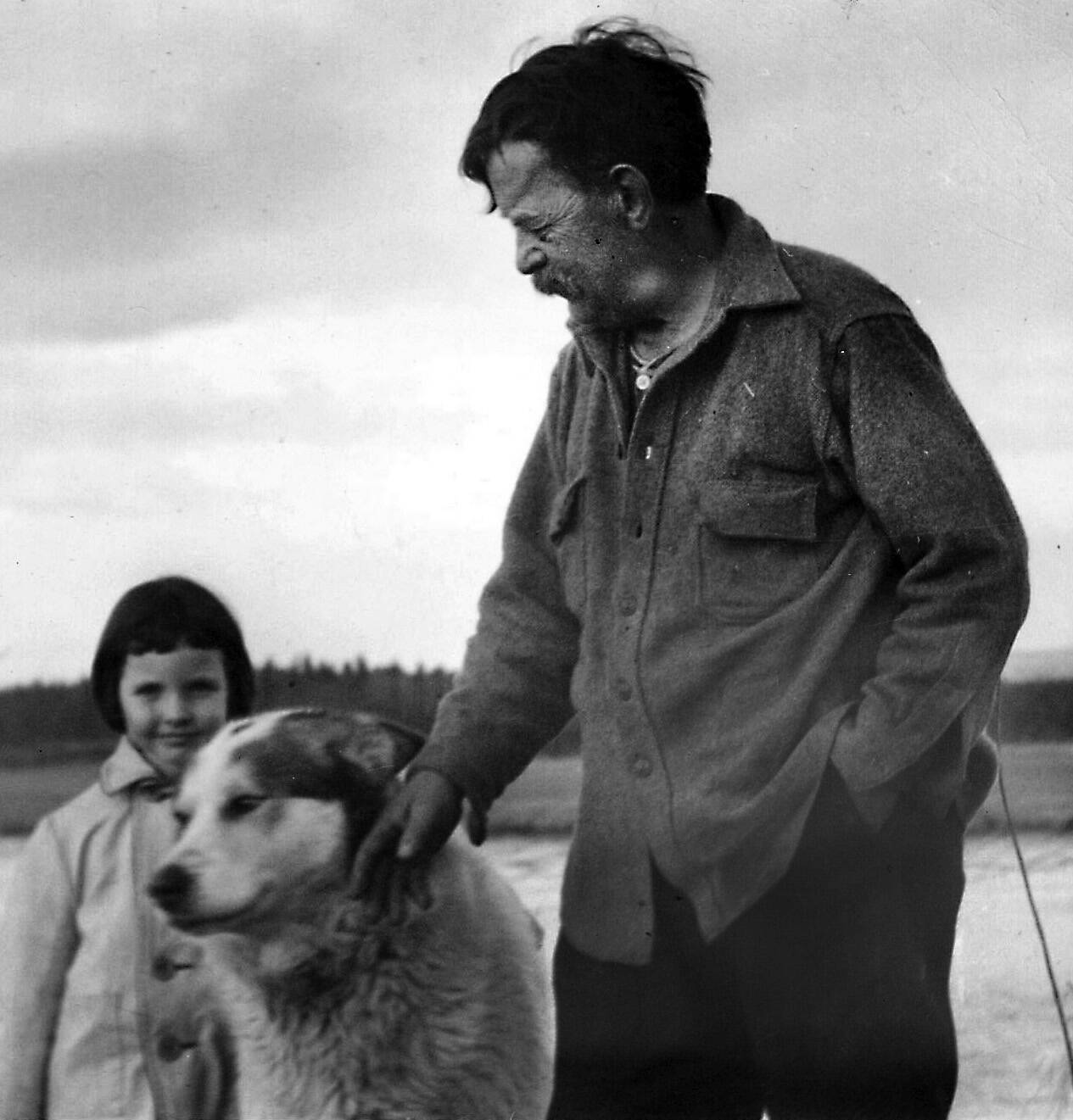
Photo courtesy of the Knackstedt Collection Charles “Windy” Wagner, pictured here in about the year in which Ethen Cunningham was murdered, was a neighbor to both the victim and the accused, William Franke.
