
As the sun begins to set before 11 p.m. and an end to summer seems just around the corner, Salmonfest appears a reminder not to let the season slip away too quickly.
“A lot of people … say I really wanted to hang out with my friends, or go camping or go to some kind of a festival. You can come down to the fairgrounds and you can get all three. We weave all three into a memorable weekend. Everyone goes home with a smile on their face,” said Salmonstock festival director and producer Jim Stearns. “We try to bring a representative of the best Alaska has to offer. And we like to think the best people too.”
A new partnership between Cook Inletkeeper and Kachemak Bay Conservation Society has Inletkeeper taking the lead in the environmental element of Salmonfest, Stearns said.
Another new element at the festival will be the King Sam parade — a 20-foot salmon puppet that illustrates the salmon migration by travelling through the fairgrounds. The parade will integrate with the kids program and will start from the Rodeo Arena gate at 3:35 p.m. and travel to the Ocean Stage Meadow.
Seventy-eight acts are showing up to perform on four stages at the Ninilchik Fairgrounds for the Aug. 5-7 festival. Though many are bands or musical artists coming from a variety of genres, including rock, ska, folk, reggae, bluegrass, singer-songwriters, and even an Irish rock folk band, others perform other forms of arts, such as dance.
For instance, Quixotic — a “cirque nouveau” that combines dance, live music and digital media to create an immersive experience — takes over the River Stage from 12:10 to 2:10 Sunday morning. Quixotic’s show follows Saturday night headliners Trampled by Turtles, bringing the Saturday festival experience into the early hours of the next day. The late performance time provides Quixotic with as much natural darkness as this time of year on the Kenai Peninsula allows to use as a canvas for lights, projected videos and fire.
“It’s definitely taken a little extra bit to figure out, but I think its really cool because I think everyone cares about it and everyone’s digging into those different details and figuring out those elements so we can do something that’s awesome and push us a little bit,” said Quixotic executive producer Mica Thomas, who grew up in Homer.
“We had talks about when to do certain parts of the show, like when the sun is setting or we have to do the fire performance here so it has an impact. I think it’s going to be a pretty sweet show.”
Other challenges of performing in Alaska for the Kansas City, Mo., group include deciding which equipment they can find in Alaska, which equipment they can ship, and which they have to forgo. Quixotic is shipping their swingset-like portable aerial rig from Kansas City because the truss equipment they use to do aerial isn’t available at all in Alaska, Thomas said.
This is hardly Quixotic’s first music festival — they have performed at others, including Wanderlust and Red Rocks — and the group adjusts their show according to the music festival atmosphere. Though many may have seen them when they visited Homer for a show at the Mariner Theatre three years ago, Quixotic’s festival performances have more of an edge to them, Thomas said.
“In the performing arts center shows, it’s more refined, more balletic. There’s lots of flowing interaction between the graphic media and live performance. The show we’re doing for Salmonfest, it’s a lot more raw and has that energy and passion. It’s a lot more driven by the music. In a performing arts center you might see a lot more projections. In this you’ll see a lot more fire performance and the pieces have a lot more energy to them,” Thomas said.
“In introducing fire, we have some amazing fire performers that are coming up to Alaska. … You don’t normally create big fire inside the Mariner Theatre. This is an opportunity to create more fire experience and there’s a different way we approach it. It’s a lot more fun.”
Salmonfest is also making accommodations for Quixotic by enlarging the River stage to a 32-by-32-foot stage, making it a place for national acts in addition to the Ocean stage, Stearns said.
After the grand performance of the MarchFourth Marching Band at the 2015 Salmonfest, Stearns said he decided it was important to have another unique act at the festival.
“Mica got a hold of me and asked how about us coming to the festival in a couple years. He and I got together and came to a meeting of the minds to make it work,” Stearns said. “Last year we had a group called the MarchFourth Marching Band. These men and women came up and they have people on stilts and everyone was just fascinated by them and I thought, ‘I can’t have a drop-off next year.’ I thought this was the perfect time to go for Quixotic.”
Thomas’s Quixotic isn’t the only act with Homer roots on Salmonfest’s River stage this year. Wylde Style, a band led by Anchor Point resident David Wylde and his wife Kim Wylde, will perform at 2:10 p.m. Aug. 5. Along with Homer resident and drummer Jeremy Buckland, the band will play their earth-conscious environmental music in their first Salmonfest performance.
“Everyone has their own take on (our sound). It’s a cross between rock, blues, reggae and jazz. I don’t know where the jazz comes from, but someone said that the other day,” David said.
David writes music with lyrics coming from positive point of view with a message about the environment, which fits into the conservation theme of Salmonfest, he said.
“It’s easy to write songs that go the other way (into negative). I do write them, but then I switch a few words and it comes out positive,” David said. “There’s so little character and morals anymore that it seems to me that you have to figure out who you are and that process leads me that way. One of our songs, ‘Flowing Water,’ basically says if you poison the water, you poison you and me.”
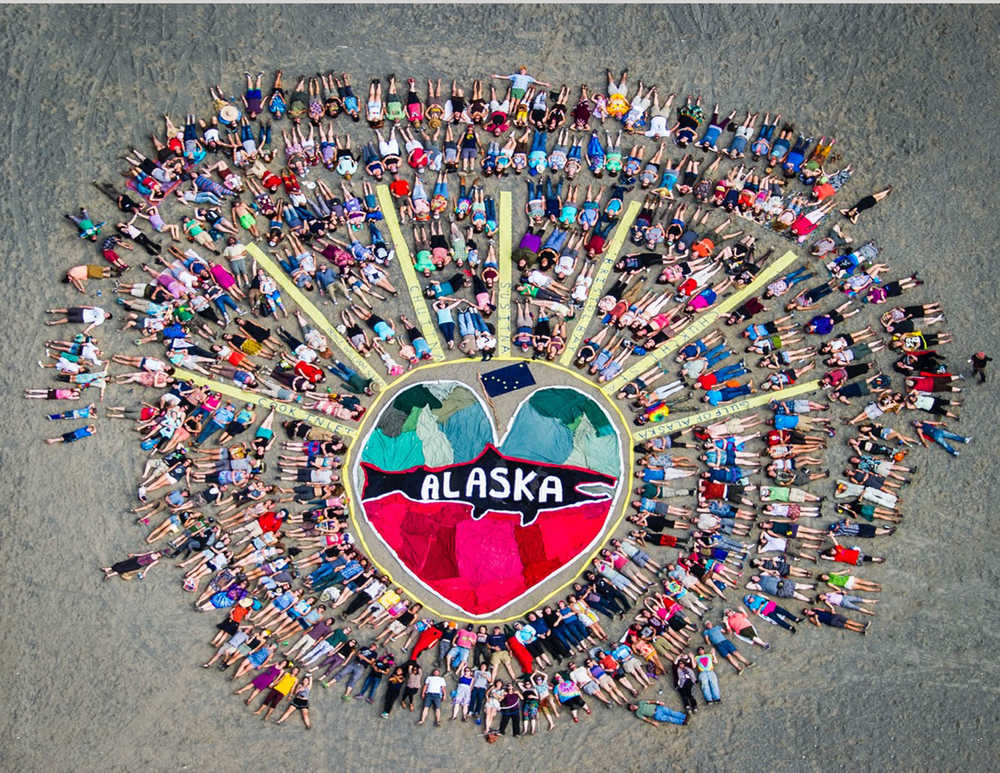
Homer artist Mavis Muller also brings an environmental perspective to the festival for the sixth year in a row with her human mosaic created at 3 p.m. Aug. 6 in the Rodeo Arena. Volunteers will use colorful fabric and hundreds of festival goers to create a design to be captured in photo by an aircraft, drone and a 40-foot high bucket lift.
“This fun event has become a tradition for the festival. The circular design conveys a message of solidarity for the protection of wild waters of Alaska that connect us as communities, and the wild salmon and fisheries that sustain us,” Muller said. “This year the interactive art activity will include a component of moving parts and soundtrack to enhance the experience to make it even more epic and memorable. With our creativity we can heighten awareness, inspire change, and we can have fun doing it.”
Anna Frost can be reached at anna.frost@homernews.com.
