
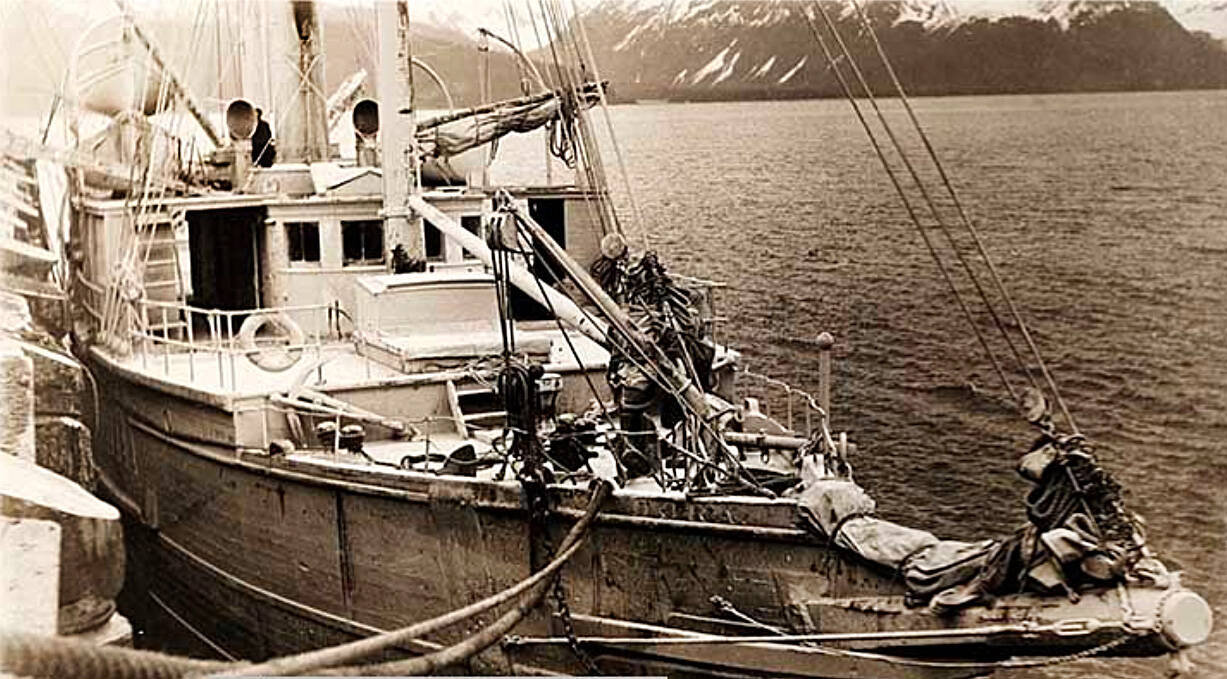
Author’s note: This is Part Two of a three-part story about the S.S. Dora, the tenacious steamship that plied the coastal waters of Alaska for four decades. Launched in San Francisco Bay in 1880, she delivered passengers and cargo and the mail across thousands of miles.
Throughout the late 1800s and early 1900s, the S.S. Dora touched lives on and became part of the history of the Kenai Peninsula and Southcentral Alaska. In 1896, for instance, when Jefferson Randolph “Soapy” Smith traveled to and sojourned briefly in the gold camps near Hope, one of the means by which he could send letters to his wife Mary was by connecting with the Dora or some other nearby steamer.
When Dall DeWeese first came to the Kenai in 1897, the famed big-game hunter — one of the first individuals to push for the establishment of what would become the Kenai National Wildlife Refuge — arrived on the S.S. Dora and sailed again with her many weeks later to Sitka on the first leg of his trip home.
Arrangements were made in 1899 to transfer many of the ailing and unsuccessful members of the Kings County Mining Company from Kenai to Tyonek, where they could be picked up by the Dora and begin their long trip back to the States. Company members had to sell off equipment and personal items in order to afford their passage home.
In 1909, when James Ward and Thomas Odale were awarded the contract for the Cook Inlet summer mail run, it was the steamer Dora that they met twice a month in Seldovia to collect the letters and packages she had hauled from Valdez and Seward.
Six months after a double-killing in Kenai in April 1918, one of the killers, Charles Coach — freshly exonerated by a grand jury in Valdez — found himself aboard the Dora, bound for Kenai and then a vacation in Colorado.
But the Dora’s influence reached well beyond the Kenai, and her adventures and misadventures were often far more exciting and perilous than ferrying passengers and cargo or toting the mail.
In 1895, according to historian Coleen Mielke, a successful miner named Peter Wyborg bought passage from Juneau to San Francisco on the Dora. He carried with him $40,000 in gold, plus a trunk containing 26 pounds of “extra gold for incidental expenses.” According to the San Francisco Chronicle, the Alaska Commercial Company charged Wyborg $1,000 (about $32,000 in today’s money) for the journey south.
In June 1916, one of the passengers aboard the Dora when she docked in Seward was a Nushagak postmaster named McLean, in custody for allegedly beating his wife to death. McLean, according to a newspaper report, swore he had not murdered his wife; instead, he said, she had been thrown from a dogsled and died from her injuries — a claim disputed by other Nushagak residents.
In July 1917, Dora passenger John Norheim committed suicide by leaping overboard, according to newspaper reports, and in November a carpenter named John Cody arrived in Seward aboard the Dora on his way to the Morningside sanitarium in Portland, Oregon.
The Anchorage Daily Times noted that Cody was being institutionalized because he was “laboring under the hallucination that enemies are trying to poison his food. In all other respects, he is apparently perfectly sane.”
All too often, however, the “bulldog of the North Pacific” arrived in one port or another bearing people she had saved from disaster. The number of rescues was staggering.
In 1895, there were the miners who had been stranded in Yakutat; the Dora delivered them to Sitka so they could catch another steamer south to Washington. A year later, the Dora rescued the crew and cargo (600 seal skins) of a 50-ton Canadian schooner that had wrecked on the rocks of Akun Island, near Unimak Pass, during a storm.
In 1897 there were four men from another wrecked schooner in Unimak Pass, and in 1898 there was a dog discovered afloat on a wooden remnant of a paddle steamer, which had left Fort Wrangell with 43 people aboard two weeks earlier. The dog was the only survivor.
In the fall of 1899, the Dora rescued a number of down-and-out miners suffering from scurvy between Copper River and Juneau. In 1906, six weeks after the wreck of the St. Paul, the Dora rescued its marooned passengers on the Semedi Islands (southwest of Kodiak Island). The following year, she saved two prospectors clinging to their overturned dory near Kodiak Island.
Throughout the years, the Dora found the victims of bad luck or disaster, plucked them from rocky, windswept shores or icy waters, and carried them to safety.
There were the 194 survivors of the sailing ship Columbia, the four crew members of the Mizpah, the 10 men from the cod-fishing schooner Czarina, the 39 crew members from the cod boat Joseph Russ, men and women from the Olympia, and the crew of the schooner Paramita.
Some of these rescues and other exploits were captured for posterity by amateur photographer John Edward Thwaites, who traveled with his Kodak camera on the Dora for the better part of a decade (1905 until at least 1912) as her mail clerk.
Thwaites and his camera were on board on June 6, 1912, when the Katmai-Novarupta volcanic eruption occurred. The Dora had left Uyak Village (on Kodiak Island) earlier in the day with a full load of 86 passengers and was heading up Shelikof Strait when the eruption began at about 1 p.m.
Crew members and passengers saw a massive column of smoke, ash and fire jet thousands of feet into the air. As daylight dimmed, they also saw lightning. By 6 p.m., dense clouds of ash were settling and chunks of pumice were falling from the sky. Thirty minutes later, Thwaites and the Dora were in what one newspaper termed “Stygian darkness.”
When she arrived the next day in Seldovia, the Dora had several inches of volcanic ash coating her deck. And Thwaites had photographic evidence.
The Dora’s passengers and crew were some of the only eye-witnesses to the full history-making, eruptive event.
But good fortune did not always smile upon the Dora. Her reputation for striking rocks and reefs and somehow surviving seemed bound to end some day.
Eventually it did.
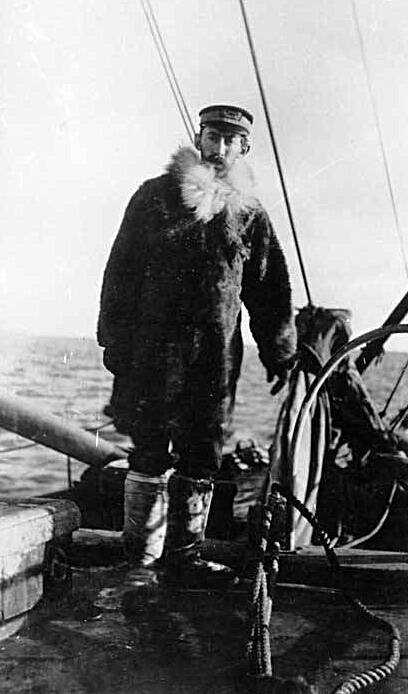
This circa 1915 photo shows Capt. C.M. McMullen, skipper of the S.S. Dora for several years.
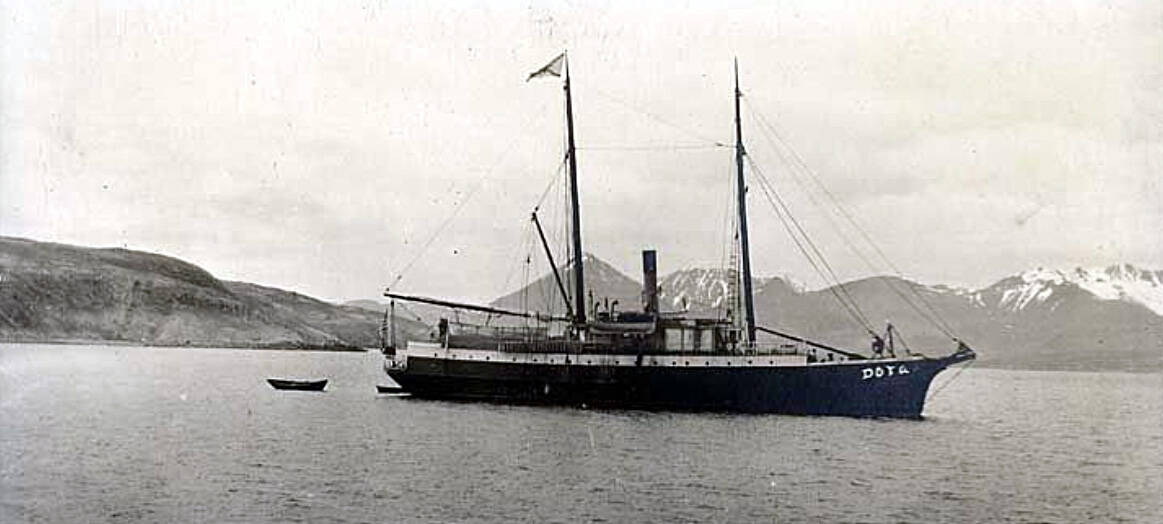
Alaska State Library photo collection This John E. Thwaites photo shows the S.S. Dora near Sand Point, Alaska. Thwaites sailed as mail clerk on the Dora between at least 1905 and 1912.
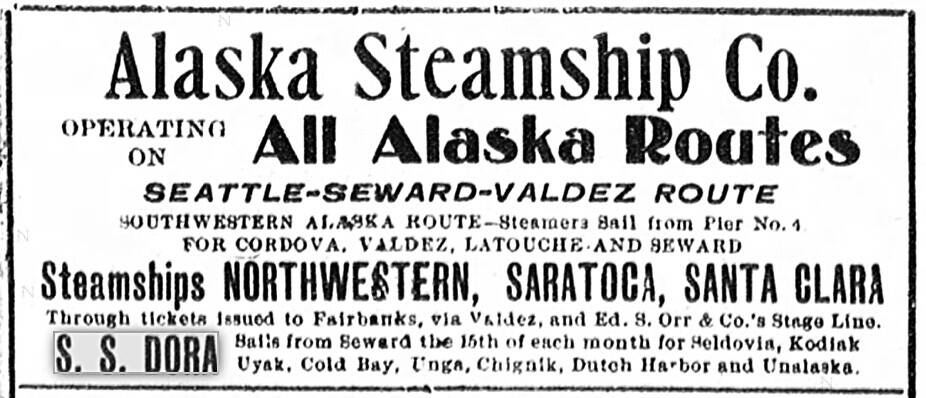
The Alaska Steamship Company printed this schedule in the Alaska Prospector in February 1908.
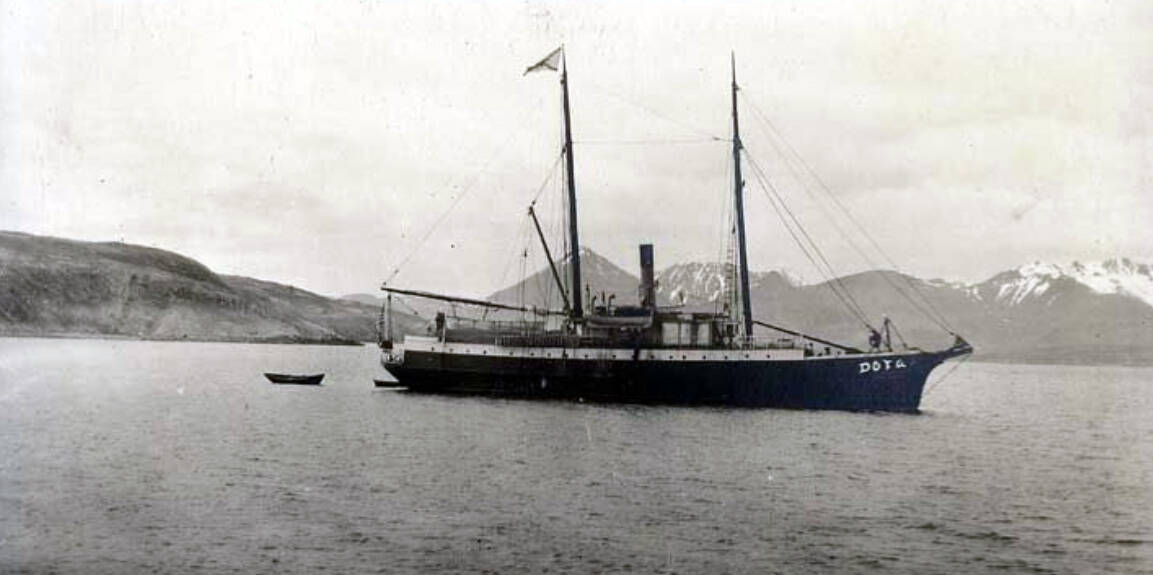
This John E. Thwaites photo shows the S.S. Dora near Sand Point, Alaska. Thwaites sailed as mail clerk on the Dora between at least 1905 and 1912. (Alaska State Library photo collection)
