
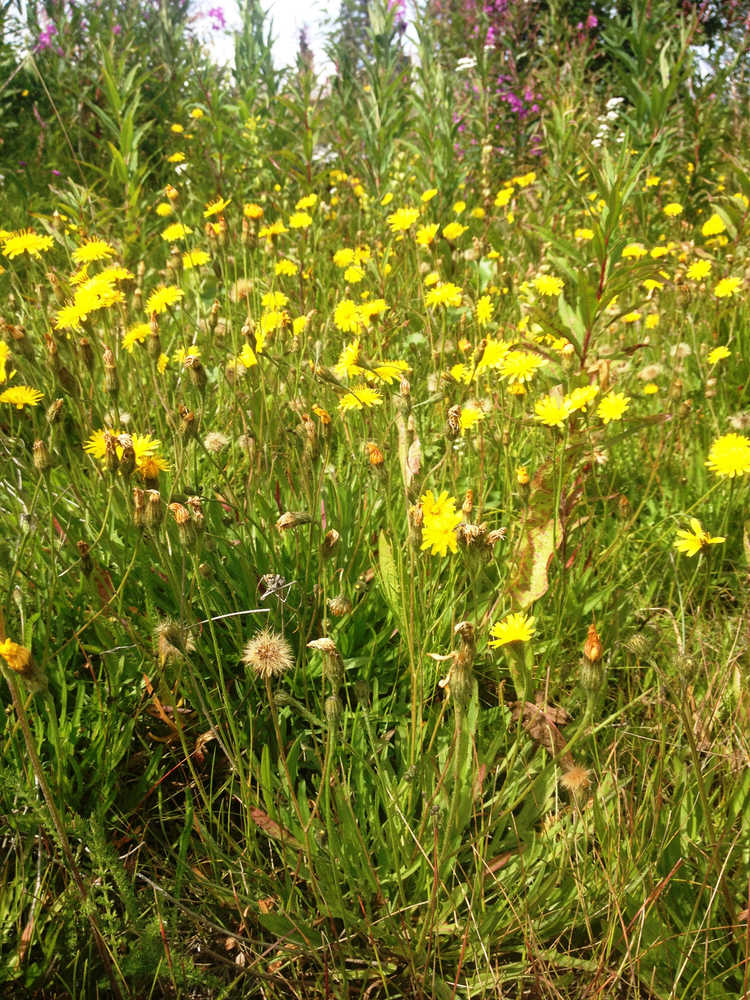
Roses are red, violets are blue, but what are all the yellow flowers along Kalifornsky Beach Road?! Along almost the entire length of Unity Trail that parallels the road, there’s a plant blooming that at first glance looks an awful lot like the common dandelion. But stop and take a closer look – there are multiple flowers per stem (as opposed to one), and the leaves of its basal rosette are “spikier” with the flower having fewer yellow ray florets (petals) than a typical common dandelion (Taraxacum officinale).
This perennial plant in the Aster family is aptly called fall dandelion (Leontodon autumnalis). Unlike common dandelion which reaches peak bloom in June, fall dandelions probably hit their zenith last week. Although both species produce the characteristic “achene-pappus unit”, which is the technical term for the feathery white puff balls that carry seeds in the wind, they’re actually in different genera.
The fall dandelion is an Old World species, and grows well in northern places like arctic Russia and Norway. It’s not clear how or when it was first introduced to North America, but in Alaska it is spread in straw, contaminated fill, and by wind. Fall dandelions are prolific, producing 779 seeds per plant on average. In parts of Germany, seed density in the soil is known to reach more than 5,000 seeds per square meter! From what I can see locally, it forms a mono-culture mat of basal rosettes, much like orange hawkweed, and so will likely demand your attention when it finally arrives in your backyard.
What’s so incredible about this week’s display of fall dandelion is that it was uncommon in our local area as recently as last summer. It has been fairly abundant around Homer for the past few years and really started to spread along the southern Seward Highway about 2 years ago, but only a few records occur around Kenai-Soldotna in the statewide database maintained by the Alaska Natural Heritage Program.
And this is precisely why this rapid spread and establishment of fall dandelion is so alarming. It underscores how insidious exotic plants with wind-dispersed seeds can be — literally here today, everywhere tomorrow.
I found an article published in 1973 that explored the dispersal effectiveness of achene-pappus units, and it wasn’t quite as impressive as the evidence around us suggests. In this particular experiment under lab-controlled conditions, the maximum dispersal distances for fall dandelion was 64 inches and for common dandelion was 89 inches in a 10 mph wind. But a more recent study I found used statistical simulations to show that if only one in every 1,000 seeds was caught by a strong convection current, some wind-dispersed plants could easily spread 8 miles per year, a migration rate that has been documented in real life in other species.
I often bike the Unity Trail, enjoying the exercise while musing about the waterfowl on Kenai Flats or the RV traffic or whatever happens to be blooming. Over the past few years, the chronology of invasion by exotic plants along the trail mirrors what has taken place over the larger Kenai Peninsula landscape. It wasn’t so long ago (2006?) that the first oxeye daisy appeared on the north side of Bridge Access Road, mixed in with common dandelions, nonnative bigleaf lupines, and clovers. These ruderal species (meaning the first to colonize disturbed soils) were followed in rapid succession by narrowleaf hawksbeard, narrowleaf hawkweed, orange hawkweed and, now, fall dandelion.
These latter wind-dispersed plants are poised to spread rapidly and indiscriminately from our major thoroughfares to residential neighborhoods, remote sections of the Kenai National Wildlife Refuge, and areas that burned in this spring’s Funny River Fire. Wind knows no boundaries and, so, neither do these yellow- and orange-flowered invasives.
Frankly, there’s not much we can do about it once these plants get established. This is a lesson that every community and every landowner learns and relearns — you can’t give an inch to wind-dispersed plants or they’ll take a mile.
Among the weed warrior community (professionals who make a living fighting invasives), we often talk about applying EDRR (Early Detection, Rapid Response) as the most effective approach for eliminating infestations. Detect them when they first appear and stomp them out by the most appropriate means before they begin to spread.
But the time between initial detection and treatment often ends up being somewhat gray, particularly if funds for treatments are scarce or permits are difficult to acquire. The message here, for both weed warriors and landowners, is don’t dither when it comes to plants that have the reproductive capacity to spread by wind.
Having trouble identifying a suspected invasive species? Wondering about the most appropriate means to treat something? Want to know about certified weed-free forage or gravel? Contact the UAF Cooperative Extension Service at 262-5824 or the Kenai Peninsula Cooperative Weed Management Area (http://www.kenaiweeds.org/).
John Morton is the supervisory biologist at Kenai National Wildlife Refuge. You can find more information about the refuge at http://kenai.fws.gov or http://www.facebook.com/kenainationalwildliferefuge.
