
Today is Earth Day! It’s celebrated every April 22, the first time in 1970 by 20 million Americans. When Earth Day went global in 1990, 200 million people from 141 countries celebrated. Now, in 2016, 193 countries will participate, their efforts coordinated by the Earth Day Network (http://www.earthday.org/).
On the face of it, Earth Day is exactly what it appears to be — global appreciation for the planet we live on — expressed as planting trees, picking up roadside litter, biking to work, an electronic recycling drive, restoring a beach dune, or the signing by more than 120 countries of the Paris Agreement on climate change that begins today. Here on the Kenai, there will be a drum circle, guided meditation and a potluck at “Where It’s At”, and a concert at Kenai Central High School. Outreach staff from the Kenai National Wildlife Refuge are conducting a special program in local schools today.
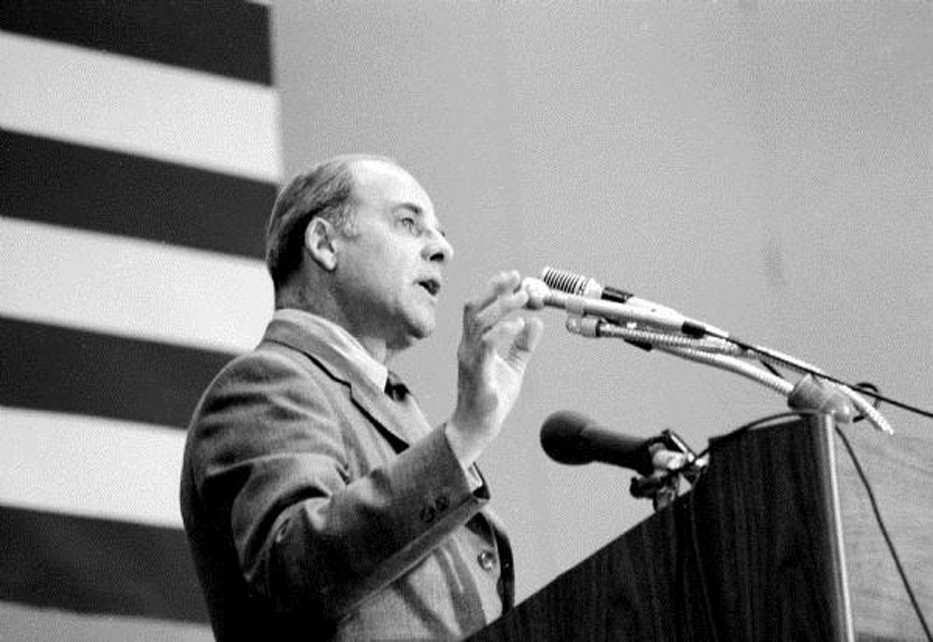
But like most things in Life, there is a story behind the story. It’s one of perseverance and passion by Gaylord Nelson, the founder of Earth Day. As the “Conservation Governor” of Wisconsin from 1959-1963, Nelson left a legacy of state programs that has served the Cheese State well. He was elected to the U.S. Senate in 1963, hoping to make his conservation agenda a national one.
Senator Nelson found out early on that a freshman senator does not have the clout of a governor when it comes to making changes. Leading up to Earth Day, Nelson was both appalled at environmental catastrophes he witnessed in the 1960s and the focus of Congress at the time on everything other than the environment. 1962 was the year Rachel Carson published Silent Spring, highlighting the dangers of indiscriminate pesticide use, particularly DDT. 1964 drew attention to rapidly disappearing wild lands in the U.S. with passage of the Wilderness Act. 1965 was when Lady Bird Johnson’s efforts to beautify America helped pass federal legislation that regulated billboards and junkyards along highways. 1968 saw publication of The Population Bomb, Paul Ehrlich’s book that made zero population growth a buzz acronym (ZPG) and reportedly inspired Nelson.
But it was Senator Nelson’s visit to the 1969 Santa Barbara oil spill in southern California, still the third largest oil catastrophe in the U.S. after the 1989 Exxon Valdez and 2010 Deepwater Horizon spills, that made him realize he not only had to do something, he had to do it in an unconventional way for Congress to pay attention.
Inspired by the grass-roots student movement against the Vietnam War, Nelson proposed a “national teach-in on the environment” to the national media, persuaded Congressman Pete McCloskey to serve as his co-chair, and enlisted Denis Hayes from Harvard as national coordinator. Hayes recruited a national staff of 85 to promote events across the U.S., deliberately picking April 22 because it fell between spring break and final exams for college students.
Long before the internet and social networking, Earth Day 1970 successfully brought 20 million Americans to the streets, parks, and auditoriums to demonstrate for a healthy, sustainable environment in massive coast-to-coast rallies. Ten thousand schools, two thousand colleges and one thousand communities participated — Congress even shut its doors so lawmakers could participate in local events!
“There was so much interest at the local level all over the country that we saw we wouldn’t have needed to do anything other than to make the announcement and name the day” (Nelson in 1970).
Considered a watershed moment in the environmental movement, Earth Day 1970 achieved a rare political alignment, enlisting support from Republicans and Democrats, rich and poor, urbanites and farmers, tycoons and labor leaders. It ushered in the “Environmental Decade” of the 1970s, leading to creation of the U.S. Environmental Protection Agency and passage of the Clean Air, Clean Water, and Endangered Species Acts. Nelson co-sponsored laws that preserved the Appalachian Trail, established fuel efficiency standards in automobiles, controlled damage from strip mining, and led to banning DDT and Agent Orange.
After Nelson lost his fourth bid as a U.S. Senator in 1980, he remained in national environmental politics as a counselor with The Wilderness Society until his death in 2005. For his role as Earth Day founder, Nelson was awarded the Presidential Medal of Freedom, the nation’s highest civilian honor, in 1995.
As a footnote to this story, although I’ve never met Senator Nelson, my family rented a house for a brief time from his sister, Janet, when we moved from Hawaii to Wisconsin in 1969, the year before the first Earth Day. Married to Karl Lee, once the Mayor of Peiping (Beijing), they had fled China as Mao Tse-tung took power in the late 1940s. Clearly another story behind the story.
Happy Earth Day!
Dr. John Morton is the supervisory biologist at Kenai National Wildlife Refuge. Find more information at http://www.fws.gov/refuge/kenai/ or http://www.facebook.com/kenainationalwildliferefuge.
