
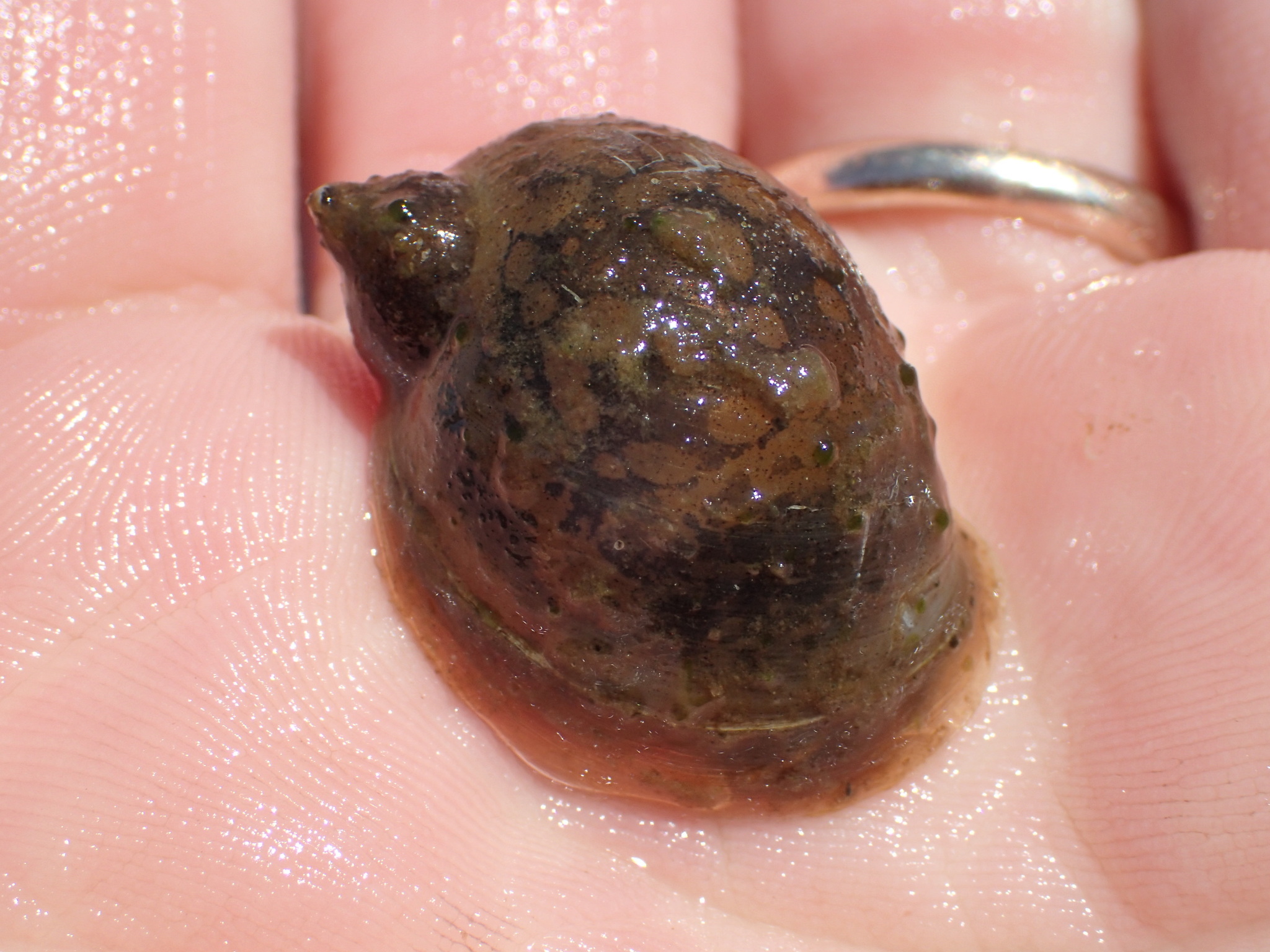
Sometimes one thing leads to another. It was in fall 2012 as the Alaska Department of Fish & Game and U.S. Fish & Wildlife Service were eradicating exotic northern pike in Stormy Lake that we first found the aquatic invasive plant Elodea on the Kenai Peninsula. Four years later in July 2016, this time as we wrapped up eradication of Elodea from Stormy Lake, we noticed some large, unfamiliar snails.
These turned out to be yet another aquatic invasive species known as the big-eared Radix, the European ear snail, or Radix auricularia. Unlike northern pike and elodea, which are native to some parts of North America, the big-eared Radix comes from Europe. This snail has now spread to New Zealand and much of North America, mostly through the aquarium trade. It is often transported on aquarium plants, on which the snails’ inconspicuous eggs easily hitch rides. A single egg of this self-fertilizing species is all that is required to start a new population.
All Alaskan occurrences of Radix auricularia have been in populated areas. The only records had been from Fairbanks, where specimens were collected from Smith Lake on the University of Alaska Fairbanks campus and from the Fairbanks International Airport floatplane pond.
Finding Radix auricularia in all three Nikiski lakes formerly infested with Elodea is consistent with our suspicion that Elodea, a popular aquarium plant, had originally been introduced to one of the Nikiski area lakes from someone’s fish tank. The two species could have been dumped together and then later transported from one lake to another on motorboats. In addition to Stormy Lake, Daniels Lake, and Beck Lake, where Elodea had occurred, we also saw this snail at nearby Suneva Lake.
The big-eared Radix prefers lakes, ponds, and slow-moving streams where it consumes algae and decomposing plant matter. This exotic snail will certainly compete with native freshwater snails and it does serve as prey for some fish species. We do not have much more information about the potential consequences of the European ear snail becoming established on the Kenai Peninsula other than its role as a vector of disease.
Radix auricularia and related snails serve as intermediate hosts for many species of flatworms that infect waterfowl, fish, and mammals—including humans. Thankfully, the species of flatworm that can get into human livers does not appear to be present in our area. Fish and waterfowl are the most commonly infected vertebrate hosts of these flatworms in Alaska.
In waterfowl, the worm’s life cycle begins as eggs shed into the water through an infected bird’s feces. The eggs hatch into a swimming stage that searches for a snail host. After living in the snail for a while, the worm again enters the water in another swimming stage called a cercaria. The cercaria, upon finding its final host, burrows into the bird’s skin and enters its bloodstream, where the flatworm grows and eventually produces eggs.
The swimming cercariae are not especially good at recognizing appropriate hosts, so they will also burrow into the skin of humans, causing a condition called cercarial dermatitis or swimmer’s itch. The worms soon die in human hosts, but not before causing irritation to the skin.
A related group of flatworms requires three hosts: a snail, a fish, and a fish-eating bird. The newly-hatched worms first infect a snail. After swimming free of its snail host, the worm penetrates the skin of a fish, where it encysts and remains, causing a condition known as black spot disease. When a bird eats the fish, the worm enters the bird and matures there. Eggs are released into the water through the bird’s droppings.
Globally, there have been efforts to reduce populations the big-eared Radix and related snails where these snails are hosts of worms that cause serious diseases in livestock and humans. Most efforts to control the big-eared Radix in North America have focused on preventing further spread.
Radix auricularia is easy to recognize because it is conspicuously larger and broader than most native freshwater Alaskan snails, with a shell growing up to nearly an inch wide. Our other common, large freshwater snails either have a shell that is much narrower or shells that are coiled flat like a coil of rope.
You are encouraged to report this and other exotic species via the UAF Cooperative Extension Service’s Citizen Monitoring Portal (http://bit.ly/2ikL8wv), through the Alaska Department of Fish & Game’s Invasive Species Reporter (http://bit.ly/2iheCYN), by calling the Invasive Species Hotline at 1-877-INVASIV (1-877-468-2748), or by sending an email to dfg.dsf.InvasiveSpecies@alaska.gov. I would also be happy to look at specimens or photos.
Matt Bowser serves as Entomologist at the Kenai National Wildlife Refuge. You can find more information at http://www.fws.gov/refuge/kenai/ orhttp://www.facebook.com/kenainationalwildliferefuge.
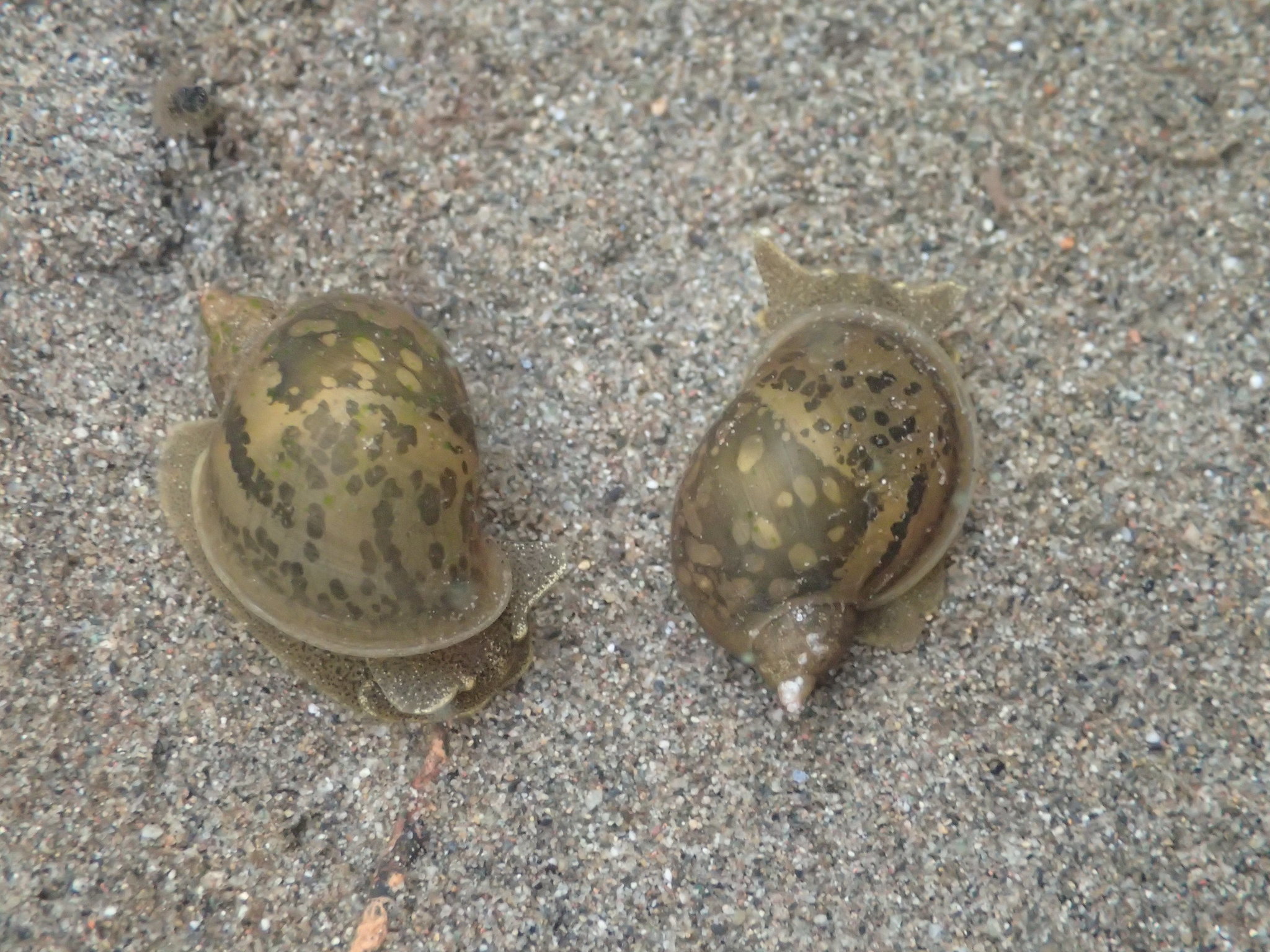
Photo by Matt Bowser/USFWS Big-eared Radix snails at Beck Lake, September 14, 2016.
