
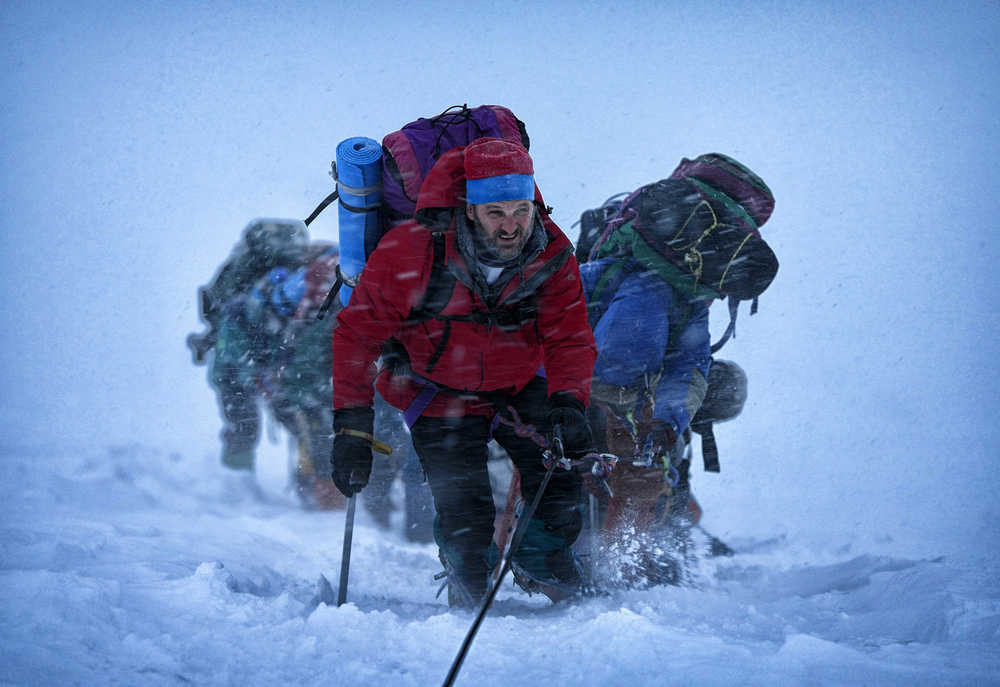
“Everest”
Universal Pictures
2 hours, 1 minute
There are some stories that seem so tailor-made for the big screen that you can’t imagine why they haven’t been made before now. In 1999, Jon Krakauer released “Into Thin Air,” his account of a terrifying disaster that had taken place on the slopes of Mount Everest three years earlier. It is a breathless read, a grimly fascinating story, and one that Hollywood would eat up with a spoon.
Instead, Krakauer sold the rights to TV and the big-screen version never materialized. There was an IMAX documentary about Everest, one that had been filming during the 1996 disaster, but it wasn’t necessarily the narrative. Even this current film which is, make no mistake, based on “Into Thin Air,” can’t make that claim, either because of a rights-issue or because Krakauer, traumatized by the event and disillusioned by the TV-movie of his story, refused to give his blessing.
Regardless, it was just a matter of time. The story of “Everest” is a fascinating one, a perfect scenario for a disaster film, made somewhat less fun by the knowledge that the story is true. You have a large cast of characters, an exotic location, and a whole chain of events where one thing after another went wrong.
Rob Hall is the owner of Adventure Consulting, a professional Himalayan guide who makes his living by leading mountain climbing tourists, mostly rich, up the side of the world’s highest mountain. Hall is ably played by Jason Clarke, a good actor, but not necessarily showy enough to carry a film completely on his own.
On his team is Doug, played by John Hawkes, whose gaunt face and open smile present the contradictions found in the best character actors. For star power, the film offers Texan Beck Weathers, played by Josh Brolin and rival guide Scott Fischer, played by Jake Gyllenhaal.
Adventure Consulting, comprised of eight clients and several guides, are not the only group with designs on the mountain. In the summer of 1996, there were dozens of people gathered at the high base camp where climbers acclimatize and prepare for the treacherous ascent. It was this confusing mass, mixed with foul weather, that led to the disaster to come.
Much of the movie is taken up by the long wait until the perfect climbing window in the first week of May. There is training to be done, but a lot of waiting around as the body becomes accustomed to life at high altitudes. This is a perfect period for the audience to get restless, but I thought the pacing of the film was fine. I was reminded of disaster movies from the 1970s and early 80s where an ensemble cast has to each be given their introductions and motivations. It’s character development, and while some of it is a little broad, it’s in keeping with the tradition of disaster films.
Once the final climb begins, the movie ramps into high gear. Here, too, the film is melodramatic, but I didn’t mind. I was literally on the edge of my seat for the last half-hour of the movie. So much so that you almost feel assaulted by the howling wind and the brutal conditions on screen. If anything, this movie makes me less likely to ever want to go mountain climbing, an activity I was pretty sure I was never going to do anyway.
“Everest” is not without its problems. The acting is fine, big and dramatic, but appropriately so. The dialogue, on the other hand, is a little too hokey and obvious. Too many characters with lines like, “I sure hope I get to the top of the mountain. Yep, I just want to get to the top of the mountain and then get home safe.” Yeah, we got that.
On the other hand, maybe this is just how people talk when placed in a stressful situation with a bunch of strangers. I never know what to say on a long elevator ride, and there’s no chance that I’ll freeze to death with my fellow riders before we reach the bottom. It’s hard to say whether the dialogue is too right or too cheesy, but the effect is that it doesn’t sound very good.
I was also surprised that “Everest” didn’t pay more attention and give more screen-time to the Sherpas. Sherpas are the native inhabitants of the surrounding area who climb up and down the mountain routinely rigging ropes, clearing paths and setting ladders. They essentially do the heavy lifting for their wealthy, white employers and their wealthy, white clients.
It’s not just my liberal sensibilities that makes me wonder about their lack of representation in this movie — Sherpas have been all over the news lately. A few years ago they struck, demanding higher pay and better working conditions. Their poor pay and lack of respect was widely broadcast. And then in 2014 and 2015, nearly thirty Sherpas were killed on the mountain in avalanches.
In the film, “Everest” there are only Sherpas in a couple of scenes, and even here they barely have any lines. In fact, the movie goes so far as to suggest that the entire disaster was, at least in part, the fault of the two main Sherpas who weren’t getting along and didn’t do their jobs. Whether or not this is true, the film’s use of these brave people feels distasteful.
All in all “Everest” is a solid disaster flick. It has solid acting, excellent effects, and adequate writing. Like any snowbound adventure it’s almost impossible to tell anyone apart once they get up on the ice, but despite some shortcomings, the film worked for me. The movie is in 2D and 3D, but if you’re afraid of heights, I’d skip the 3D.
Grade: B
“Everest” is rated PG-13 for language and terrifying scenes of peril.
Chris Jenness is a freelance graphic designer, artist and movie buff who lives in Nikiski.
