
AUTHOR’S NOTE: Poopdeck Platt, who lived in Homer for more than forty years, and in Alaska for more than a half-century, was nearly 80 when he decided to retire from commercial fishing.
Clarence Hiram “Poopdeck” Platt said he didn’t quit commercial fishing because he was too old or couldn’t handle the workload anymore. He quit because he didn’t feel like doing it anymore.
In a 1992 interview with KBBI public radio in Homer, he explained his actions: “I (had) really enjoyed fishing, but all of a sudden, for some reason or other, it quit being fun. I wasn’t enjoying it. I wasn’t looking forward to it. I was dreading it … and I said that’s enough. So I sold out to my grandson (Erik Huebsch, in 1984) my boat, permit, gear and the whole works…. I haven’t regretted quitting at all.”
Despite the diminishment of joy Poopdeck felt as he entered retirement, he loved his long tenure as a fisherman. In December 1977, he told the Homer News, “You can’t ever find two days alike when you’re out fishin’. The weather’s different. The seas are different. The fish are different from day to day. You’re always facing a new set of problems.”
Still, he faced those problems with his sense of humor intact: “In order to be a fisherman, you’ve got to be slightly crazy to begin with. You can’t like a steady job because, if you did, you’d go and get one — and say the hell with fishin’. But anyone that can’t stand a steady job, and ain’t got brains to be a millionaire, why, he can be a fisherman.”
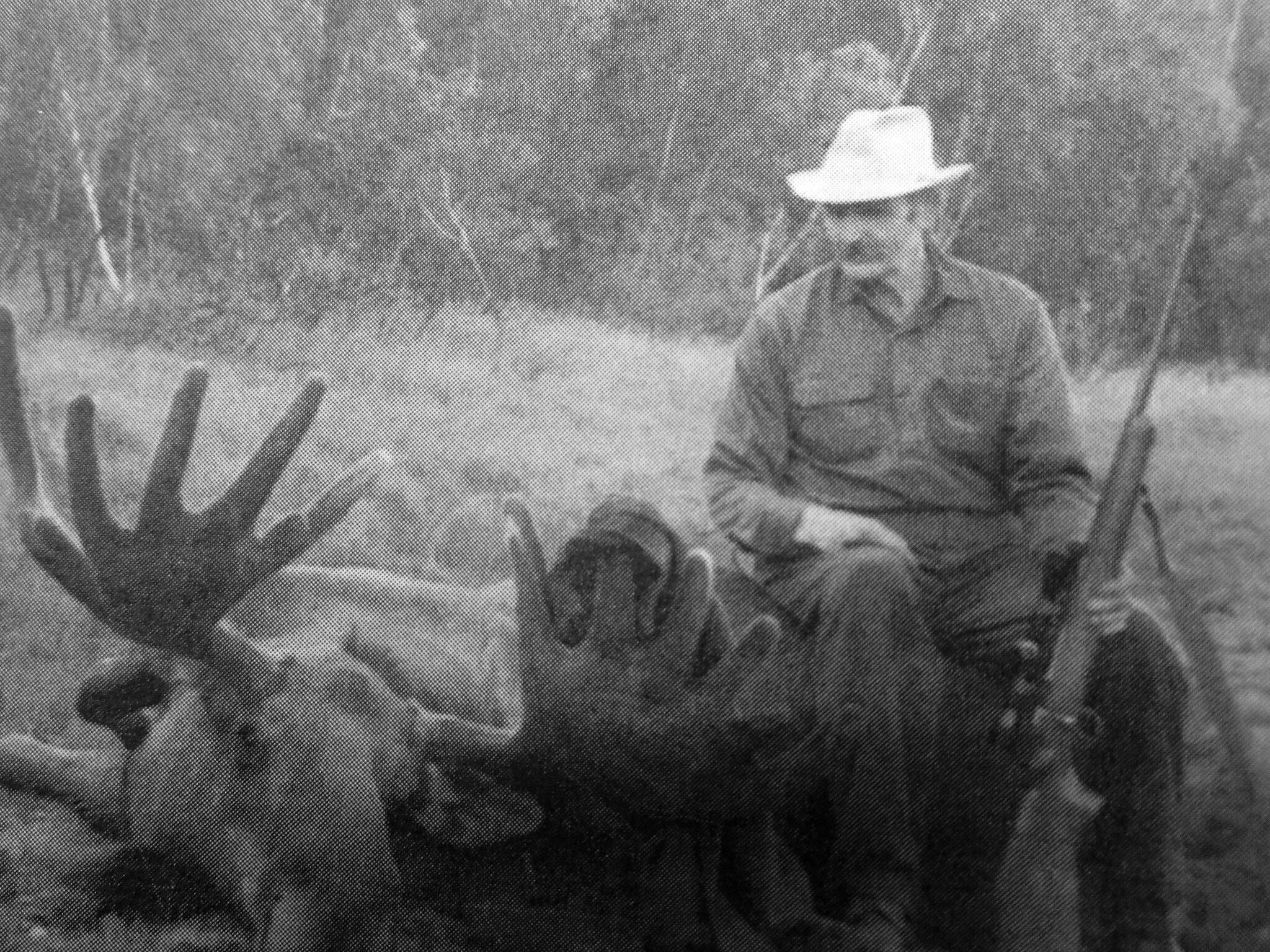
Poopdeck was equally passionate and good-humored about hunting, which he considered one of the grandest adventures life could offer.
“Next to enjoying people,” wrote his buddy Kenny Moore, “hunting was one of Poopdeck’s greatest interests. Probably it was not just the hunt, but the lure of something new and different…. A lot of it was that he preferred to hunt a different place and a different way every time. I found out, too, that if you intended to go with Poopdeck, you’d best enjoy adventure.”
Hunts with Poopdeck, Moore said, often contained unexpected consequences — battles against rough seas or lousy weather, uncooperative tides, mechanical problems with boats or vehicles, especially tough terrain, and so on. “To Poopdeck,” wrote Moore, “this was ‘just another good time.’”
A common refrain from Poopdeck was: “Whatever you do, don’t let your work interfere with your huntin’.” And, Moore said, when hunting partners complained about the expense of big trips just to fill their freezers with winter meat, Poopdeck’s response was likely to be: “You just can’t look at it that way. You chalk the expenses up to recreation, and that makes the meat pure profit.”
Despite such “profit,” not everyone was game for Poopdeck’s idea of adventure. His son-in-law, Fred Huebsch, once said, “I used to hunt with Poopdeck a lot, but I quit. A hunt with him isn’t a hunt. It always becomes an experience.”
And then there was the processing and consuming of whatever they brought home: Over the years, Moore said, he and Poopdeck ate sea lion, coyote, sandhill crane, porcupine, black bear, seal, salmon shark and “probably a few other strange things that I have forgotten about or, more likely, didn’t know about.”
After Fishing
His retirement from commercial fishing provided Poopdeck with more time to travel, more time to spend in his garden, more time to create homemade wines, and more time to share the products of garden and wine cellar with other people.
His gardening efforts declined over the years, not because he grew weary of tilling the soil, pulling weeds and harvesting vegetables, but because he tired of dealing with slugs.
At first, he planted a nearly half-acre garden and said of its upkeep, “It ain’t work. It’s fun.” But then: “The slugs moved in on me…. (and) they got so bad that they put me out of business. I worked all summer … a half-hour a day on the garden and three hours a day killing slugs, and I totaled that I counted — (and) there was quite a few that didn’t get counted that got killed — forty-five thousand two hundred and seventy-six slugs that I killed on purpose.”
His energy then shifted even more to his wines, which he dubbed “bug juice” because of the “yeast bugs” that did the work to produce each vintage.
In the early days of Poopdeck’s life in Homer, said friend Kenneth Jones, he would “lubricate conversations with home brew. Later, he switched to numerous varieties of ‘bug juice’ … from blueberry, raspberry, dandelion, peach, elderberry and sometimes even grape. A trip to his cellar to choose the wine of the day involved sampling about 10 choices in varying strengths and vintages.”
“He’s famous for his bug juice,” wrote Kenny Moore, “but some of his batches have been adventures, too…. He produced a few cases of blueberry burgundy. In the middle of the night, it started exploding from the kitchen floor. It repainted the ceiling a really nice, dripping, reddish blue. We named the stuff ‘Poopduck’s Colddeck.’”
When asked about the “secret recipe” for his wines, Poopdeck told KBBI, “Well, it’s impossible to tell you, because I don’t have any genuine recipe that I could write down and tell anybody. Now, I can show people if they come around what I do, but I do it by looks, smell, taste, and so forth … and I do not have any set recipe.”
Poopdeck did want to let listeners know, however, that only dandelion wine required more than a year to make. “It takes five years to make good dandelion wine,” he said, adding that it tastes lousy when freshly made but grows in sweetness and deliciousness over time in storage.
His favorite was wine made from wild blueberries. “Boy is it delicious,” he said, “but it is one that won’t last. You can’t keep it because it turns to vinegar. You have to drink it, but that’s no hardship at all if you can get the blueberries.”
“Locals and visitors from all over the world have climbed down the stairs (into Poopdeck’s cellar) to sample his mostly delicious homemade wines,” wrote Catherine Cassidy. “His mother Susan did not approve of alcohol and, as far as the family knew, was not aware of her son’s wine cellar.”

Photo courtesy of the Huebsch Family Collection Poopdeck Platt (left) and a visitor sample homemade vintages in Platt’s wine cellar in Homer.
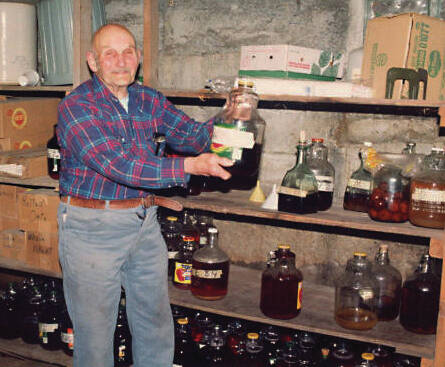
Photo courtesy of Ken Moore Poopdeck holds up a sample of his many wine varieties.
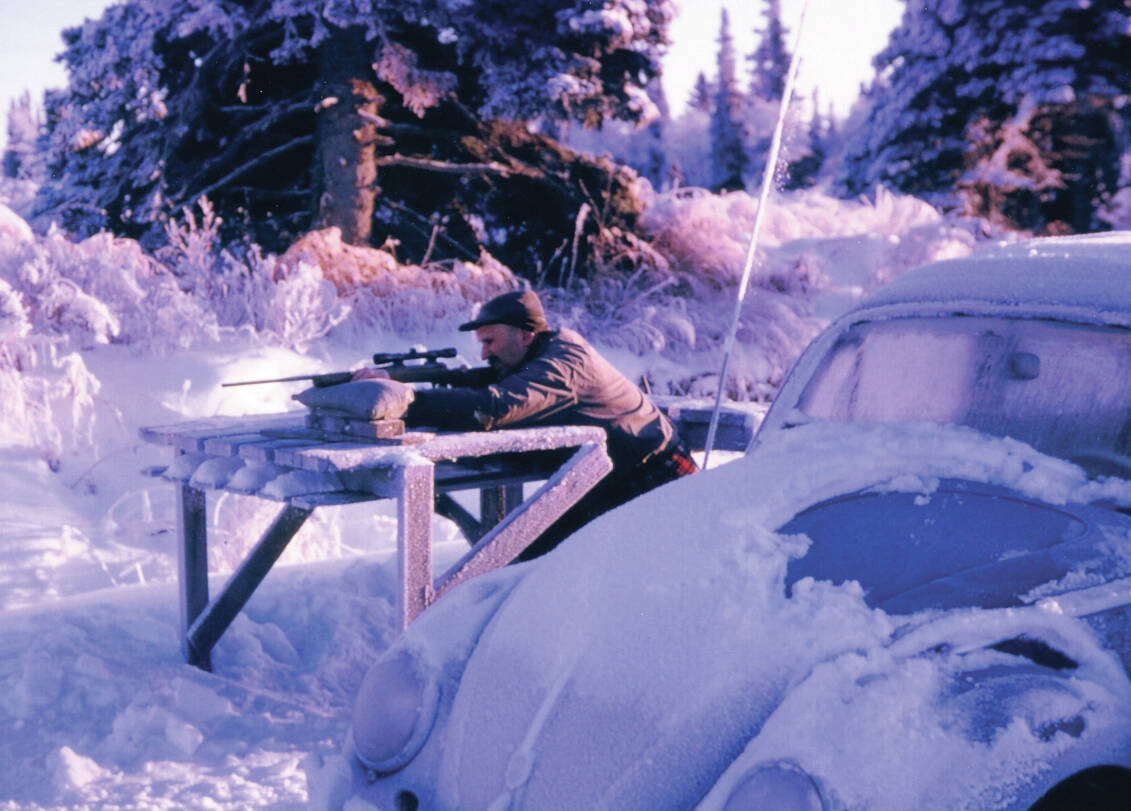
Poopdeck Platt, in about 1968, does a little winter target shooting. (Photo courtesy of Ken Moore)
