
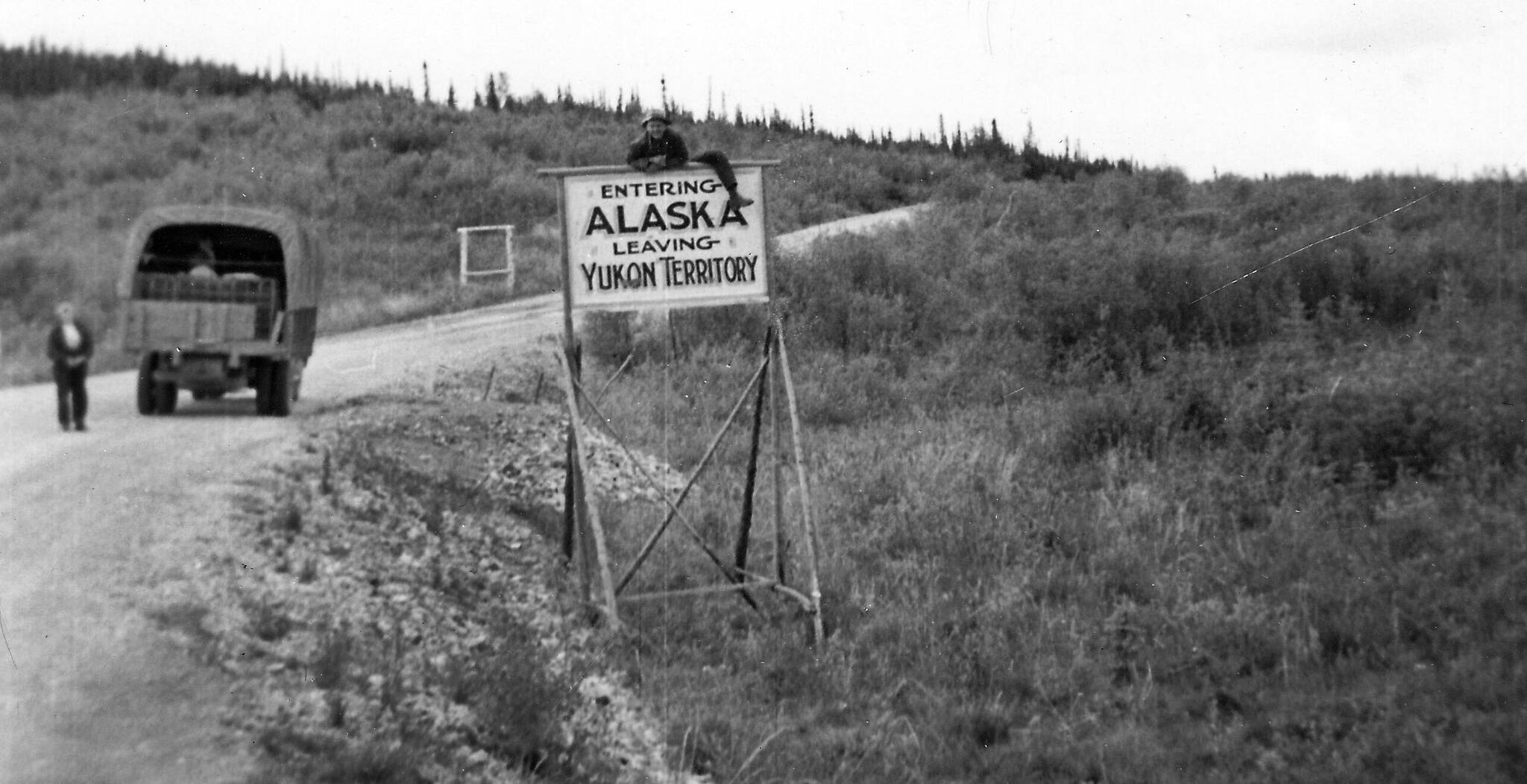
AUTHOR’S NOTE: Poopdeck Platt, who lived in Homer for more than 40 years, was inspired to move north after World War II by a new love interest and an unlikely gift.
While her father, Clarence Hiram “Poopdeck” Platt, was serving in the U.S. Navy during World War II, Alice Louise Platt, who was in nursing school in San Francisco, decided to introduce her dad to an older friend named Bernice Madge Morrison, who was a professional chemist teaching school. Poopdeck and Bernice became pen pals, and at some point, Bernice decided to give Poopdeck a subscription to Alaska Magazine.
In 1947, their correspondence led to wedding bells, and the magazine subscription led them to make a new home in the Territory of Alaska.
Discouraged by his return to truck farming in Montana, and unable to stomach his business partner’s new wife, Poopdeck had sold his share of the operation and decided to move north. He had written to Bernice and asked her to marry him and come with him to Alaska. She accepted both proposals.
On May 17, 1947, Poopdeck and Bernice wed in Poopdeck’s parents’ home in Corvallis, Oregon. Among those in attendance were Mickey (Poopdeck’s son, Clarence Vernon Platt), and Alice and her husband, Frederick Robert Huebsch. The newlyweds invited Poopdeck’s children and Fred to accompany them to Alaska, and they all agreed to do so.
(Interestingly, Alice and Mickey’s birth mother, Bonnie — Poopdeck’s ex — also remarried in the 1940s. Her new husband was Herman Huebsch, an older brother of Fred. At some point, Bonnie and Herman moved to Alaska and eventually homesteaded at what became known as Bonnie Lake, east of Sutton.)
North to Alaska
All five members of the northbound group had managed to save some money during the war, and Poopdeck also had some cash from selling his portion of the Montana truck farm. Among his first purchases was a new two-ton Ford truck, on which he built a bed and a shell to protect their belongings.
They left the States only weeks after the wedding ceremony, camping along the way. The new truck was able to manage most of the primitive Alcan Highway, although they, like many other travelers, relied occasionally on assistance from road-building and maintenance crews.
They arrived in Anchorage on July 7 and found the housing market virtually nonexistent. The family reacted by buying three or four lots near Merrill Field and then going into construction.
A large Indian boarding school in Eklutna had recently been condemned because of fire danger. Poopdeck and Fred Huebsch bought the gymnasium for a thousand dollars from a speculator who had purchased the entire school.
The gym featured 40 windows and plenty of wood, held together almost entirely by nails. The men set to work prying apart boards, while the women focused on removing nails. They piled salvaged wood on their truck and hauled it to a couple of their lots in Anchorage, where they used the materials to construct three houses — two to live in and one to rent.
“We was building houses right close to Wally Hickel at one time,” said Poopdeck, wishing aloud that he had had some portion of Hickel’s business acumen. “He borrowed money from the government, lots of it, and kept building houses and hotels and stores and all kinds of things until he got to be a billionaire, more or less. And I didn’t.”
In fact, it didn’t take Poopdeck long to become disenchanted with Anchorage and the construction business. “We started looking around for something else to do,” he said, “and Fred got a job fishing one summer (1948) with an outfit that was fishing (near Anchorage). That sounded like more fun than building houses.”
Poopdeck and Fred built their own wooden setnet dories, and in the summer of 1949 bought a setnet site at Kasilof. They began fishing at Kasilof in summers and spending their winters in Anchorage.
According to the 1950 U.S. Census, Poopdeck, Bernice and Mickey were living in the Chester Creek area of Anchorage. Living nearby were Alice and Fred and their young daughter, Susan. Bonnie and Herman had also moved into the same vicinity. Fred, Poopdeck and Mickey were still in the construction business, Bernice was working as a chemist in a medical laboratory, and Herman was operating a truck farm.
But a tragedy later that year interrupted their string of successes.
Back in February 1944, when Clarence Vernon “Mickey” Platt was still attending high school in Hamilton, Montana, he had enlisted in the U.S. Navy. Only two months after his enlistment, while in the service at Farragut, Idaho, he was given a medical discharge because he suffered from epilepsy.
On Sept. 22, 1950, Mickey, recently returned from a hunting trip, was bathing at his sister’s home when he was struck by an epileptic seizure, became unconscious and drowned. Efforts to revive him with artificial respiration failed. He was only 24 years old.
Kenai Peninsula bound
By the mid-1950s, Poopdeck had left the construction business behind and was spending his summers fishing. It was also around this time that he decided it was time to get out of Anchorage for good.
In 1956 — while working on a 36-foot wooden boat he had purchased for fishing — he paid $8,500 to Albert J. “Whitey” Schenck for 4 acres of land and a log cabin in the center of Homer. Schenck carried the paper at zero interest. Poopdeck never did fish with the wooden boat, and he sold a 100-by-150-foot piece of the land to a friend, but the log cabin became his home for the rest of his life.
The following year, Poopdeck borrowed money from the Libby, McNeill & Libby cannery in Kenai to purchase a steel Puget Sound troller converted for gillnetting. He named the boat the Bernice M. for his wife, and in 1959 he and Kitchel Lenard “Red” Cleaver hauled the boat up near Red’s house by Green Timbers, cut off the stern, welded on two and a half feet and reattached the front and back to form a bigger boat.
With Kenny Moore, and a cousin of Moore’s, that summer, Poopdeck went crabbing for a month or so, and they hunted together on Afognak Island and at Port Dick.
“You didn’t have to know Poopdeck very long,” said Moore, “to find out he did not intend to let his life run in a rut. He enjoyed being different and sounding different. He always liked to leave you with a few words that were unique and quite often put them in a manner that you would tend to remember. At his house the standard greeting was always ‘Come in and look out.’ And everyone was always welcome, as one of his great loves in life was ‘keeping up with the B.S.’
“He just plain enjoyed knowing what other people had going on in their lives,” Moore continued. “And, as we found out that summer of 1959, he was always ready to help out and provide a bed for anybody that needed a place to stay. My cousin and I stayed in a loft above his old shop that later burned down. The loft had a hatch that swung open to the outside world. Very early every morning, there would be a loud call from below the hatch: ‘Daylight in the swamp! Coffee is hot!’ There stood Poopdeck with two huge cups of scalding-hot coffee and a few stories to tell before the day got started.”
In about 1962, Poopdeck became the winter watchman at the Libby, McNeill & Libby (later Columbia Ward) cannery in Kenai. He and Bernice moved in to the cannery in the fall and back to Homer in the summer. In their absence, they rented their home to “Mud” and “Stinky” (Wilma and Charles) Jones.
As watchman — a job he held for at least a half-dozen years — Poopdeck had little to keep him occupied, except for two weeks in the fall when he had to winterize the facility and two weeks in the spring when he had to prepare it for a new summer crew.
Life for Poopdeck and his family, then, took on a regular, comforting rhythm — until 1965-67, when Poopdeck experienced three consecutive years of misfortune.
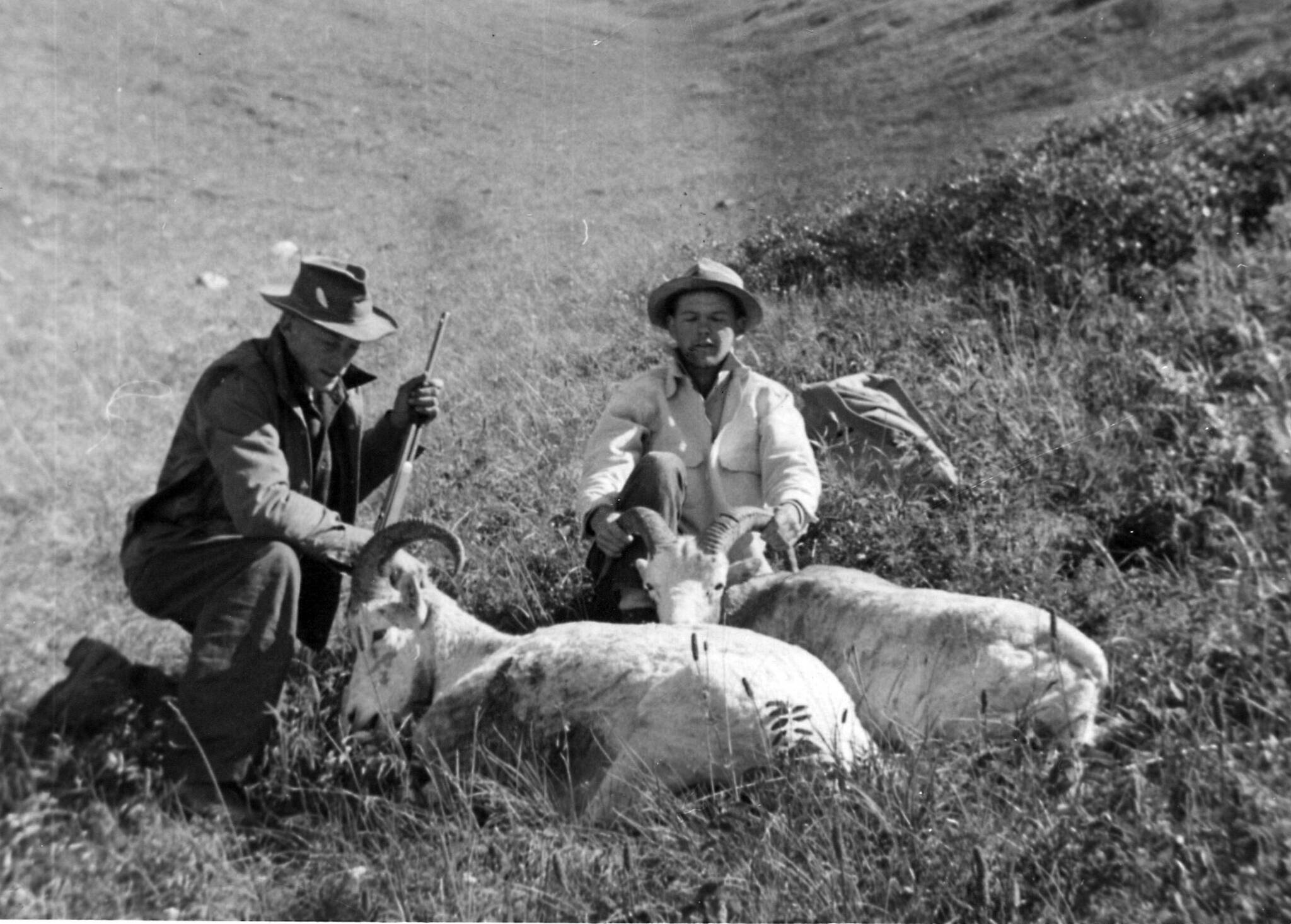
Photo courtesy of the Huebsch Family Collection Fred Huebsch and Clarence Vernon “Mickey” Platt (son of Poopdeck) with two Dall sheep in 1947.
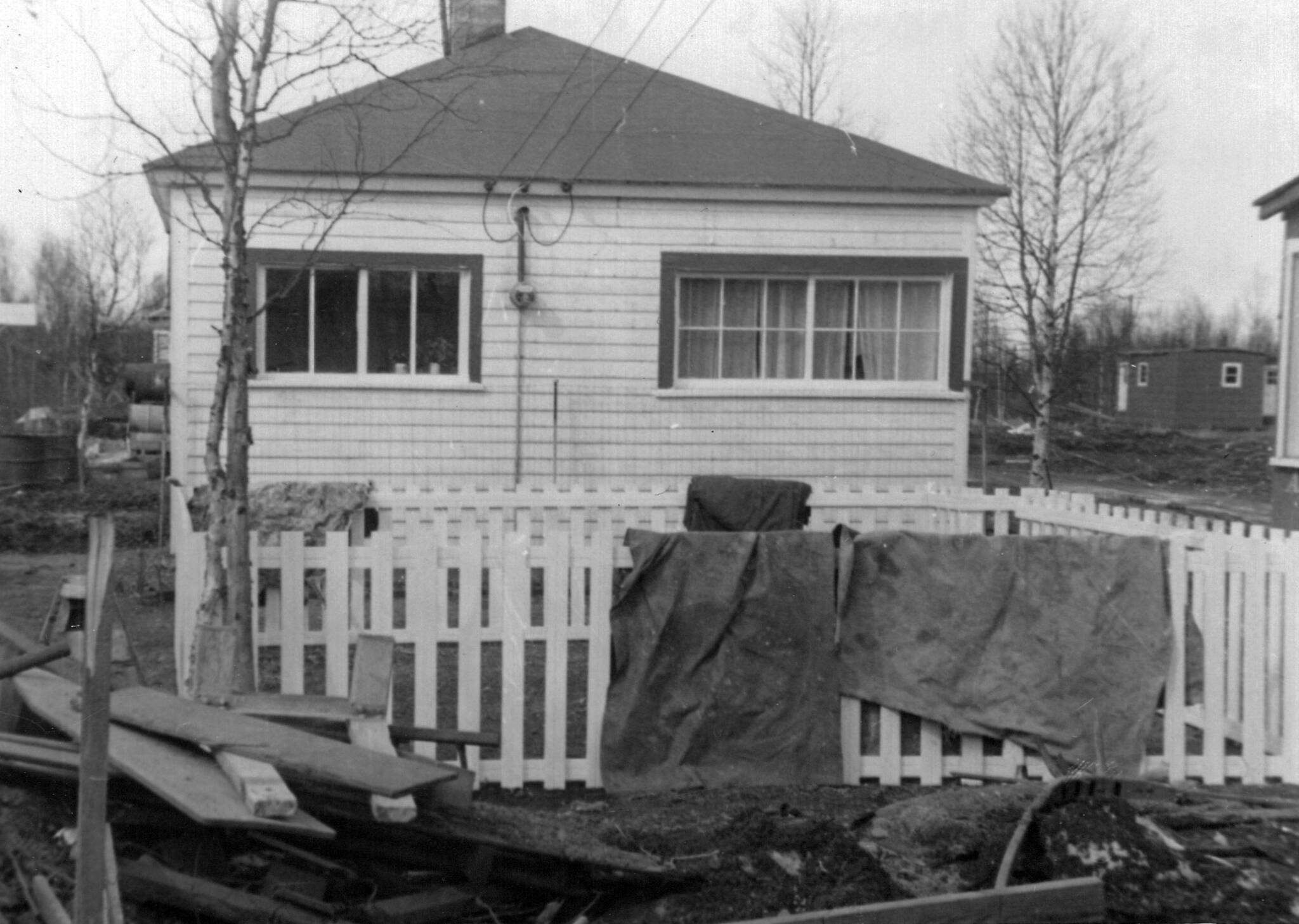
Photo courtesy of the Huebsch Family Collection The house that Poopdeck Platt built in 1947-48 at the corner of 8th Avenue and I Street in Anchorage. This was Platt’s home in his early days in Alaska.
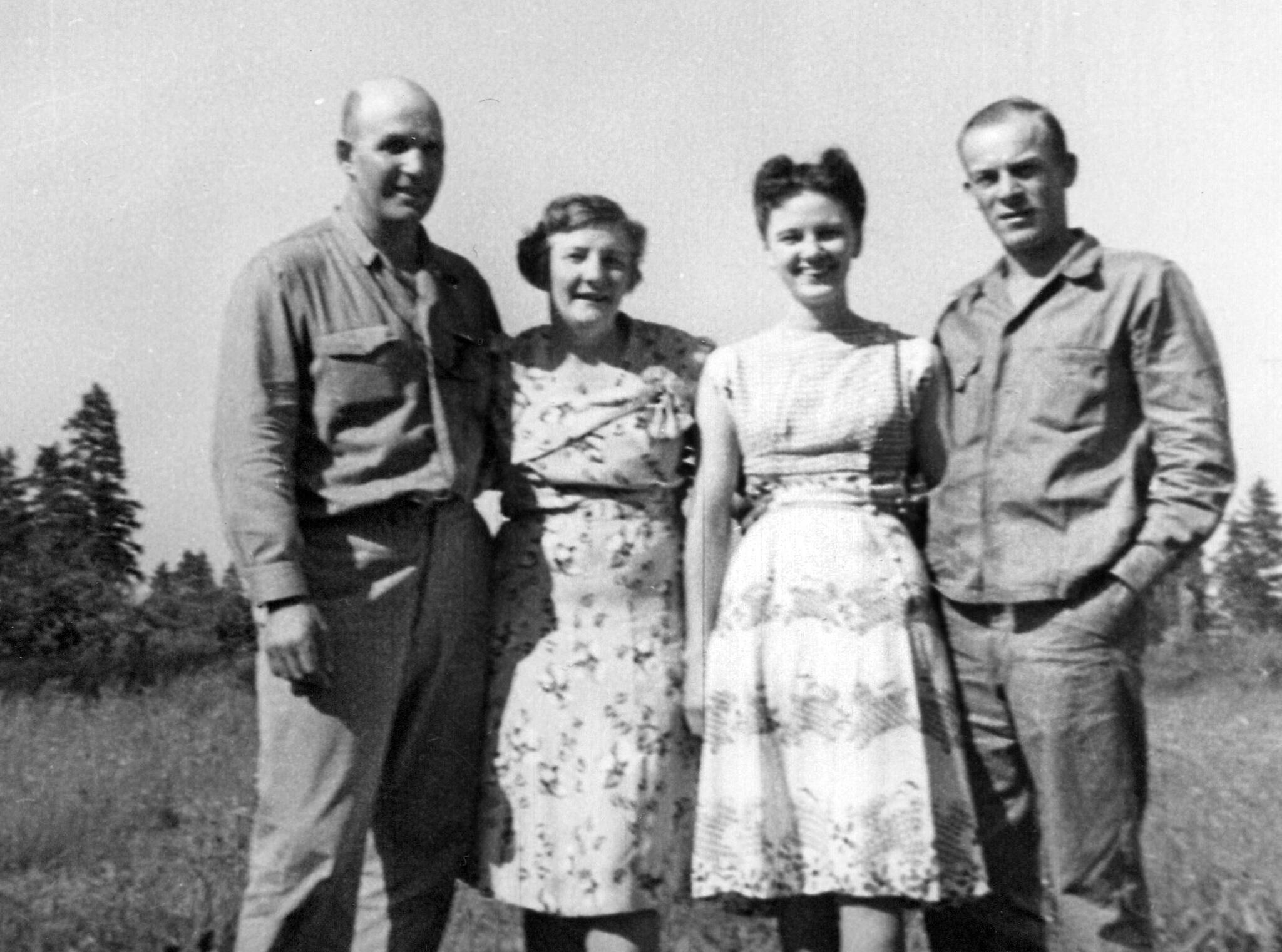
Photo courtesy of the Huebsch Family Collection Two husband-and-wife pairs: Poopdeck and Bernice Platt (left) and Alice (Poopdeck’s daughter) and Fred Huebsch, 1947.
