
1937 to 1955
Northern Colorado
I have a small book that my grandson Michael Jordan gave me, titled, “Grandma, Tell me your Memories.” He gave it me the year my great granddaughter, Cecile was born. It has a small page for every day of the year with a question at the top. I started filling it in and have through the years, filled out lots pages. When I am stuck with an idea for an article – I refer to this precious little book. Thank You Michael and Happy Birthday!
March 21-22-23:
Describe some household chores you had as a child:
We always had “chores” on the farm and each task was just referred to as “the chores.” Chores are everyday, all day long on a farm. One of Dads many “chores” was milk the cow in the morning, every morning, and eventually that was my chore for a few years in high school. My brother, John, escaped that “chore” and it was handed to me. Dads other chores were feeding and watering the cattle and seeing that they were healthy. Our chores were, at times, clean out the barn and the chicken house. Gingers chore was to gather the eggs and see that the chickens were fed and watered. She was commissioned by Dad, at one time to get rid of a poor old sick hen, something she did not do very well between tears and sobs, the hen survived, until Dad took over.
Dad’s big chores were plowing, harrowing and planting and irrigating crops of beets, corn, hay and wheat. The maintenance of the equipment was up to my Dad and my brother John and later little brother, Jim. Haying season was a big chore for them! I could write for hours about the everyday chores of farming!! Dad’s biggest and most prideful “chore” was taking care of his family.
On of my chores was to help Mom catch and pluck the chicken for Sunday dinner. We had a “chicken hook” a long piece of heavy wire with a hook on the end. It usually took me three of four tries to get an unsuspecting chicken on the hook. It had to be the one that Mom would pick out – because if we were eating fried chicken for Sunday dinner, it had to be a young one. Otherwise the old hens in the fall were for boiling and Mom’s “chore” was making her wonderful egg noodles for Sunday dinner. The left over boiled chicken was de-boned and ground up (my chore) and she added Derek’s Dressing, Miracle whip, salt and lots of pepper. It was spread on her homemade bread, buttered, with a big lettuce leaf and served with the noodle soup, We usually had some kind of relative company on Sunday so Mom baked a cake or some pies or cookies for dessert. Her chores, as Dad’s, were endless.
Ginger’s and my chore was to set the table, and clear off the table and wash the dishes. Ginger’s chore for many years was washing the dishes, as I usually had my right hand in a cast from surgeries. I smashed third finger getting it caught in the suicide doors of the Pea Green Dodge. That took a year. And standing on my head in gym class, on the bottom row on a pyramid, the top three rows fell on the bottom row – and I ended up with a thumb that was bent back to my wrist. I had surgery on that and was in a cast for a year, until I got tired of it and sawed off the cast myself. But not soon enough, as Ginger got real tired of the washing dishes chores.
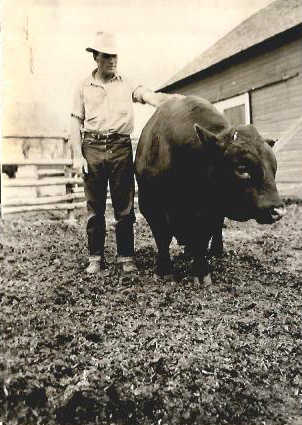
At one time while in high school, John, Ginger and I had 4-H calves. That was a whole new set of chores. Feed them every day – take them for walks to halter break them, clean the pens. In the fall when the cattle shows started, we would each give our calves a bath. I had a white Shorthorn calf named Snowball. We bathed them with DUZ Laundry Detergent and in my case, if parts of the calve did not get white, Dad got out Mom’s Clorox bottle. Then we rinsed and rinsed with cold water out of the well we had to water the animals. Other chores also included – trimming the calves with a big scissors that probably cut everything including baling wire. We also learned to trim their feet. We learned a lot about caring for animals through the 4-H program. Everyone should join 4-H !!
Chores on Monday included gathering and sorting the dirty laundry, carrying it down stairs to where the Maytag washing machine was. Making sure the white clothes were washed first, run through the ringer and making sure your fingers were not in the way – or your long hair. Rinsing them twice, carry the basket of wet clothes up the stairs to the clothes line and hang them on the second row. Never ever hang them on the front line – for all the neighbors to see our underwear!! The sheets came next and they were hung on the front line. Chores did not end with the many trips up and down the stairs to help Mom with the wash. The next chore was gathering the dry, sweet smelling laundry off the line, carefully folding it and placing in the basket and carrying it back in the house to be “hand-ironed” and folded and put away in various places. The gathering of the clothes off the line I loved – it smelled so good and fresh. The sheets and bed clothes were put back on the bed and when you crawled in at night – it was like the cleanest place on earth. Our dryers of today do not have that same effect.
Then I learned to iron. At one time we had a “Mangle” a rolling cylinder with a large hot curved iron that you controlled by your knee to clamp down on the wrinkled clothes, roll them through and you had, hopefully, no wrinkles in your clean clothes. We ironed all the sheets and pillow cases. The shirts and Levi’s we learned to iron on the monster that stood in the corner of the kitchen. I am not certain why they called it a “Mangle” other than if you got your fingers, hands in the rolling cylinder and clamped the large hot iron down on top – you got mangled!! I liked ironing on it, but I also loved to just iron on a ironing board and still do, although the sheets and pillow cases do not get ironed at this house.
The page of my little book asked: Which chore did you dislike the most?:
Cleaning out the chicken house comes first to mind and then cleaning out the barn.
And “Which chore did you like?” Gathering in the clean dry clothes, ironing, feeding the animals, helping Mom with her chores, which usually entailed baking something in the kitchen.
What “chores” did you have and did you teach your children the art of “doing chores?”
Ann “Grannie Annie” Berg is a 47-year resident of Alaska. Ann shares her collections of recipes from family and friends.
She has gathered recipes for more that 50 years. Some are her own creation. Her love of recipes and food came from her Mother, a self taught wonderful cook.
Grannie Annie can be reached at anninalaska@gci. net.
