
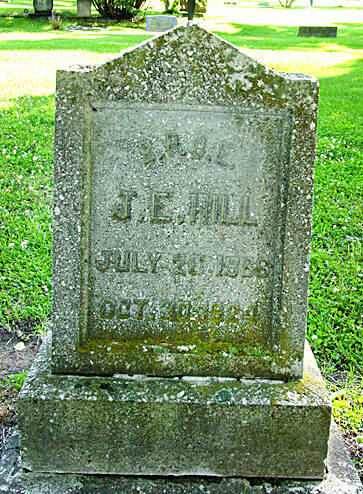
AUTHOR’S NOTE: In the first part of this two-part story, Alaska baseball star and World War I veteran James “The Daylight Kid” Hill became a United States deputy marshal in Seldovia and attempted to “clean up the town.” On Oct. 30, 1924, he and Robert Jacobson, a roustabout at the local jail, were searching for illegal liquor-making equipment on the property of William and Dora Brooks when the Brooks dog bit the marshal. Hill fired numerous shots with his pistol at the fleeing animal, and down at the Brooks home, William picked up a rifle and threatened to go kill the marshal if the marshal had killed his dog.
Origin of the Marshal
U.S. Deputy Marshal Hill was born James Edward Altier, Jr., on July 26, 1886, in St. Paul, Minn. By the time young James turned 6, his mother, Bridget, had divorced the elder James and gotten remarried to a man named David Hill.
The record is unclear, but James Jr. soon became James Edward Hill, while his older brother, John Willard Altier, retained his original surname, even though both of them lived with their mother. In 1893, their father also remarried, but it does not appear that either boy ever returned to live with James Sr.
By the time the U.S. Census was enumerated in 1910, young James was living in Valdez. He apparently also spent a considerable amount of time in Kodiak, where he owned and operated a saloon until he sold his interest in 1913 and returned to Valdez.
In 1915, the 5-foot-6 Hill was living at Matanuska Junction, was captain of the local baseball team, and was working as a lineman for the Telephone & Telegraph (T&T) Department, connected to the Alaska Railroad.
He joined the U.S. Army Signal Corps in March 1918 and soon found himself stationed in France. A year later, with World War I at an end, he was eager to return home. On June 15, 1919, he sent a letter from Paris, where he was on leave, saying that he was “thoroughly tired of foreigners” and sought the company of old friends.
When the U.S. Census was taken in 1920, Hill was back in the Matanuska area and working again for the T&T Department. A year later, he married Minnie Louise Popp, who was 10 years younger and a former employee at the T&T Department. In 1922, the Hills moved to Seldovia so James could begin his law-enforcement career.
Origins of William and Dora Brooks
Details of William Brooks’s early life are scarce. According to the Anchorage Daily Times, he was a “Kentuckian,” but the few census records in which he appears indicate an Ohio birth in about 1872.
He moved to Emerson, Mills County, Iowa, by at least the early 1900s and met Dora Huntsman, who was 10 years his senior and still unmarried. On March 31, 1904, Dora and William slipped across the state border into Plattsmouth, Nebraska, where they were wed by a judge.
Prior to their marriage, Dora had been living with her elderly father, William Huntsman, who had been widowed since 1880, when Dora was 19. Dora also had two younger siblings and may have been helping to care for them after her mother died.
By 1910, the Brookses were residents of Bonners Ferry, Idaho, just south of the Canadian border, but they may have lived briefly in South Dakota before that. In 1907, a man named William Brooks — a homesteader who “recently arrived in South Dakota from Iowa,” according to the Sisseton Weekly Standard — was arrested for illegally harvesting timber on the Cheyenne Indian Reservation.
The next move for William and Dora appears to have been to Alaska. By 1918, they were in Ketchikan, where William worked as a fisherman. He had a commercial permit for the Kasaan District and purchased an 8-ton fishing vessel called the Hiawatha at this time.
In March 1921, the Brookses were on the move again. The Anchorage Daily Times reported that they had come to Anchorage and expressed an interest in buying a house there and settling down. Regardless of their intentions, however, they didn’t stay long.
Later that same year, the Alaska Daily Empire reported that William Brooks had filed on 80 acres on the north side of Kachemak Bay, and about the same time he and Dora acquired the 35.26-acre Mickie Doyle property along the slough in Seldovia. Likely, success in Seldovia, including a greater ease of access, prompted William to relinquish his claim across the bay.
After the shooting in 1924, William Brooks would be identified as a 52-year-old homesteader “with the reputation of being a ‘gun-toter.’” During his time in Seldovia, according to those same reports, he worked “at various jobs … as a fisherman, woodsman and sawmill man.”
According to investigator Claude Shea a few days after the incident, Brooks was “evidently of a surly and quarrelsome disposition as he had attempted to kill a man with an axe while in the woods last summer.”
Fatalities
Vowing to kill the marshal if the marshal had killed his dog, William Brooks, with a .35-caliber Remington automatic rifle in hand, and over the protestations of his wife, bolted from their house and sped toward the canvas wall tent where Hill and jail roustabout Robert Jacobson were determining their next move.
In an affidavit, Jacobson testified that he and Hill heard a bullet pass near or through the tent. Hill, who had emptied his pistol shooting at Brooks’s dog, pulled out his firearm again and began loading it while poking his head out of the tent to see what was going on.
“Bob,” he said, “that crazy fool is shooting at us.”
Jacobson made a run for it, lifting the back of the tent and racing for the safety of a nearby brush pile. When he reached cover, Jacobson turned to see whether the marshal was running to join him. “[I] saw Jim running around the tent [and] down the clearing. Brooks came around the corner of the tent right after him.”
Brooks, said Jacobson, issued a string of expletives and hollered at Hill to get off his land. He then fired several shots at the fleeing marshal. Jacobson raced further into the woods and didn’t stop, even when he heard Hill say, “Oh, Bob!”
According to Dora Brooks’s statement, she heard a volley of gunshots and then William returned to their house. He told her, “I have got him or crippled him for I saw him fall.”
She testified that William then “went into the front room and came back out and went around the house, and I heard another shot and thought someone was shooting at Brooks.” She hurried outside through the attached woodshed and called her husband’s name. She heard no response and continued around the house.
“When I came to the corner of the house,” she said, “there he lay.” William Brooks had put a gun to his own head and committed suicide.
The body of U.S. Deputy Marshal James Hill was found, lying face down, about 275 feet from the tent. He had been shot through the right shoulder, the bullet severing arteries near the heart before exiting from the center of his chest. Investigators determined that Hill had been struck first about 125 feet from the tent, had fallen about 75 feet later, then risen and struggled forward only to fall again a final time.
Aftermath
Despite all its yelping, William Brooks’s dog had not been hit by a single bullet from Marshal Hill’s pistol. In fact, when investigators arrived a couple days later, Claude Shea said the dog “was running about, as lively as ever.”
Brooks’s three bootlegging accomplices, all of whom had been taken to the Seldovia lock-up by jailer Milo Hurlburt, pleaded not guilty at their trial, but a jury determined otherwise. All three were sentenced for Prohibition violations.
Hurlburt, the town jailer, was sworn in to replace Hill as deputy marshal.
Dora Brooks, in 1927, received patent to her homestead and lived there until her death, at about age 83, in 1944.
James Hill’s widow, Minnie, along with their 2-year-old son, Robert, stayed in Seldovia only a few more months before moving to Seattle. There, she remarried twice more, the first ending in divorce.
Robert Hill, who stood 5-foot-6 like his father and weighed only 130 pounds, registered for the military draft in 1942, shortly after the United States became embroiled in World War II. He served in the Pacific and died on Dec. 5, 1945, from a reaction to a sulfa drug administered to fight an infection. A Canadian hospital ship managed to get him to Tacoma in time to reunite with his mother before he passed away.
In a hyperbolic but fond farewell about two weeks after the shooting, the Seward Gateway praised Marshal Hill, who “died in the discharge of his duty — a pleasant task for a red-blooded man — never faltering or sidestepping the administration of the law … to avoid the Grim Reaper, [even] if his path led over the Great Divide.”
The editorial called Hill’s death “one of those regrettable accidents which go to form the warp and woof of Life,” and concluded with this line: “Were we to inscribe his epitaph, it would be: ‘Here Lies a Man.’”
