
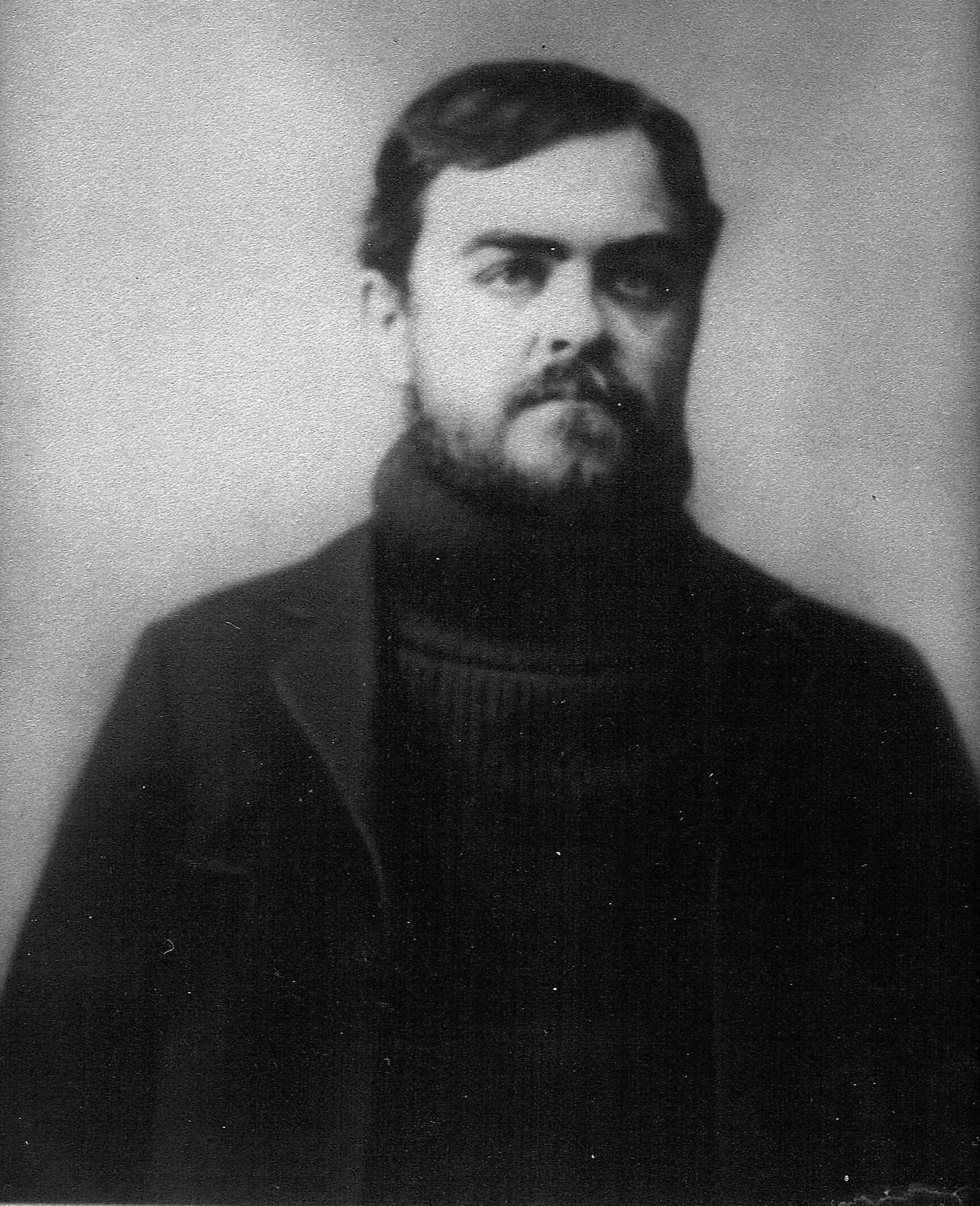
AUTHOR’S NOTE: Brooklynite Mary L. Penney and the rest of the Kings County Mining Company had departed New York in the bark Agate in mid-February 1898. By mid-August, after passing around the southern tip of South America, they had sailed into San Francisco on their way to the gold fields of the Klondike. They had already missed most of the summer prospecting season.
The three-masted ship called the Agate was a reliable 30-year ocean veteran when it entered Cook Inlet in mid-October 1898. Originally constructed by Charles H. Currier & Co., it had launched its maiden voyage July 6, 1868, from the shipyard at Newburyport, Massachusetts. The 175-foot-long, 626-ton vessel was commanded then by one of its first owners, Capt. Jacob B. Brown.
After its time in Cook Inlet, the Agate would continue sailing for almost another decade, but its final years would be difficult — a topic for later in this series.
When the Agate dropped anchor in Kachemak Bay on Oct. 16, it carried nearly 60 passengers, all members of the Kings County Mining Company, plus its captain and crew and a mountain of supplies and provisions.
Among the cargo specifically mentioned in contemporaneous newspaper reports and in later historic documents were: wheelbarrows, shovels, three dozen gold pans, sledges, 40 boxes of candles, 350 pounds of three-quarter-inch steel, 500 pounds of nails, 150 pounds of screws, a dozen seven-pound hammers, a dozen eight-pound hammers, a dozen picks, and boat clamps, drawing knives, chisels, crowbars and extra tool handles.
There was also clothing and personal items from individual passengers, plus enormous stockpiles of food, and chopping blocks, doorknobs, mirrors, a large copper boiler, a carpenter’s boring machine, a drill press, an anvil, a portable forge and a bench vise.
Finally, there was a complete blacksmithing shop and a complete sawmill, two steam-powered launches (for exploring up streams), and “several” whale boats.
What is unclear, however, is just how much of this cargo actually accompanied the miners once they were deposited on land. After all, they were not dropped right at the gold fields, as they had expected. In fact, Homer had never been part of the plan.
San Francisco
The Agate had left the harbor in Brooklyn, New York, in mid-February and arrived in the harbor at San Francisco in mid-August. Company plans had called for a New York departure at least one month sooner. The sailing schedule had not accounted for storms, for the eruption of the Spanish-American War and for the American Consul’s decision to hold the vessel in Uruguay for fear of capture by Spanish forces.
It had been hoped that San Francisco would be a quick layover on the race to the Klondike gold fields, and that the Agate would be already sailing up the Yukon River or, with luck, have even arrived in Dawson City, allowing the New Yorkers to file on placer claims and start raking in gold nuggets.
But even their supposed pit stop dragged on; it was mid-September before the full complement of the Kings County Mining Company unfurled its sails and began cruising north.
The first thing on the agenda after reaching San Francisco was alerting the men comprising the other half of their company that it was time for them to leave Brooklyn, to catch a ride on the transcontinental railroad and join the rest of the team.
Company officers also apparently sold the ship. One of the new owners — from Macondry & Co. of San Francisco — was E.M. Connolly, and it was understood that the vessel, once it had deposited the miners and their gear in Alaska, would return to California and enter the coastal trade.
The Kings County Mining Company had also — because of the lateness of the season — voted not to attempt to reach the Klondike in 1898. Instead, they set their sights on Cook Inlet and the gold-mining towns of Hope and Sunrise along Turnagain Arm. The Klondike would have to wait.
Because they had taken so long to reach California, the Agate passengers had already used up much of their food stores. They needed to reprovision. Some ship maintenance was also required, which would lengthen the delay.
Consequently, most of those who had just spent months aboard a ship at sea now had time to kill on land.
Mary L. Penney — who, along with Ida Gollee, were they only two women stockholders in the company — had already telegraphed her family back in Brooklyn. She then took advantage of time and her proximity to Alameda to travel there to visit members of her husband William’s family. Later, she and Mrs. Gollee assisted the ship’s cook and also went shopping.
One of their purchases was a chess set, featuring ivory chessmen who fit neatly into holes on a specially designed board, thus preventing them from tipping or sliding with the motion of the ship. The women used the game to help pass the time during the weeks remaining on their voyage.
Meanwhile, the other half of the company arrived Aug. 27 by train in Portland, Oregon, lounged for a day at a fancy hotel and then hopped aboard the West Shore Railway to unite with the rest of the company in San Francisco. The Aug. 28 edition of the Sunday Oregonian featured a lengthy piece on the expedition and interviews with several company members, including the company dentist (and former newspaperman), Dr. Thomas F. Sweeney, who was brimming with confidence — and more than a dash of ignorance — about what lay ahead.
Sweeney asserted that the company would be prospecting throughout the winter, and if their prospects were not favorable, he said, they would “push into the interior in the spring.”
“We may go into the Tanana country,” added Sweeney, who had perhaps been feasting too heartily on the dime-novel Westerns so popular in that day, “and if we do, the Indians will not trouble us, for every man in the party has a good rifle, a good revolver and plenty of ammunition.”
One of the train-riding company members who was not interviewed in Portland was Herman Stelter — one of a handful of men who would decide to either stay in or return to Alaska in the aftermath of the expedition.
Stelter’s story is known because he told it repeatedly to curious audiences who visited his Kenai River home over the next two decades. One such narrative was related in 1912 to Bob Beach, a member of a hunting party that dropped by the Stelter home.
Beach wrote that Stelter remembered little of his time in California. “(He) was on a big drunk in Frisco,” said Beach. “He thought he would not want money in Alaska, (and) therefore was trying to get rid of it.”
The Kings County Mining Company departed San Francisco on Sept. 20. By the time company members reached Kodiak and felt the chill of approaching winter, the challenges that lay ahead were stark.
Stories of what happened next vary considerably. Some claimed erroneously that the Agate was to be “banked for the winter” and used as a headquarters while company members prospected. (That had been the plan when the Agate was assigned to the Copper River Mining and Development Company, but that idea had long been abandoned.)
Other stories mentioned quarreling within the company as members tried to decide what to do. It was said that the whole company broke into small groups, each responsible for its own fortunes. Still others claimed that Capt. Thomas Suttis tried to convince his passengers to persevere and move ahead with their plans, but many in the company were ready to call it quits, turn around and head home.
What is known is this: The Kings County Mining Company coupled its fortunes to the burgeoning gold-rush towns of upper Cook Inlet.
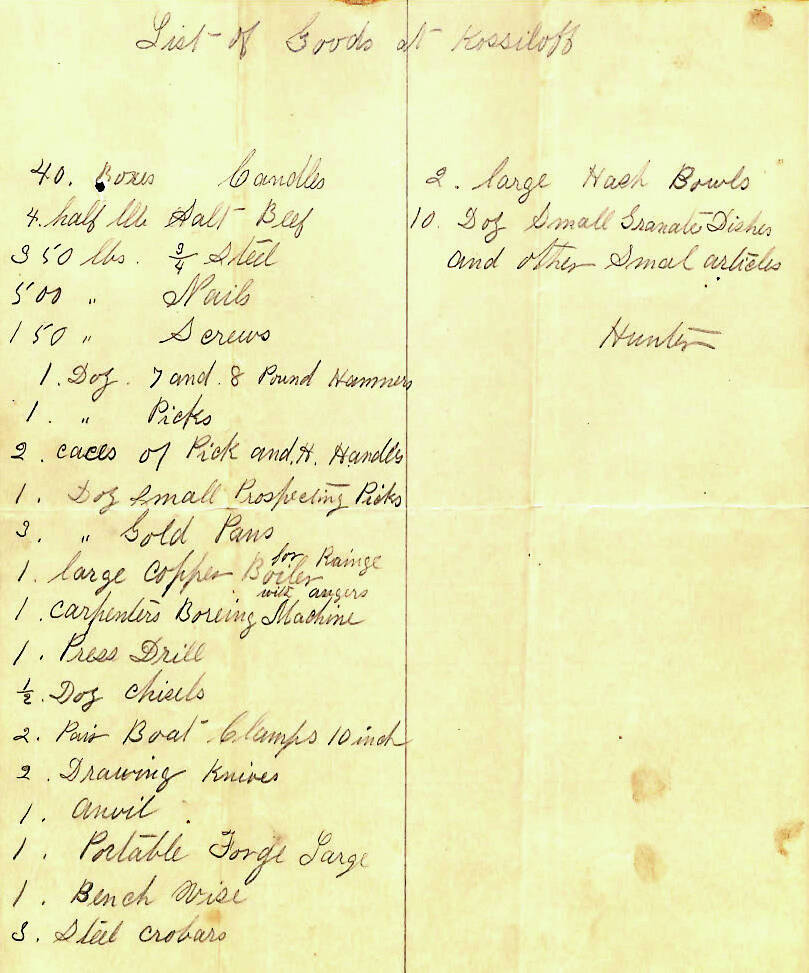
Image from ACC Box 116, Folder 1039, of the Rasmuson Library historical archives In 1899, when William Hunter, of Kenai, learned that the Kings County Mining Company had cashed a large store of goods at Tustumena Lake, he arranged to purchase all of the items and then attempted to sell them to Alaska Commercial Company. This list, which Hunter compiled, is one of few lists of specific items brought to Alaska by the miners.
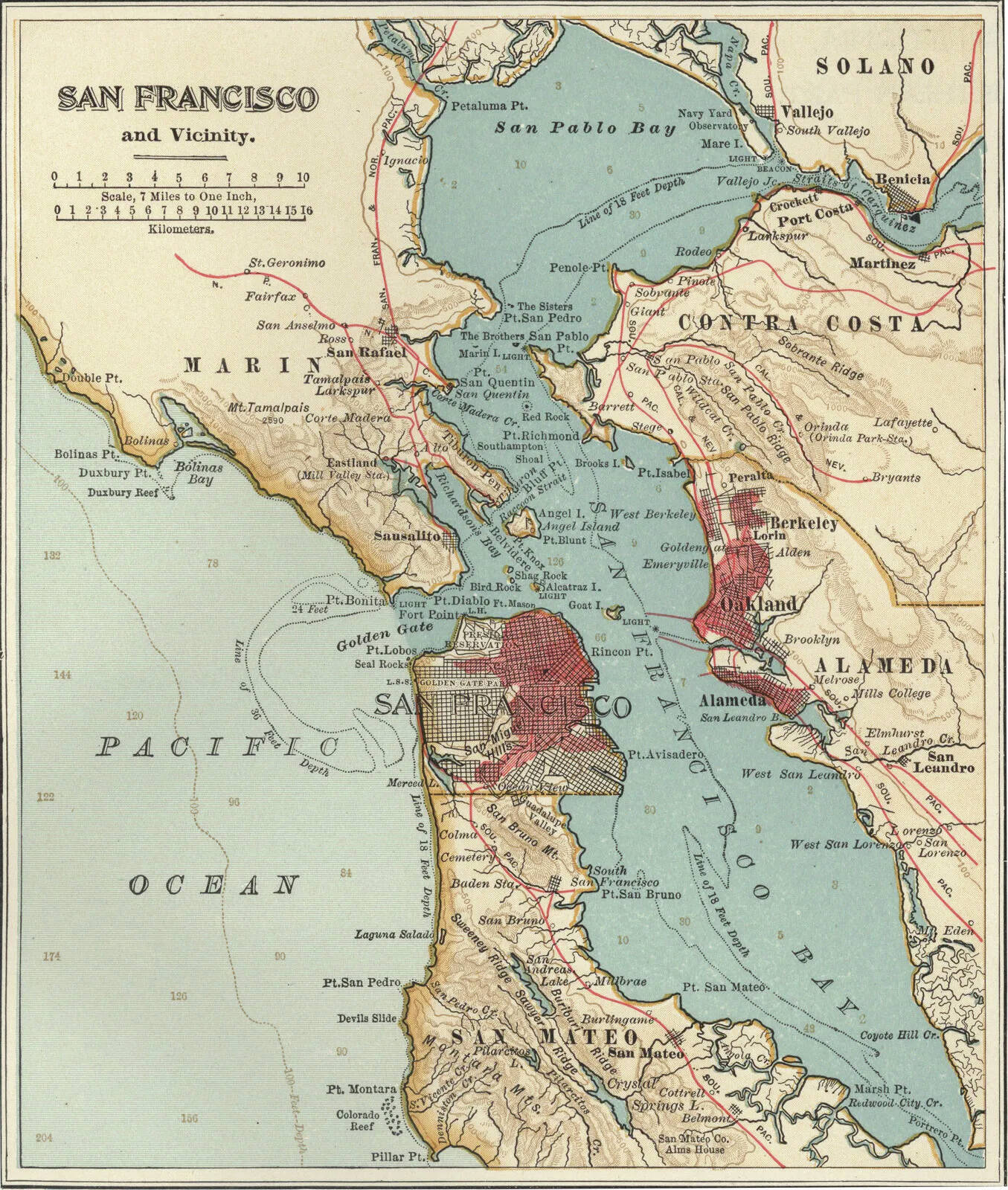
San Francisco Bay and Vicinity map, circa 1900, from the Encyclopedia Brittanica’s online page.
