
AUTHOR’S NOTE: Most of the nearly 60 members of the Kings County Mining Company who had traveled from Brooklyn, N.Y., to Alaska to get rich prospecting for gold in 1898 had departed, sans gold, by late summer 1899. A small number of members stayed or left and came back. At least one member died in Kenai, and one more was grievously ill when he was taken to Tyonek to catch a steamship to the States. The vast majority, however, were gone.
But the stories of their adventures persisted, and the expedition’s after-effects lingered. Locals were intrigued by tales of East Coast miners pushing homemade wheelbarrows and pulling heavily laden sledges across the mountains. They were fascinated by the notion that such a large “community” could spend the winter, and peacefully coexist, in the Skilak wilderness. They looked for Kings County artifacts, followed Kings County trails, and named a stream after the Kings County efforts.
Meanwhile, it appears that none of the miners ever wrote magazine articles or books about their adventure, and by the mid-20th century, nearly all of the miners had died. Consequently, the passage of time and the human capacity for misinformation mangled the remaining shreds of the story and rendered it nearly unrecognizable.
The ship
After the company-owned barque Agate completed its passage from Brooklyn, around Cape Horn to Cook Inlet in Alaska, the plan called for it to enter what was called the “coastal trade.” Since company officials had sold the vessel in San Francisco, the Agate’s coastal work would not benefit shareholders of the Kings County Mining Company.
Also, the miners would have to find another ship to take them home once their two-year expedition had ended. The Agate was off and running, but not without significant challenges.
After dropping off the miners and their equipment near the base of the Homer Spit in mid-October, the Agate was confirmed arriving in Port Townsend, Washington, on Nov. 28; it would soon be heading for San Francisco.
On Jan. 26, 1899, after a storm-filled, 26-day voyage, a battered Agate arrived in the California port, having lost most of its cargo of lumber at sea.
A year later, the ship endured another series of storms sailing from British Columbia to Honolulu. The 48-day passage resulted in water-filled staterooms, a busted boiler, ruined provisions and the exhaustion of its fresh-water supply, requiring assistance (200 gallons of water) from a passing ship.
But two months later, the Agate prepared to join the salmon-fishing “cannery fleet” for the upcoming summer. The vessel had been sold to new owners, overhauled and once again refitted for a new venture.
In 1903, more than 50 members of the mining company sued to recoup money from the initial sale of the ship. A lawyer for the company was caught in a lie when he claimed that the ship had been lost at sea, when in reality it was still operating out of San Francisco.
The Agate sailed until the winter of 1906, when it was deemed too damaged to continue plying the open seas. It was towed into harbor at Astoria, Oregon, with ten feet of water in its hold and its decking removed. By 1910, it lay, waterlogged, on its port side in the mud of Oakland Creek in San Francisco Bay. Two years later — 44 years after its maiden voyage — it was condemned, hauled into open water and set ablaze.
Artifacts of a difficult passage
Almost immediately after residents of the sparsely populated Kenai Peninsula received word of the mining company’s departure from Alaska, the things that company members had left behind began finding new users.
The trail between Kachemak Bay and Skilak was a fresh scar across the landscape and for many years was easy to find and to follow. Many travelers along this route claimed to find caches of food and equipment — including miscellaneous discards of old wheelbarrows and sledges — anything too burdensome to carry forward.
Kenai resident William Hunter, knowing a good deal when he saw one, discovered that a large cache of mining company property had been left at Tustumena Lake, and he arranged to purchase the entire lot from the company. He then freighted all the items down the Kasilof River to the old Humes cannery, itemized his inventory and offered it all for re-sale to the Alaska Commercial Company.
The list included 40 boxes of candles, some granite dishes, gold pans, a large load of three-quarter-inch steel, some salted beef and numerous tools large and small.
Other backcountry travelers grabbed whatever they needed or believed they could sell. When they reached the log cabin at what was becoming known as King County Creek, they found more tools and various other items. They used the cabin for shelter, leaving untouched the charter and by-laws that the company had left behind, while extracting pages from a company diary to start fires in the woodstove.
Trappers took up residence there, as did fox farmers. Hunters and guides stopped by. But maintenance of the old place was minimal and it was probably well on its way to becoming a ruin by 1930.
Meanwhile, the history of the company and all it had left behind slowly faded or became so fragmentary that much of the truth was lost. Reassembling any pieces of this puzzle would require collecting from diverse sources. Many, if not most, of those pieces will probably never be found.
Coda for Mary
Mary Lovett Penney, one of two women in the company, had gone home to Brooklyn, arriving in September 1899. She resumed her nursing career and her role as a wife and as a mother to her five children, some of whom were still in their teens. But Penney could not settle down. She had been adventurous and in constant motion as a child and in her young adulthood. Some had hoped that middle age and rigors of the Alaska expedition would finally calm her down, but those hopes had been in vain.
Although her husband William, nearly three decades her senior, refused to leave his old apartment in his beloved Brooklyn, Mary kept moving. She lived for years and was a nurse in Iowa. She and daughter Geraldine homesteaded in Montana. Then, about a decade after William’s death in 1913, she remarried to Silas Wright Munn, an older, retired farmer and house painter.
The marriage was brief. Whether Mary and Silas divorced is uncertain, but Mary did not stick around. By at least 1930, after many years away from Brooklyn, she was back in New York—but again, not for long. She appeared in the 1931 city directory as a resident of Lakeland, Florida, and that’s where she stayed until the end.
She died on Aug. 31, 1938, in Lakeland, and her remains were shipped to Brooklyn for burial. She was, according to her death certificate, 78 years old, and she had lived a very full life. Her death was attributed to arteriosclerosis and “senile dementia,” with a probable onset in 1936.
In the end, perhaps, the memories of her time in Alaska had faded, the pieces of the puzzle drifting like the snows in the mountains on the trail to Skilak Lake.
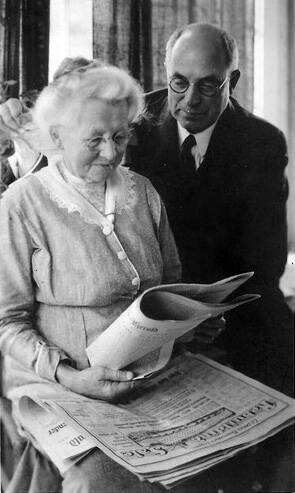
Mary L. Penney and her son Ronald, circa 1930, probably in New York prior to her move to Florida, where she lived out the final years of her life. (Photo courtesy of the Penney Family Collection)
