
AUTHOR’S NOTE: The process of reconstructing the events of history includes weeding out details that are clearly untrue.
This series of articles is, broadly speaking, the story of a boatload of East Coast argonauts, especially one named Mary L. Penney, who sailed into Cook Inlet more than 125 years ago in an ill-fated attempt to find gold and return home wealthy. The myriad misinformation about this expedition began before their ship ever left its New York harbor, continued as it voyaged around the tip of South America, and ramped up fiercely during the first two decades after its rather anticlimactic conclusion.
I have been chasing the facts of this adventure for 35 years.
In the summer of 1990, I first heard about the expedition and learned that some of its original paperwork could be viewed in the Pratt Museum. I was entranced by the tale of gold-seekers being dropped off at the base of the Homer Spit in October of 1898, assured that they could reach the mining areas at Hope and Sunrise by traveling overland, then toting their tons of provisions and equipment on their backs, on sleds and in wheelbarrows.
I drove to Homer, was placed in the museum’s tiny library and was allowed to view a folder of documents. I took notes. I did follow-up research, as much as I knew how to do at the time, and then I wrote about my findings in the Sept. 21, 1990, edition of the Peninsula Clarion.
In so doing, I succeeded in informing the Kenai Peninsula public about this amazing adventure. But what I also did — unintentionally, by relying primarily on second- and third-hand sources — was perpetuate some of the old misinformation.
I reported a seriously low number of participants. I spelled some of their names wrong. I got the expedition’s time of departure incorrect. I made hasty assumptions about the weather, the condition of the seas, and the items carried by the group once its members reached the shore. And on and on.
I got the essence of the tale correct. Many of the details, not so much.
I tried again 29 years later — almost to the day — when I began a two-part effort to set the record straight, again in the pages of the Peninsula Clarion.
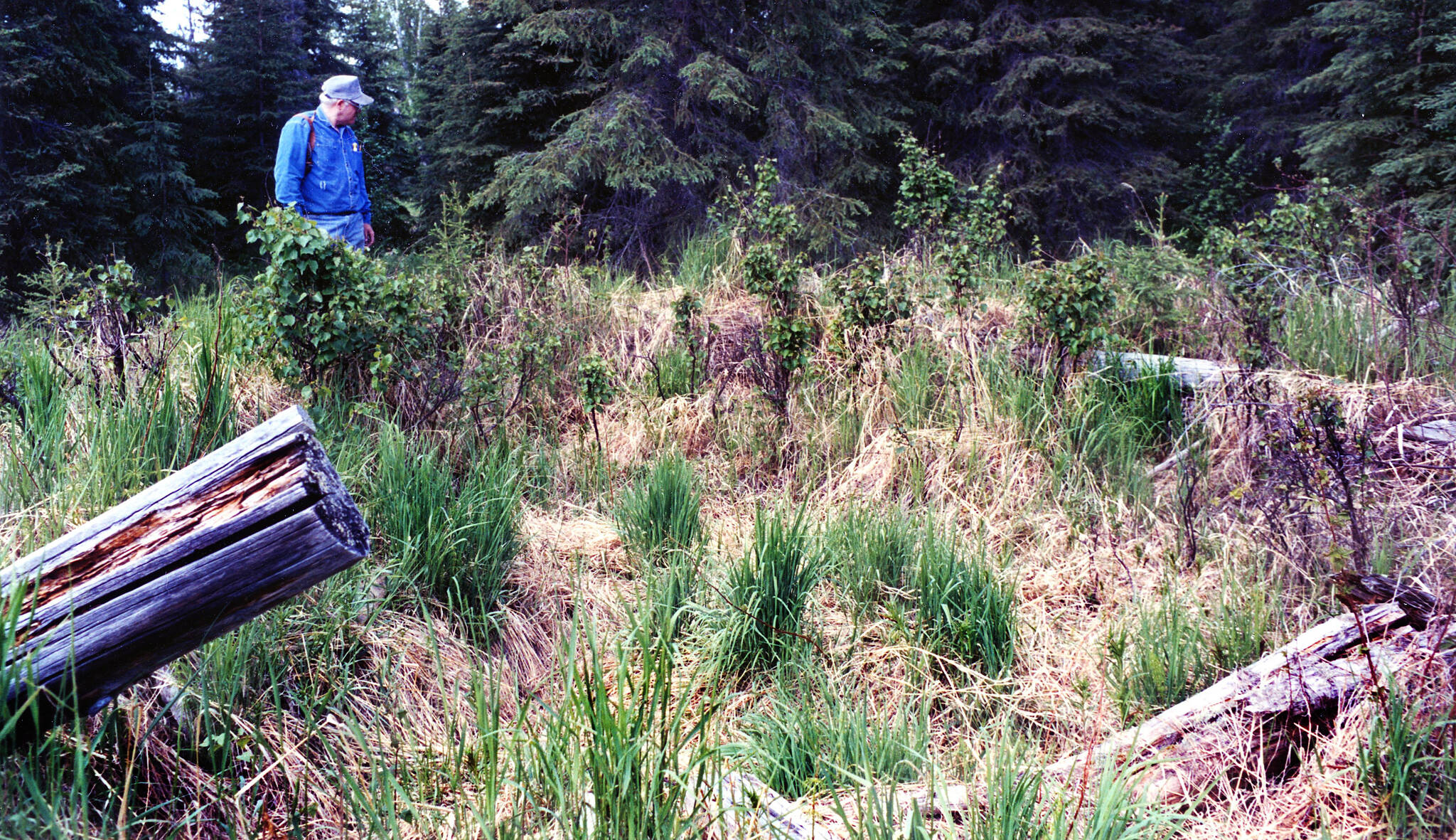
By this time, I had actually visited the site near Skilak Lake where the gold-seekers had built a cabin and spent the remainder of the winter of 1898-99. I also had improved documentation, some photographs of the cabin ruins and a better sense of place.
This written version of the history was a big improvement over my first: fewer out-and-out errors, many more facts, a broader base to the story, and a black-and-white image of one of the key participants. I was pleased with the effort and the outcome, but I still saw serious flaws.
This retelling still lacked personality and a voice other than my own. I wanted to know more about the individuals, the real people, who had actually lived this adventure.
In this third attempt, the biggest change has been the result of good fortune. Through ancestry.com, I encountered a genealogist named Tanya Bogert Allen, who turned out to be the great-granddaughter of Mary L. Penney, one of only two women to make this momentous journey to Alaska.
Tanya was willing to share a prodigious amount of the material she had gathered over the years about her great-grandmother, including accounts written by two of Mary’s granddaughters (Tanya’s first-cousins, once removed).
Mary’s unique story will, I hope, help humanize and clarify many of the struggles encountered by the Kings County Mining Company.
The wrong stuff
It’s important, before jumping into that story, to expose and to dismiss some of the especially egregious falsities about this expedition that have arisen over the years.
To begin with, maps of the central Kenai Peninsula today show that the stream near which the mining company overwintered is called King County Creek. On the earliest maps I have seen, however, it was called Kings County Creek, which is correct.
Later, mapmakers believing that “Kings” was meant to be possessive added an apostrophe before the S. Then the S and the apostrophe were dropped altogether, leading some casual observers to wrongly conclude that the name referred to the county in Washington containing Seattle.
In 1914, a U.S. Forest Service employee named H.W. Fisk delivered to his superiors the results of a timber survey that touched briefly on the Kings County mining expedition. In his survey, Fisk offered speculative reports about the expedition that had probably existed well before he began writing and were then perpetuated for decades to come. He stated that “there was too much ice” in Cook Inlet to justify sailing past Homer, and that the nearly 60 members of the mining camp managed to transport about 50 tons of equipment over mostly trailless terrain from Homer to Skilak Lake, starting in mid-October.
But the stories of the expedition — like fishing tales spun by exaggerating anglers — grew wilder over time. For instance, Bob Huttle, who spent the winter of 1933-34 on Tustumena Lake and listened to many of these retellings, offered in his diary what were surely some of the versions being related back then.
Among Huttle’s errors and speculations — as reprinted in a 2012 book about Huttle’s life — were: (1) tension grew so severe among members of the mining company that they started attending meetings with guns; (2) company members employed dog teams to freight their gear across country; (3) each night they traveled overland, they built a small overnight log cabin for a shelter, creating a string of such cabins from Kachemak Bay all the way to Skilak Lake; and (4) numerous members of the company perished.
In 1938, a biologist with the Bureau of Biological Survey blamed members of the Kings County Mining Company for scattering poison in the area, thus resulting in “the killing out of all furbearers.”
Even Kenai’s Ralph Petterson, the son of mining company member Carl August Petterson, didn’t have his facts straight when he related his father’s story in”Once upon the Kenai (1985): “My dad and 50 other men [wrong] bought a schooner in California [not true] and sailed to Alaska…. They landed at Fox River in Kachemak Bay [incorrect]. They then hauled tons of supplies and groceries across the mountains to Tustumena Lake, then the party broke up [false].”
To be fair, accurately remembering old stories that one’s father told decades earlier can be problematic. Events become conflated, and details are forgotten, misrepresented or misremembered. Ralph Petterson’s father had died at age 64 in 1937; by the time Ralph told his story, Carl had been dead for nearly half a century.
Even the recovery of original mining company documents was not without problems. In November 1966, the Anchorage Daily Times reported that Hjalmar “Andy” Anderson, who had discovered and preserved some important documents, had recently donated them to the Homer Society of Natural History (whose museum was just being built). Although the article did not quote directly from Anderson, it implied that he personally offered information about how and when he found the documents.
The truth is, Anderson had died during the month preceding the article. The donation, made in his name, had actually come from Homer homesteader Yule Kilcher, who had promised his friend Anderson that he would do so.
However, when the new museum was in place and officials penned an explanation of the donation, they stated that Kilcher had provided a history of the documents (a company charter, a set of by-laws and a list of company officers and trustees) on Jan. 4, 1976, nearly a full decade after the donation was made.
Even today, despite diligent research and study, the truth remains fragmentary. To my knowledge, no person who actually experienced the expedition ever wrote a book or even a magazine article about what happened. If such narratives ever did exist, they have slipped quietly into the folds of history.
What follows, then, is the best piecing-together of this mosaic I can manage.
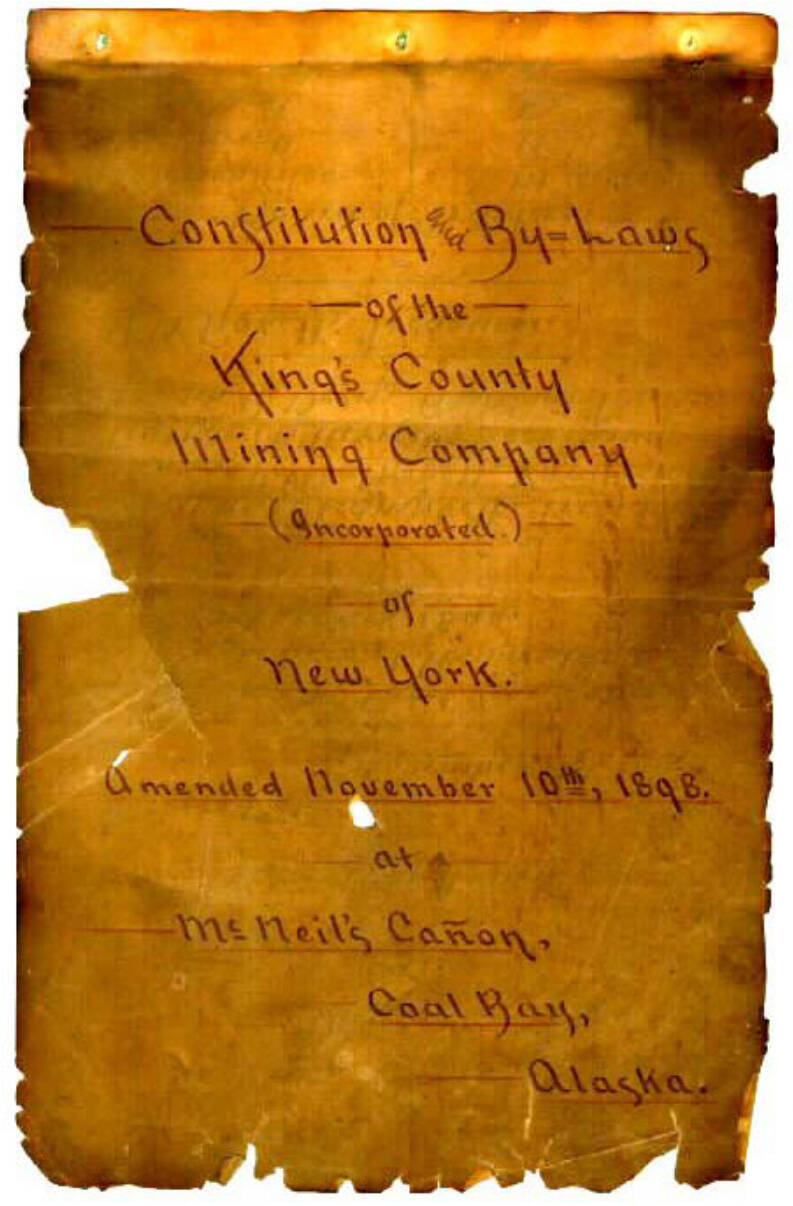
This was the cover page of the Constitution and By-Laws of the Kings County Mining Company, amended on Nov. 10, 1898, at McNeil Canyon on Kachemak Bay. (Image courtesy of the Pratt Museum)
