
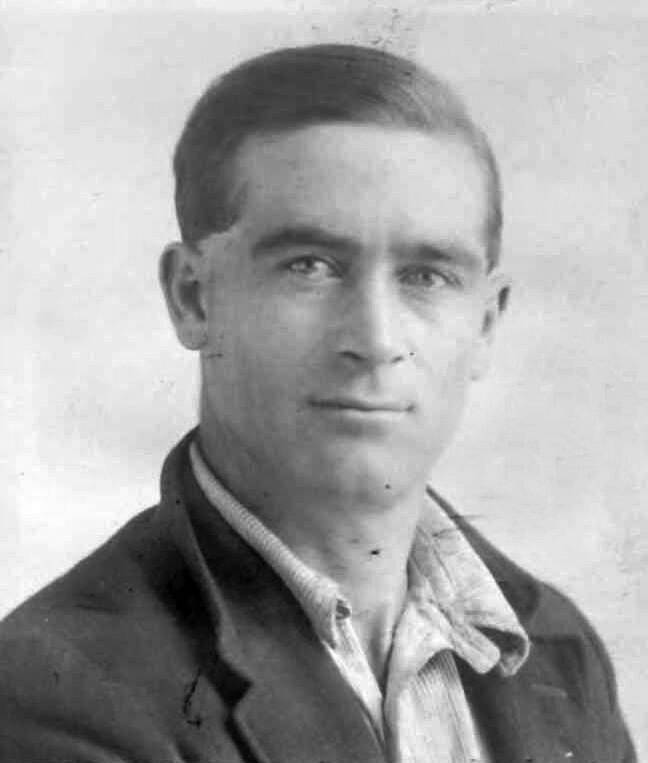
AUTHOR’S NOTE: Floyd Nelson Keeler, eldest son in a family containing 12 children, was arguably the least well-understood of the bunch. He appears to have had an unusual marital arrangement and exhibited some behavior that was difficult for others to explain. He came to Alaska the first time at least as early as 1942 and likely departed for the last time in 1965.
The Vanishing
Speculation was rife after the younger brother of Floyd Nelson Keeler went missing.
According to the first edition of Volume 24 of the World Family Tree (WFT), an early digitized genealogical compilation, George William Keeler had been living with Floyd at Hawk Inlet on the west side of Admiralty Island, near Juneau, when he disappeared on about Sept. 13, 1964.
“George went out to check his traps lines and just never returned,” reported WFT. “Floyd spent many days looking for him but never came across any sign. Floyd always felt that George either fell in the water and the body was swept out to sea … or that George was killed by a bear…. This may explain why no body or any sign of George was ever found.”
Hawk Inlet is a large body of water with a north-south orientation and a rugged coastline, and Admiralty Island is known to have one of the highest concentrations of brown bears in the world, but proof of George Keeler’s demise has remained elusive in the nearly 60 years since he vanished.
A single-paragraph note in the Fairbanks Daily News-Miner on Sept. 18, 1964, said that a seven-man search party had been dispatched to the inlet to hunt for Keeler. According to the Juneau Empire, the searchers were a group organized by the Territorial Sportsmen’s rescue council, which reported that tracks that had been discovered in the woods near Trap Cove (an outer part of inlet, south of the Hawk Inlet Cannery) and were being followed.
A week later, the news was less optimistic: Bud Boddy, a leader of the Territorial Sportsmen, reported that the search for George Keeler had been discontinued. “Three search parties have probed the area where Keeler was last seen,” said the Juneau Empire, “but to no avail.” The rescue council promised to restart the search if new information about Keeler’s whereabouts came to its attention.
But new information apparently never materialized. Even now, however, the marker on his grave in Coos County, Oregon, says, “GEORGE W. KEELER, 1904-1964, MISSING IN ALASKA.”
Instead of information, the Keeler family was left with speculation.
Cecil “Spek” Jones, longtime Homer-area resident and the husband of George and Floyd’s niece, Ina (Keeler) Jones, said he recalled hearing that George’s boat had been discovered up a nearby creek. In the boat, searchers had found George’s rifle and his backpack. It was thought, said Spek, that George had taken his boat upstream and then walked away from it but never returned.
David Williams, longtime Soldotna resident and the husband of George and Floyd’s niece, April (Keeler) Williams, recalled the situation differently: “There was a woman involved,” he said. “I don’t know if it was Shorty’s wife or what.” (Uncle Shorty was Floyd’s family nickname, a reference to his 5-foot-4 height.) “I remember there was a woman there,” added Williams, “and I think (Floyd and George) got in an argument over the woman.”
Some family members conjectured that George, rather than going out to “check his traps,” might have taken off because of the argument with Floyd.
Nothing about an argument or a boat containing George’s personal items has yet been found in newspapers or other documents of the time.
However, it is worth noting that the WFT reference to a trap line seems problematic. September is hardly an optimal time for trapping because fur quality is not yet at its peak. It is possible that the reference was mistakenly applied to fish traps, which had been made illegal with the advent of statehood in 1959 but were still around in some areas until they had been officially decommissioned.
Hawk Inlet, in those days, was known primarily for its cannery and mining operations.
Retired Alaska State Trooper Norm Carson, after conferring in 2023 with an old friend named Andy Pekovich, learned that his friend’s father, W.S. “Sam” Pekovich, had owned at least two mining claims in Hawk Inlet and had, on occasion, hired George Keeler as a winter watchman. It is possible that Floyd, too, may have worked for the elder Pekovich.
Andy Pekovich also indicated that George Keeler, as a watchman, may have stayed in a cabin belonging to the mine at the head of Hawk Inlet. The cannery and the fish trap operators also employed watchmen, usually giving them a cabin for shelter during the off-season periods.
In June 1965, nine months after his brother’s disappearance, 77-year-old Floyd Keeler left Hawk Inlet and moved back to Oregon, announcing plans to live in Astoria. A one-paragraph notice in a Coos Bay newspaper said that Floyd had lived at Hawk Inlet for the previous 13 years.
Pre-Alaska Days
According to family lore, Floyd Keeler met Edith Lillian Connor on a blind date in early November 1913 and married her two weeks later. Both Floyd and Edith had been born in 1888, and by 1926 they had had eight children together — five sons and three daughters.
One son, named Samuel after Floyd’s father, died before his fourth birthday, and one daughter, named Pearl, also died in childhood. Of the six children surviving to adulthood, two perished in accidents: Jack, while employed in a logging camp in 1953, and Charles, who died from injuries received in a 40-car pileup on Interstate 5 in 1968.
Of Floyd’s four remaining children, Bob lived into his 70s, Myrtle and Ernest into their 80s, and Charlotte into her 90s.
Their first three children had been born in the mid- and late 1910s, a time during which Floyd was employed as a railroad engine hostler, another term for railyard engineer, whose job it is to move locomotives between tracks to keep trains organized and on schedule. Hostlers also drive trains to and from maintenance shops and prepare them for locomotive engineers.
Although Floyd and Edith were married for more than half a century, they seemed to spend an inordinate amount of time apart.
In the fall of 1942, 54-year-old Floyd quit his job with the Westside Lumber Company in Eugene and left his family in Oregon to go work on the Alaska Highway construction project. Where exactly he worked and when he returned home is unclear, but the time he spent in the north seems to have inspired him to consider a new home in Alaska.
In 1947 — again leaving Edith behind— Floyd moved to Alaska to homestead. Accompanying him, in her stead, were sons Bob and Jack and daughter Myrtle, apparently along with Bob and Myrtle’s spouses and children. Floyd’s kids and their families were all back in Oregon by 1950, but Floyd himself lingered in the northland.
He had returned to Oregon in 1948 long enough to join his brother Lawrence, sister-in-law Lorna and their family in moving to the southern Kenai Peninsula. He was still on the Kenai in June 1951 when he signed as a witness to Alex Petrovich’s final homestead proof in Naptowne (now Sterling). But he was back in Oregon in 1952, long enough to pose for a photograph with Lawrence and family when they visited the Keeler matriarch, Samantha, then in her late 80s.
Later that same year, however, he appears to have joined his brother George at Hawk Inlet — again without his wife. Even when Floyd returned to Oregon for good in 1965, he announced plans to live in Astoria, about as far north of Edith as it was possible to get while remaining in the same state.
Yet, when Edith died in Port Orford, Oregon, in 1968, Floyd was listed as both her husband and a resident of the same town. He died there, too, eight years later at the age of 88.

Photo from findagrave.com George Keeler’s grave marker emphasizes the lack of closure concerning his death.
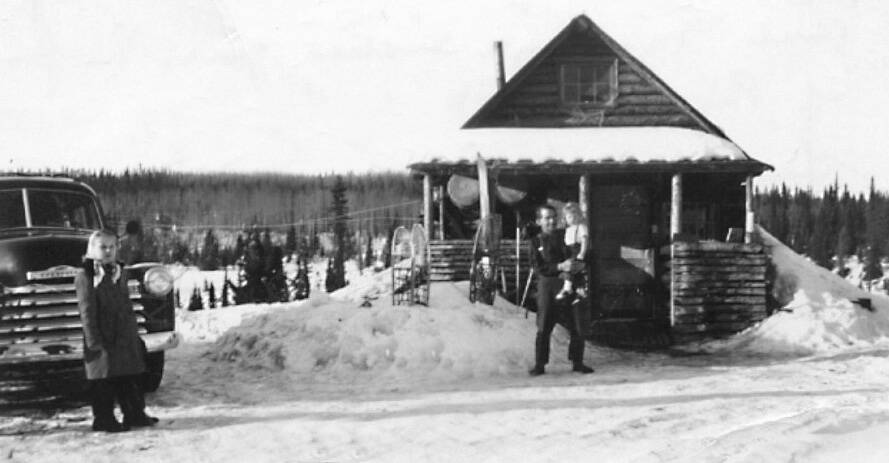
Ray Sandstrom photo courtesy of the KPC historical photo archive Floyd “Pappy” Keeler, standing in 1951 in front of his cabin on the homestead of his son Jack, is holding a girl who is likely Barbara Sandstrom, while her sister Rhoda, standing by a truck, looks on.
