“Into the Woods”
Disney Enterprises
2 hr 5 minutes
There are musical people and then there are people who can handle a level of “musicalness” in a production to varying degrees, based on their tolerance. And then there are people like my mother-in-law who exclaimed frustratedly when I expressed disbelief that she knew absolutely nothing about the plot of “Annie,” “I told you, I don’t watch musicals!” She, needless to say, declined to come with us to see this week’s “Into the Woods.”
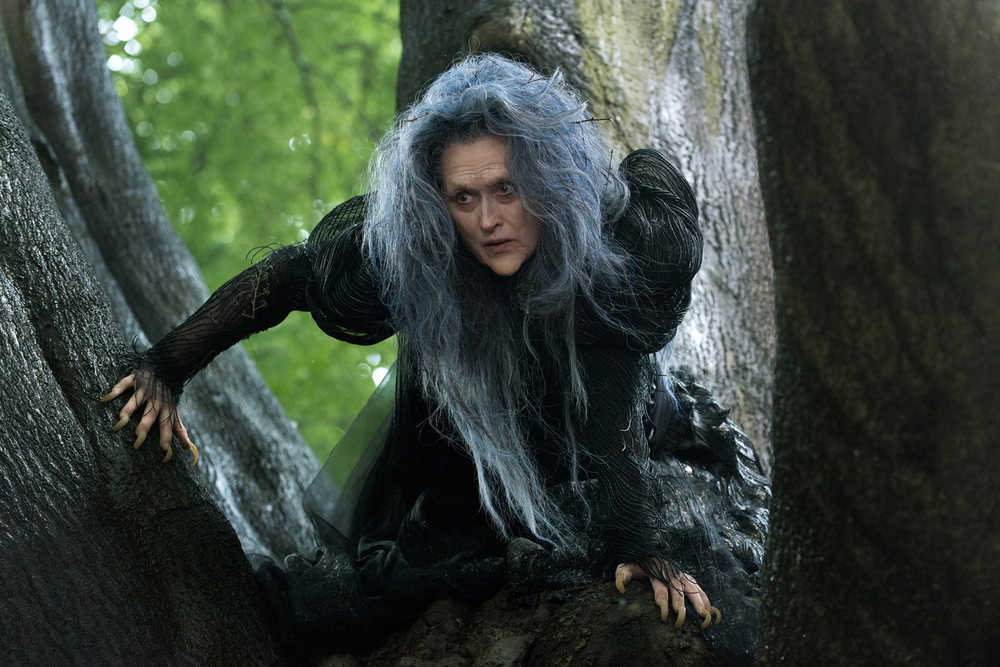
“Into the Woods” is based on Stephen Sondheim’s hit Broadway musical from the late eighties – or so Wikipedia tells me. I had heard of it, but I couldn’t have told you a thing about it, let alone whistled a tune from it. After seeing the film, I’m a little surprised the play isn’t better known – I found the music better than “Phantom of the Opera,” and the plot at least twice as interesting as “Les Miserables.” (I admit to liking neither of those shows, so I suppose that knocks me a few notches down the musical tolerance scale.) The story involves a childless baker and his wife and how their travails with the vindictive witch next door send them careening into the narratives of Red Riding Hood, Cinderella, Rapunzel, and Jack and the Beanstalk. It’s interesting to imagine these characters as all being contemporaries considering that each of their parables are self-contained. The woods are where Granny resides, where Cinderella flees her Prince Charming, where Rapunzel’s tower is hidden, and where Jack sells his cow for magic beans. It’s the witch that ties the tales together, having cursed the baker’s house to be childless in retaliation for an indiscretion on his father’s part. In order to lift the curse, she must have a blood red cloak, a milky white cow, a lock of yellow hair, and a slipper of pure gold (not glass – I guess that would have been difficult to do on stage). You can see where this is going.
There are lot of musicals I like, everything from full-on opera-style musicals like “Evita” to fun rock ‘n rollers like “The Blues Brothers.” What’s hard about some musicals is the awkwardness of having characters break into song for no apparent reason. It’s goofy sometimes, like in “Oklahoma” or “Paint your Wagon,” but it’s all part of the experience and you just have to go with it. A production like “Into the Woods,” has it easier, I think, because it is so allegorical. Certainly each of those above fairy tales were meant to carry a certain moral lesson, but the entire script of “Woods,” is meant to be looked at less as a literal story and more as a symbolic journey from pre-adolescence through young adulthood all the way up into maturity. The “woods” are representative of life itself, and the dangers therein are the dangers we all face as we grow. And this isn’t just me being a hoity toity movie critic, finding deeper meaning in every longing glance – it’s pretty obvious. Just listen to Cinderella dithering about whether to go with the Prince where she may be happy but everything is unknown, or to stay home where she knows she’s unhappy, but everything is familiar and safe. And just in case you weren’t convinced, listen to Johnny Depp singing to Little Red Riding Hood as the Big Bad Wolf. He leaves little to the imagination about what his true intentions are.
The music in “Into the Woods” is fully-integrated and moves the plot along, not really lending itself to stand-alone listening. It’s good, but not necessarily catchy. It is well-performed, however. Aside from Depp, who had a little too much Jack Sparrow in his rendition, all the singing is top-notch. Meryl Streep, as the witch, proves once again that no role is impossible for her, and Anna Kendrick, as Cinderella, proves that her starring turn in “Pitch Perfect” was no accident. I especially liked Emily Blunt, as the baker’s wife. Blunt is one of my favorite actresses, but I didn’t know she could sing, too. I should have guessed it. Chris Pine was probably the biggest surprise, however. As Prince Charming, his singing voice has a surprising goofy theatricality to it, almost Shatneresque, ironically, and it fits the character perfectly. If you have young children, you will likely recognize the voice of James Corden, the baker, as that of the mouse from the delightful animated adaptations of Julia Donaldson’s “The Gruffalo” and “The Gruffalo’s Child.” I just kept waiting for him to say, “Silly old fox – doesn’t he know? There’s no such thing as a Gruffalo.”
I very much enjoyed “Into the Woods.” At times the allegory is a little too on-the-nose, but overall the story is entertaining and gives you something to think about. If you are planning to bring the little ones, however, be forewarned – this isn’t the Disney version of the tales. The second act of the play is about what happens after Happily Ever After, and it isn’t always so happy. Such is life, however, as we all go into the woods. Grade: A-
“Into the Woods” is rated PG for mature themes and some frightening images. Younger children will be confused by most and frightened by some of the scenes, but middle-schoolers and older would probably be able to appreciate the dual nature of the narrative.
Chris Jenness is a freelance graphic designer, artist and movie buff who lives in Nikiski.
