
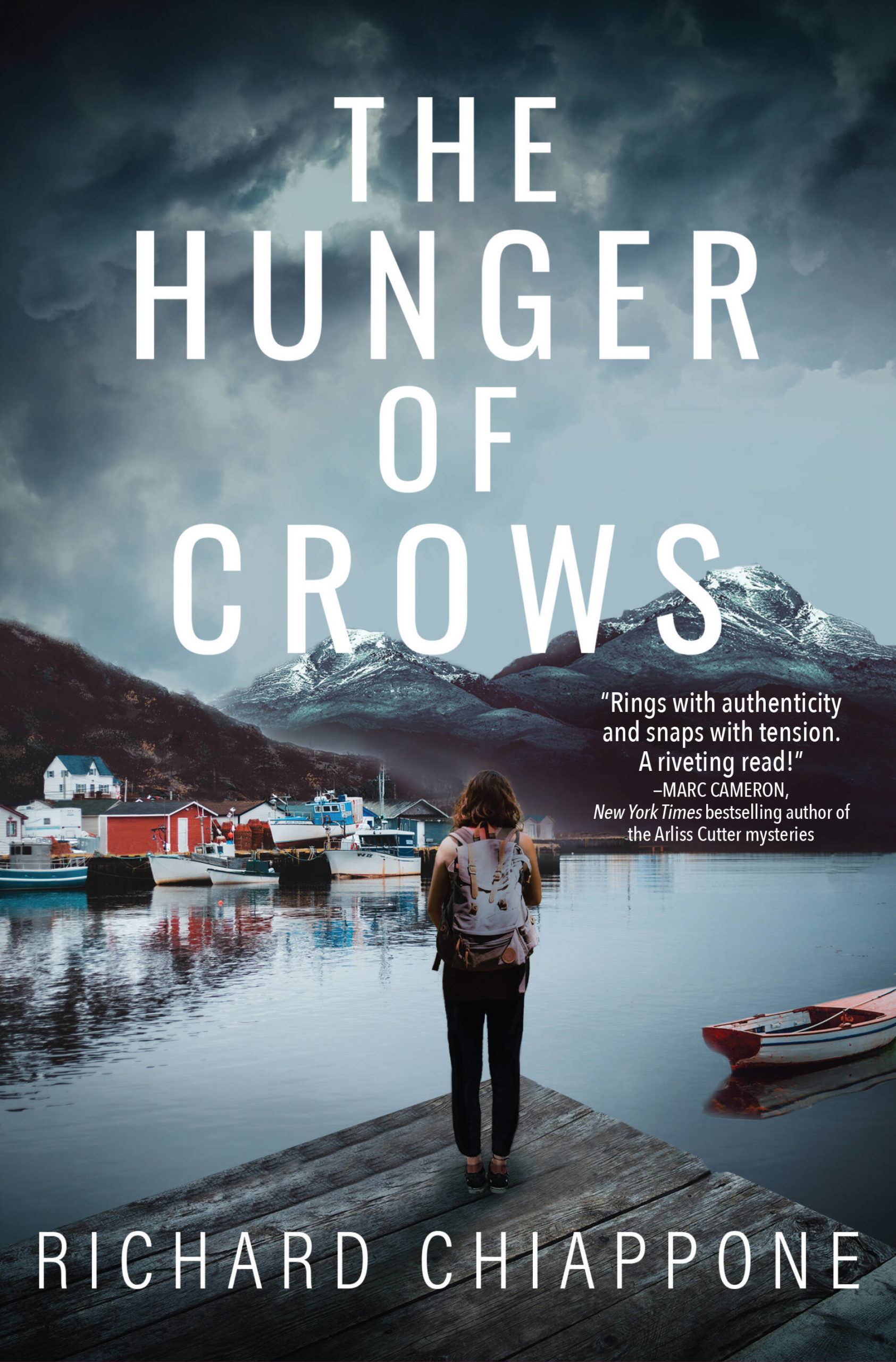
With the mercury plummeting to the single digits, give or take the minus sign, it’s time to throw another log on the fire and curl up with a good book. Homer author Richard Chiappone’s break-out novel, “The Hunger of Crows,” is the perfect warmer-upper.
With the novel taking place on the southern Kenai Peninsula, Homer readers will get a good laugh from the literary freedom Chiappone takes with the setting. Anyone who has spent time on either side of a bar at any of Homer’s watering holes will chuckle at the tangled web his cast of characters weaves. Mariners, both sport and commercial, will appreciate boating references and sea conditions that are woven into the plot with the precision of a seasoned net-mender.
For readers from outside the Homer area, who have never been on the Kenai Peninsula and only dreamed of coming to Alaska, Chiappone’s cast of evil-doers, heroes, do-gooders, beauties and the ridiculously clueless will be inspired to hop the next flight north with hopes of having the same outlandish adventures as main characters Carla, D’Angelo, Shire and Scott.
Skilled at shorter writing endeavors, Chiappone invested 10 years and hundreds of revisions pulling together pieces from past writings, combining, expanding, fine-tuning and resurrecting them with a breath of fresh, salty air. The resulting novel is devoid of lengthy, back-story paragraphs that make even the most dedicated readers yawn and seriously consider setting a book aside.
“Short stories teach you to be very economical. You’ve got to make everything count, so my inclination is to make everything matter,” said Chiappone in a phone interview while he was recently visiting Arizona.
He knows whereof he speaks with three already-published works — “Liar’s Code,” “Opening Days,” and “Water of an Undetermined Depth” — comprised of essays and short stories.
“In a novel you’re allowed to sprawl, which is one reason I don’t read a lot of novels. I find they drag on sometimes and there’s all this filler,” he said.
Chiappone’s default to the short-story format wasn’t easily left behind.
“I kept writing stand-alone chapters that were like short stories. My agent and publishers went crazy, saying I had to keep the story going,” he said. Creating a common thread that bound those separate pieces together was the key.
Was using Homer as “The Hunger of Crows” main setting a concern, possibly exposing the book and author to criticism from stick-to-the-facts fanatics? Originally, Chiappone used another name for the town based on Homer.
“The publisher thought we should use the real name, and I had to go back and rewrite a few scenes, but I made a point at the beginning that it’s not accurate in all aspects. I didn’t want to be held to factual accuracy,” said Chiappone.
True indeed. An “author’s note” preceding page 1 excuses Chiappone for varying levels of literary liberty that were “taken for the sake of storytelling and in the interest of privacy. … Any resemblance to real places or people — living or dead — is pure dumb luck.”
So, when locals read about dipnetting at Goat Cove or think Chiappone’s misplaced the harbormaster’s office or that he’s based the Orca Grill on a favorite hangout, forget it. It’s the world at Latitude 59 as fits the plot.
On the other hand, there are references to Subarus that will have hard-core Homerites nodding their heads. Knee-high brown rubber boots are mentioned with enough frequency to hook any Alaska coast-dweller. And Italian food finds it way into the story enough times to make any Italophile drool.
Chiappone was working as a wallpaper hanger in Anchorage when the state spiraled into a recession in the mid 1980s. With money short, getting new wallpaper was low on people’s priority list, so Chiappone was left without much to do. On a lark and having never written anything, he submitted a story in an Anchorage Daily News writing contest and it received honorable mention. That led to enrolling in a writing class at the University of Alaska Anchorage and, at the age of 45, earning a Master of Fine Arts degree in writing. The following year he began teaching writing workshops.
In addition to his collections of essays and short stories, Chiappone’s writing has found its way into national magazines and anthologies, been recognized with the Robert Traver Award twice, and one of his stories was made into a 20-minute short film viewed at international film festivals. His writing has been performed on BBC Radio, he’s been the Alaska Quarterly Review’s senior associate editor and “had the lifetime thrill and honor” of helping organize Kachemak Bay Writers Conference for 18 years.
With one novel under his belt, Chiappone is hard at work on more.
“It’ll be another Homer story and there may actually be some characters showing up from ‘The Hunger of Crows,’” he said.
Chiappone and Tom Kizzia, author of “Cold Mountain Path,” will do a reading at the Homer Public Library at 6 p.m. Dec. 10 and 11. They will discuss the pros, cons and benefits of writing about Alaska in fiction and nonfiction and sign copies of their books. Due to COVID-19 precautions, seating is limited to 25 people and reservations are required. The readings also will be available on Zoom. To sign up or get Zoom log-in information, visit https://www.cityofhomer-ak.gov/library/author-talk-tom-kizzia-and-richard-chiappone.
In January, Chiappone will do a reading at Writers Block in Anchorage.
“The Hunger of Crows” can be found at The Homer Bookstore and on Amazon in hardback, Kindle and audiobook format.

Homer writer Richard Chiappone. (Photo by Joshua Veldstra)
