
Something else about the marshal
Many people with an eye for Kenai history know the name of former U.S. Deputy Marshal Allan Petersen, but there’s one thing — from more than a century ago, when Anchorage was barely out of its Ship Creek swaddling clothes — that most folks probably don’t know at all: In his late 20s, Petersen was a championship wrestler.
His daughter, Peggy Arness, still has the coin-sized medal to prove it.
According to “Once Upon the Kenai,” Petersen, who was born in 1890, left a teaching career in California in 1914 to join his father in Alaska and look for a better job. After working initially on an Alaska Railroad survey crew, he used his newfound railroading skills for the U.S. Army in France during World War I.
Upon his return to Alaska, he briefly resumed teaching, this time in Seldovia, where he met and married another teacher, Jetret “Jettie” Stryker, the sister of Enid (Stryker) McLane, for whom the first Kenai Peninsula Community College building was later named.
In Kasilof, and on Kachemak Bay, in Seldovia and later in Unga, Petersen worked various jobs — as a fox farmer, herring fisherman, clerk in a general store, store owner and United States commissioner — before being appointed deputy marshal in 1934. He was stationed as a marshal initially in Unga and then was transferred to Kenai in 1946.
Petersen retired from his post in 1953 and then was elected in 1959 to be a member of the first State Legislature. He died in May 1969 and was buried in Spruce Grove Memorial Park in Kasilof.
In his younger days, said Arness, her father enjoyed using his “very large strong arms” in displays of strength. In the 1930s and 1940s, she said, “(he) would often arm wrestle with guys in bars, just for fun, as he made his rounds as marshal. Alec Wik (Sr.) was bound and determined to crash him but never did.”
Prior to these arm-wrestling days, however, Petersen was an adept wrestler. In fact, a staged photo of him in action, and an article mentioning his prowess on the mat, graced the pages of the Anchorage Weekly Democrat newspaper on Feb. 16, 1918.
According to the brief article, Petersen had earlier been victorious in a wrestling competition at a smoker — a popular men’s-only social gathering common in the early to mid-1900s, typically held on the grounds of a private charitable club, and usually in a haze of tobacco smoke.
At the smoker, Petersen had defeated an opponent named Hegstrom, and the paper said it also expected him to fare well against his next foe, a “Mr. Kincaid”:
“While Kincaid (is) giving away some weight, the match promises to be fast, as Petersen has demonstrated to the fans of Anchorage that he is there with the good, and the easy manner in which he handled Hegstrom, considered a good man and a hard one to beat, proves conclusively that he understands the game from all angles.”
The Petersen-Kincaid match was held during the second anniversary celebration of the organization of the Alaska Labor Union in Anchorage. The union, run in part by Socialist activist Lena Morrow Lewis and made up mainly of railroad workers, hosted the smoker on Feb. 25, and once again Petersen emerged victorious.
Arness still keeps her father’s small engraved medal on the end of a thin chain and wears it sometimes as a necklace. She also keeps an original copy of the newspaper clipping, which shows her bare-chested and muscular father, head down, with a leg-and-toe hold on an apparently overmatched opponent.
Boone & Crockett, unexpectedly
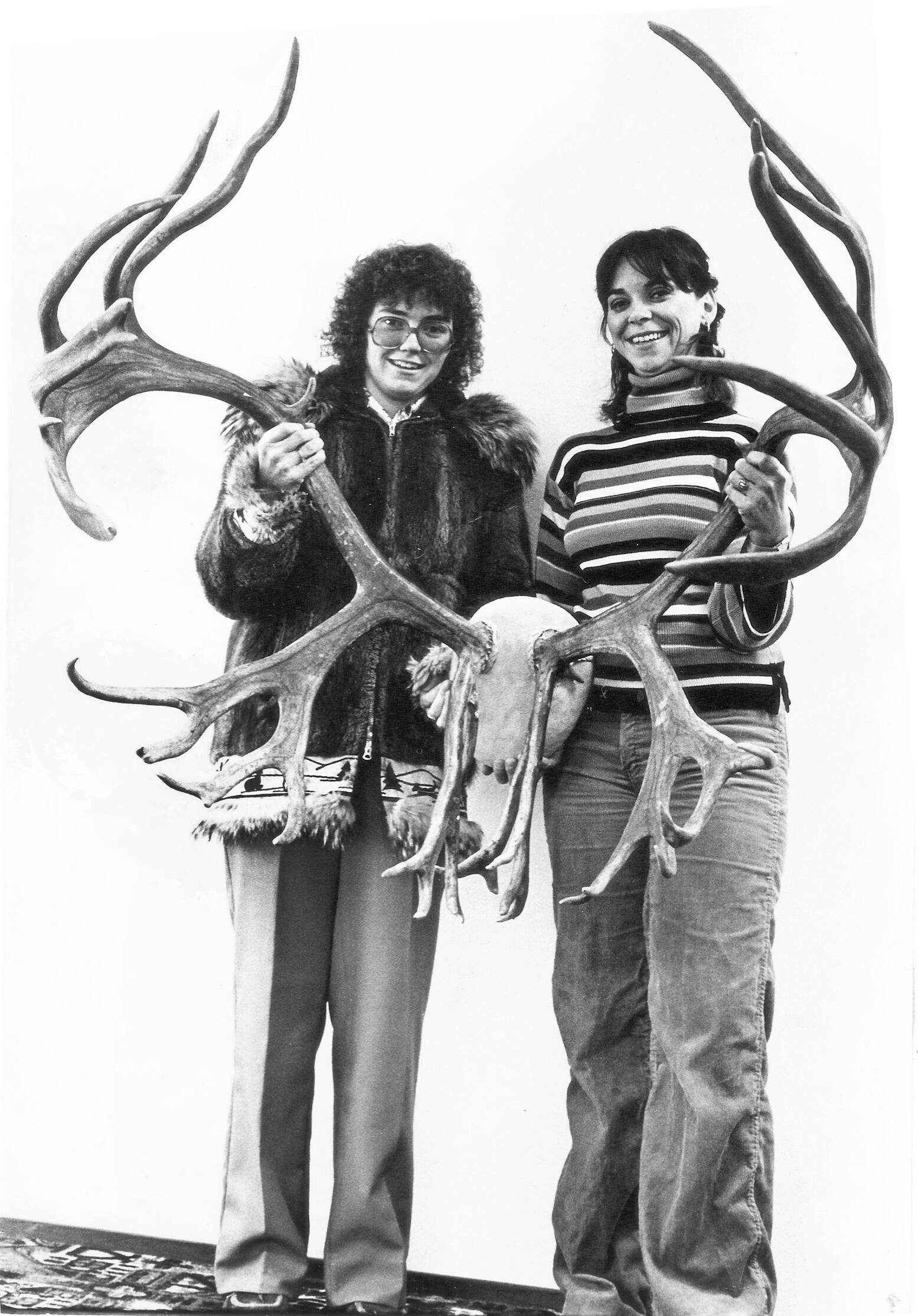
By holding on tightly and walking in a circle around the body, the two sisters were able to twist the spine, winding it somewhat like the rubber band on a balsa-wood airplane, until the head popped neatly off and the prize was theirs.
The sisters, Marcia and Mary Alice Grainge, had never intended for this winter day in 1972 to involve a head-hunting expedition. In fact, it had begun as volunteer work.
The Cheechako Ski Benders Club was preparing for a snowmachine race, and the Grainge girls were out helping to mark trail. From their family home on the north shore of Sports Lake, they had driven out on a pair of snowmachines, an Arctic Cat and an old 12-horse Ski-Do pulling an ahkio, a narrow, runnerless, low-riding sled convenient for trail use because of its shape.
The ahkio had been modified with tubular bars on the sides to allow it to hold a larger load, and on this particular day, as they traveled over deep snow in minus-15-degree weather, the sled held a number of trail signs. About eight miles from the house, they stopped along Marathon Road, near Kenai, to do a little trail marking.
As they worked, Marcia spotted something curiously smooth and spiky protruding from the snow a short distance away. In her one-piece, zip-up blue snowsuit, white helmet and Sorels she ambled nearer, and she realized she had been looking at a piece of an antler. With Mary Alice’s help, she began to dig.
What Marcia had suspected was a dropped caribou antler turned out to be a very large dropped caribou antler. It also turned out to be attached to the skull of a very large dead caribou bull. Except for the single tine that had been poking out, the entire body of the animal and both of its antlers had been buried beneath at least 2 feet of snow.
Once the upper carcass was exposed, the sisters could see that the body was badly decomposed and had probably been lying on the spruce-dotted tundra for quite some time before winter had dropped it into the deep freeze.
“There was no hide on the skull,” Marcia said. “It was totally bare and brownish-white.”
Determined to keep their prize, each sister grabbed an antler and began to move in a circle around the head. “Not a normal way to harvest antlers,” Marcia said.
After they had detached the antlers and skull from the rest of the body, they lugged their massive trophy over to their ahkio, wedged it into the sled, fastened it to the side rails with a piece of rope, and headed for home. “But we had to keep checking it because the trail was rough, up and down, bouncing, etc.,” said Marcia.
The antlers sat in their parents’ garage for a number of years before someone suggested having them measured. Eventually a representative from the Boone & Crockett Club traveled to the Kenai Peninsula and performed the official measurement.
The representative determined that the antlers scored 440 2/8 with a double-shovel, enough to enter them into the “Found” section of the Barren Land Caribou record book with a ranking of 58th largest in the world — a ranking they continue to hold.
Later, the antlers were mounted professionally and displayed in the home of Marcia and her husband, Rich King. In 1990, when Marcia and Rich relocated to Kauai, they gave the antlers on a temporary loan to the visitor center in Soldotna.
About 20 years later, the sisters told center officials to make the antlers a permanent part of their collection. The antlers are still there for public viewing, with a somewhat shorter version of the story of their discovery.
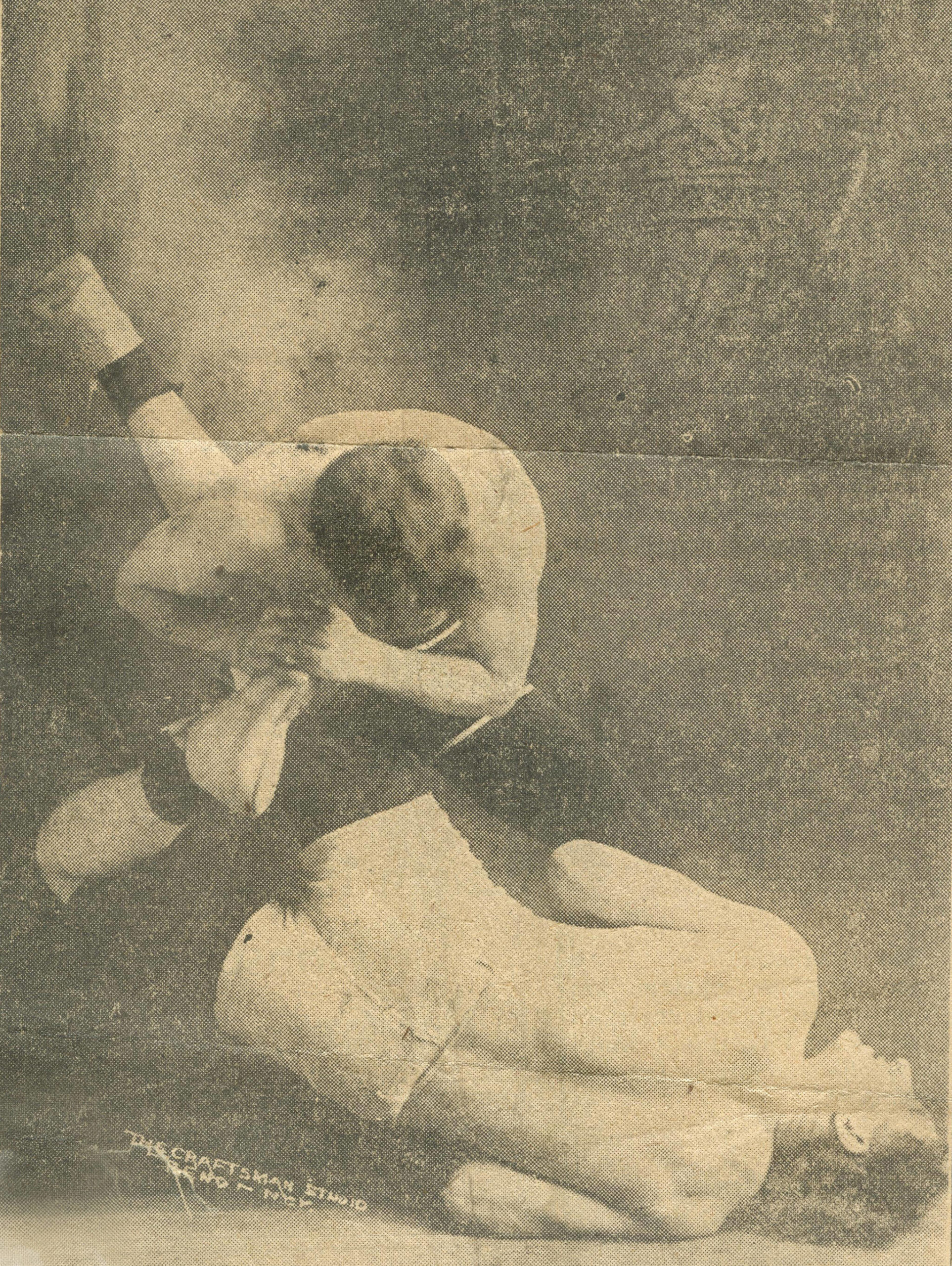
Photo provided by Peggy Arness This photo of wrestler Allan Petersen appeared in the Anchorage Weekly Democrat on Feb. 16, 1918. Years later, Petersen served as U.S. deputy marshal in Kenai.
