
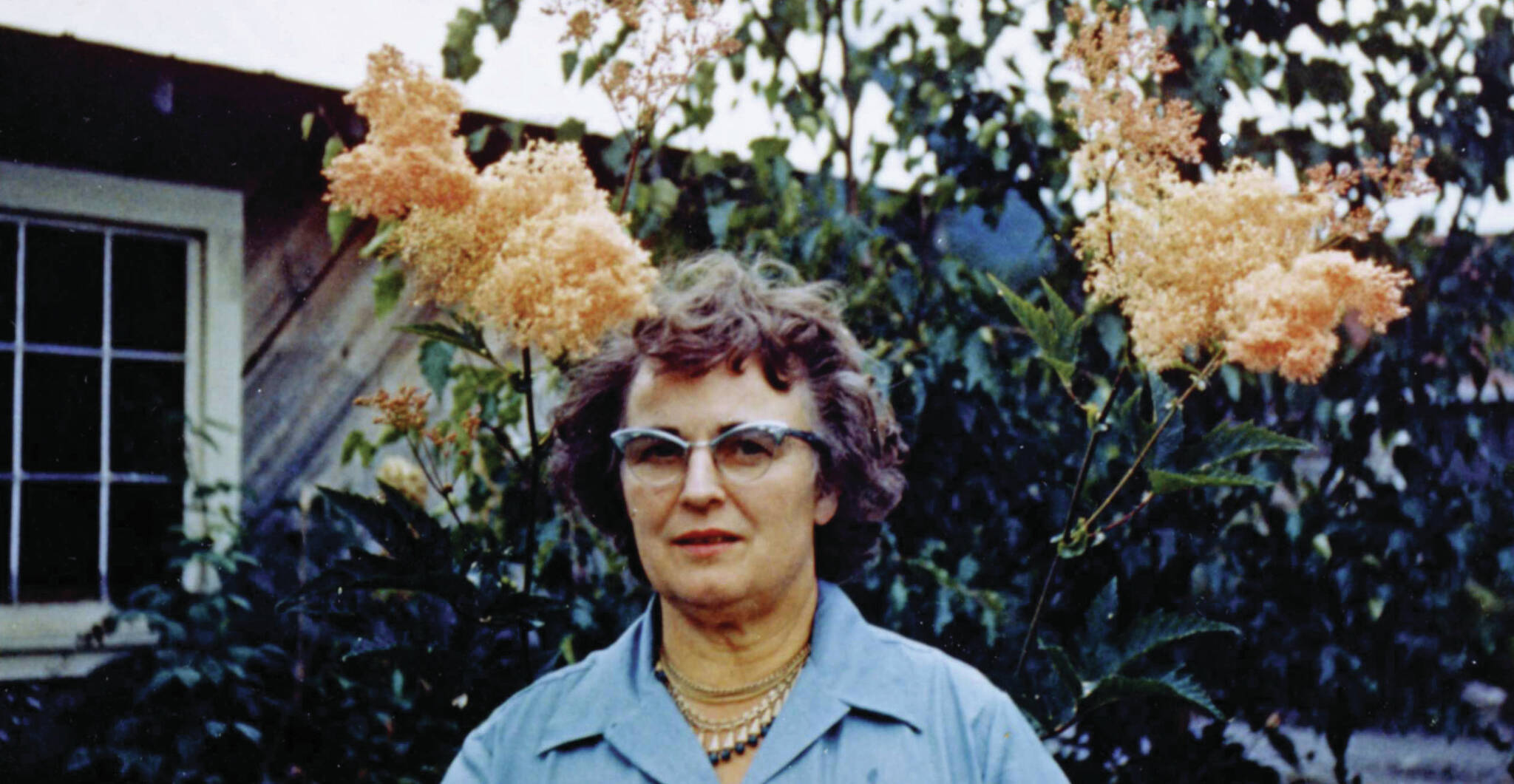
AUTHOR’S NOTE: Warren Melville Nutter spent the final 32 years of his life on the Kenai Peninsula, working mainly as a trapper, a mail carrier and a longshoreman. His work became part of the legacy he left behind.
No evidence has yet been uncovered to indicate how soon after arriving on the Kenai Peninsula in the summer of 1930 that Warren Melville Nutter began trapping. In fact, the earliest known reference to Nutter as a trapper appeared in December 1935 when the Seward Gateway reported on his early season success.
In a June 1936 Alaska Sportsman Magazine article penned by Nutter himself, he mentioned his already established trap-lines and his two trap-line shelters—his Hidden Creek Cabin on the west bank just upstream from the mouth of the creek where it entered Skilak Lake, and his Hidden Lake Cabin near the southern shore of the big lake’s western half.
It seems likely that he constructed these two spruce-log shelters no later than the summer of 1935. Since he was living near the railroad tracks four miles north of Seward during the 1930s, his access to the Skilak area would have been fairly straightforward and quick by the standards of the day.
The Hidden Creek Cabin stood until 1984, when it was deemed a “nuisance” structure and was dismantled by a Youth Conservation Corps crew under the direction of administrators from the Kenai National Wildlife Refuge. For at least the previous decade, the refuge had offered the cabin as a public-use shelter.
When he was a backcountry ranger for the refuge, Gary Titus, using a map created by former Skilak homesteader Hjalmar “Andy” Anderson, attempted to locate the Hidden Lake Cabin but discovered no trace of the structure. Titus did find what he considered a good cabin location, with level ground and a few cut stumps.
According to refuge records, the last trapper to have a special-use permit to use the Hidden Lake Cabin was probably James “Big Jim” O’Brien, partner of James “Little Jim” Dunmire of the well-known placer-mining duo who lived in Cooper Landing and operated primarily on Surprise Creek. The last date for which O’Brien is associated with the Hidden Lake Cabin is May 1961—probably when his permit ran out. At some undetermined time after that, the cabin was considered “abandoned” and a “ruin.”
It appears now that there is only one person still living to have seen both of Nutter’s trap-line cabins while they were still standing. Thea (Herring) Nutter, the widow of Warren Nutter’s only biological child, David, was taken to the cabins in 1970 or 1971, shortly after marrying into the Nutter family.
“We went down to the Kenai,” said Thea Nutter from her California home, “and (Dave) was just saying, ‘Hey, I want to show you something’ … He was talking about the lakes and said, ‘My dad built these cabins.’” Thea, who referred to herself as a shutterbug who “would usually take 500 pictures of everything,” for some reason took no photos of either cabin on that day.
Although refuge historians have two images of the Hidden Creek Cabin, no images of the Hidden Lake Cabin are known to exist.
“They were pretty rough,” Thea recalled of the two structures. “They were … kind of old, weathered, gray and small.” At the time, Warren Nutter had not used either cabin for 30 years.
Nutter’s Other Jobs
According to his somewhat flawed obituary in the Feb. 17, 1962, edition of the Seward Petticoat Gazette, Warren Nutter in 1936—his busiest year as a trapper—began hauling the U.S. mail from Seward to Hope and from Moose Pass to Henton’s Lodge near Cooper Landing. Until he was married in December 1939, he lived primarily near Seward, which is where the mail was delivered by ships traveling into Resurrection Bay.
Occasionally, in this capacity, Nutter found himself doing more than simply carrying the mail. In May 1939, for instance, he gave rides from Moose Pass to Hope to two teachers vacationing from Palmer. That fall, when a former Kenai Lake ferry operator died in Lawing, Nutter transported the body to Seward so that funeral arrangements could be made.
In December of that year, the Moose Pass Miner reported that a “tremendous” snowstorm had struck on Christmas Eve, prompting six snow slides that had blocked the Seward-to-Hope Highway at Mile 21 and between mileposts 36 and 38.
Nutter, however, was not long deterred. While the U.S. Forest Service worked with bulldozers to clear the obstructions, he was able to deliver the mail from Moose Pass to Hope by New Year’s Eve by covering the final 35 miles on snowshoes. Then on Jan. 1, he carried the first-class mail back in the other direction, again on snowshoes.
In the fall of 1940, Nutter bid on and was awarded a contract for weekly mail service between Seward and Moose Pass from Oct. 1, 1940, to Sept. 30, 1941.
After this contract terminated, it appears that he ended his time as a mail carrier. By at least the end of 1944, however, Nutter’s wife, Muriel (known in Hope as “Peggy”) was toting the mail. According to a January 1945 article in Alaska Life magazine, she had the contract for the Hope-to-Seward route, which she drove weekly in the Nutters’ big red truck.
Warren, meanwhile, moved on to other endeavors. When he signed his draft-registration card in Seward in May 1942, he claimed to be an employee of the Alaska Railroad. During World War II, he built a huge chicken house in Hope, and he and Muriel sold poultry to military personnel stationed in Seward.
An avid gardener, Muriel helped out at the local school. She also filled in at the post office whenever the postmaster was out of town and tended to the needs of her twins, John and Joan—both of whom suffered from muscular dystrophy.
When their eight-room house in Hope burned to the ground in 1944, Warren constructed an even larger home. He also began spending time at the Seward docks, doing work as a longshoreman.
All this activity did not, however, keep the marriage intact. By the end of 1946, Muriel had married a third time. She produced her eighth and final child (Frank) in 1948. Warren and Muriel remained close. In about 1952, he built a restaurant in Hope for her to run. The eatery, called Nutter’s, catered initially to the road crews working on the Hope Road after the Seward Highway was opened between Anchorage and the Hope Road junction.
In 1954, after a dearth of students caused the Hope school to close, she moved with her youngest children to Sitka and later split time between Anchorage and Hope to provide her kids with an education.
Throughout the remainder of the 1940s and during the early 1950s, Warren Nutter spent time in both Hope and Seward. By at least the mid-1950s, he was living permanently in Hope. He died there Feb. 17, 1962, at the age of 74.
Never a man to vie for attention or public acclaim, Nutter would, nevertheless, leave a legacy. It’s just that that legacy would lie for decades in small fragments and require some careful piecing together.
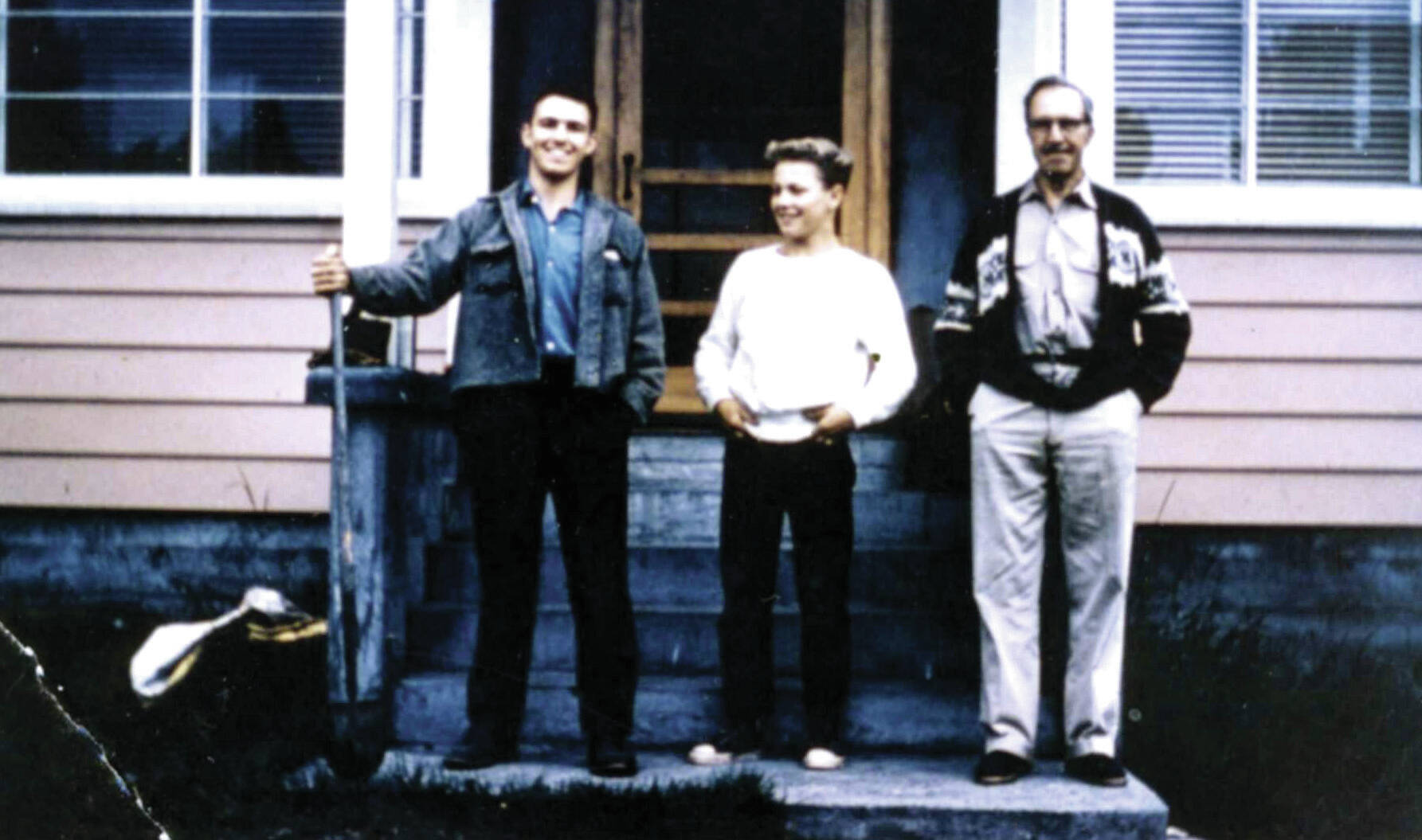
Photo courtesy of the Nutter Family Collection Posing in front of Warren Melville Nutter’s large home in Hope in about 1961 are (L-R): Warren Nutter’s only biological child, David; David’s younger half-brother Frank Gwartney, and Nutter himself. After Nutter died in 1962, his Hope property was split between the two boys.
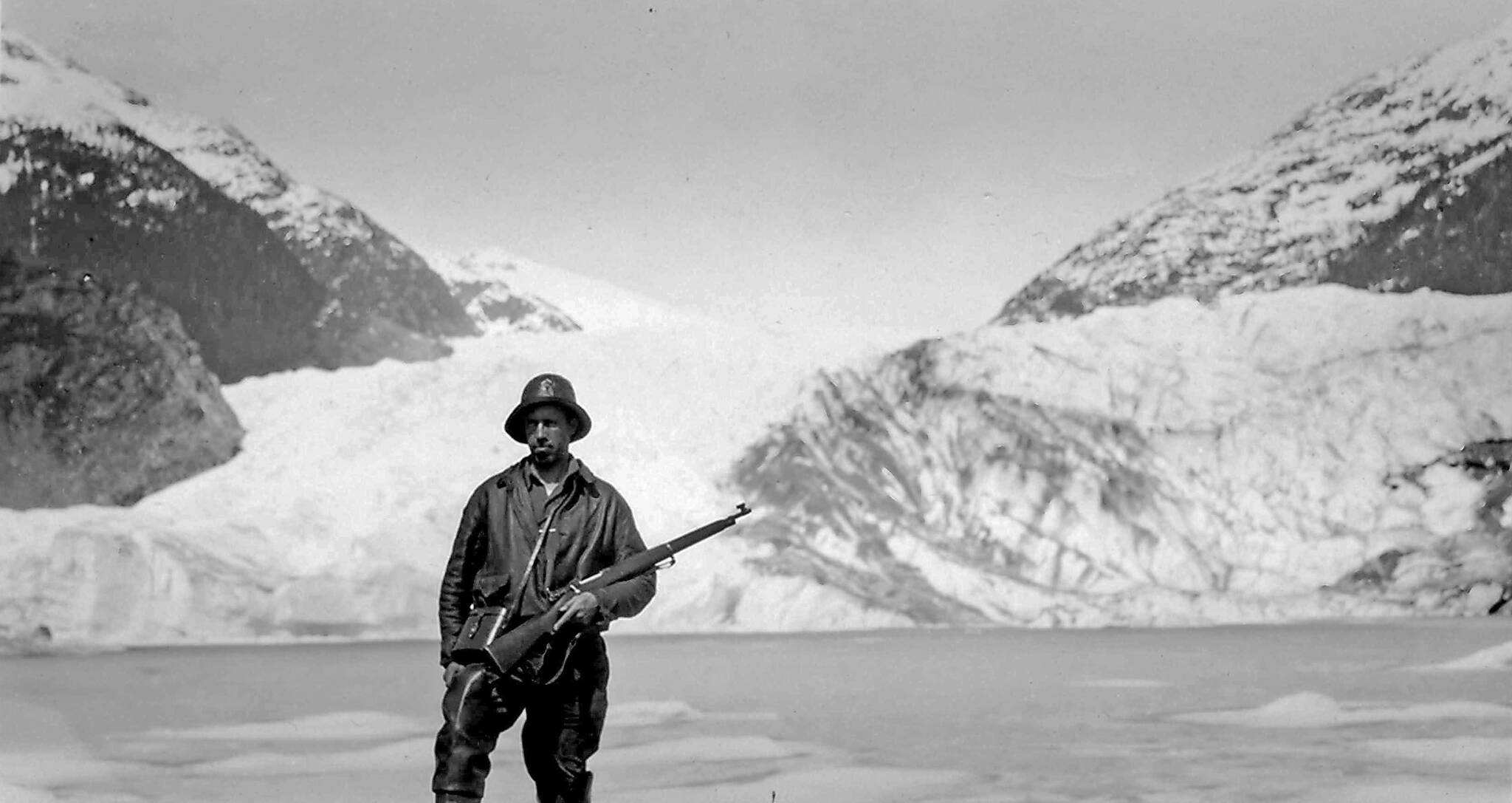
Photo courtesy of the Nutter Family Collection This photograph shows hunter/trapper Warren Melville Nutter near the lake at the foot of what was almost certainly Skilak Glacier, circa late 1930s.
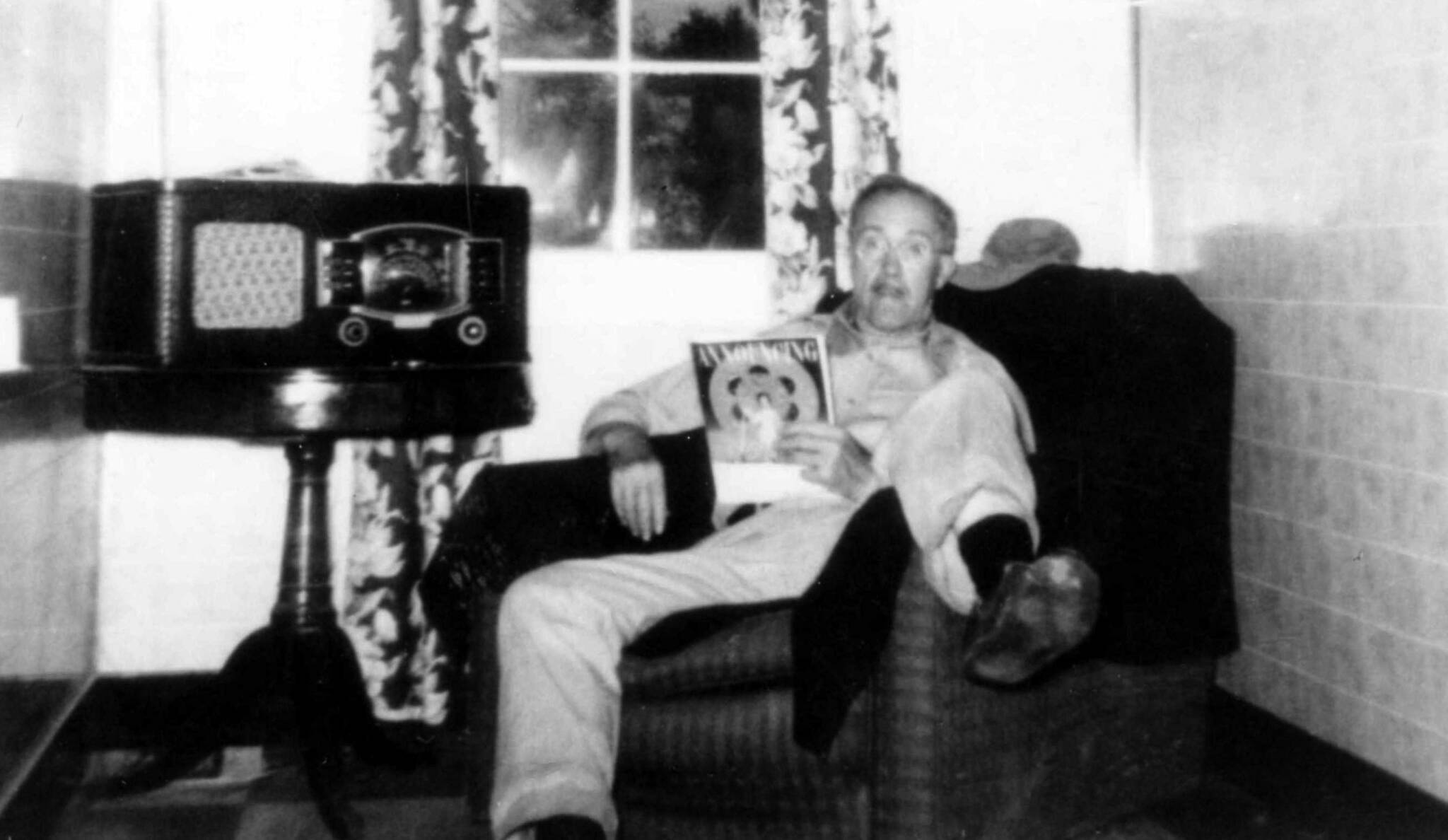
Photo courtesy of the Nutter Family Collection This undated photograph shows Warren Melville Nutter relaxing inside his home in Hope.
