
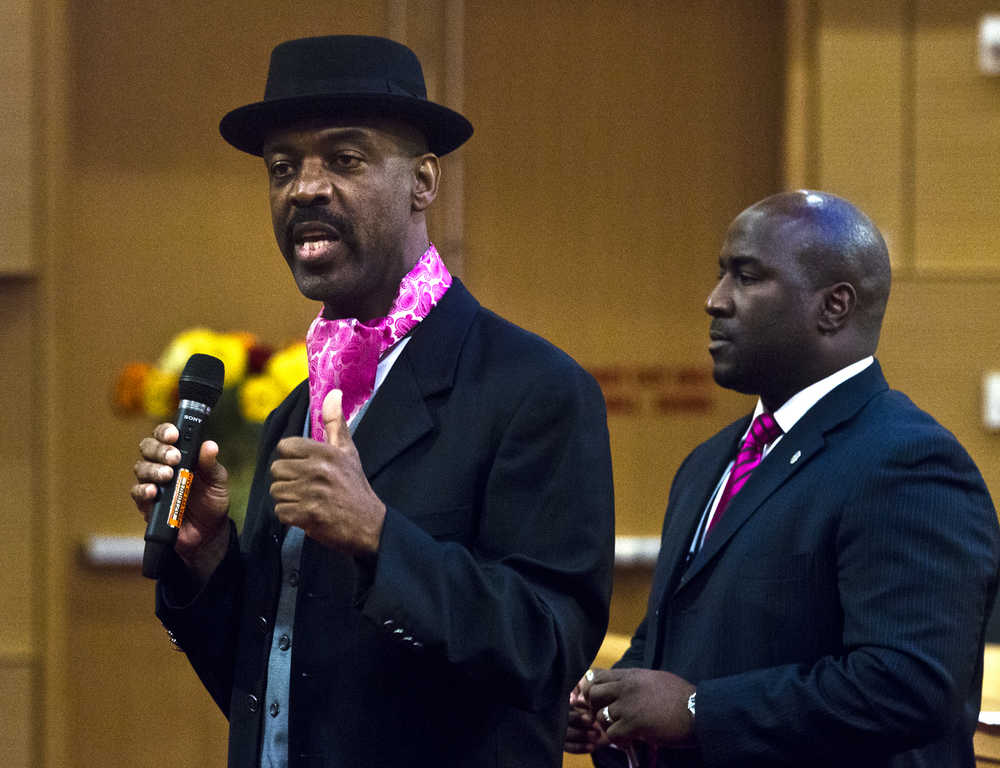
Fremont Street Experience busker Scarlett Ray Watt speaks during an informational meeting at the Las Vegas City Council regarding a new ordinance which sets new standards for them during performances on Tuesday, Aug. 11, 2015.   Councilmen Bob Coffin and Ricki Barlow introduced a measure July 29 aimed at cleaning up the acts of tip-seeking buskers in the Fremont Street Experience pedestrian mall. Key provisions would require performers to obtain city permits and stay in performance zones.  (L.E. Baskow/Las Vegas Sun via AP)

Fremont Street Experience busker Scarlett Ray Watt speaks during an informational meeting at the Las Vegas City Council regarding a new ordinance which sets new standards for them during performances on Tuesday, Aug. 11, 2015. Councilmen Bob Coffin and Ricki Barlow introduced a measure July 29 aimed at cleaning up the acts of tip-seeking buskers in the Fremont Street Experience pedestrian mall. Key provisions would require performers to obtain city permits and stay in performance zones. (L.E. Baskow/Las Vegas Sun via AP)

Downtown Vegas performers concerned with bid to rein them in

LAS VEGAS — On the Fremont Street pedestrian mall, Michael Troy Moore can be found wearing nothing but a G-string and a stuffed rooster on his lap while he plays heavy metal music.

To him, that’s good-natured comedy.

Inside the confines of Las Vegas City Hall on Tuesday, though, Moore dressed far more conservatively to air his grievances with a proposed ordinance aimed at creating order in the chaotic confines of the downtown Las Vegas mall that officials say are driving tourists and families away.

“Talent is not the threshold for us to be there,” he told the city’s attorney. Rather, the Constitution allowing for free expression is the threshold, he said.

Moore and a small crowd of other street musicians, magicians and impersonators and others took up the constitutional issue when offering varying concerns about a proposal to limit performances to 38 zones measuring six-feet in diameter during peak hours between 3 p.m. to 2 a.m.

Most agreed on one thing.

“It’s chaos, basically, right now,” said Jay Gelbman who goes by Stogee Blues when he’s impersonating a Blues Brother. He suggested different rules and performance boundaries could help.

City Attorney Brad Jerbic, who fielded performers’ comments on Tuesday, laid out the proposal inspired by Santa Monica, California’s rules for its outdoor promenade, a system criticized by a few of the Las Vegas performers.

“The environment downtown is declining. It’s a fact of life,” he said.

Jerbic said he didn’t want a desire for perfection in the law to get in the way of passing one.

“We are here to achieve a good thing,” he said. “You’ll be a lot more successful if this works.”

The crowd was evenly divided between supporting the zones and having a registration system to identify performers and not having either.

Some said the spaces the city had drawn up were too small to accommodate performances. Zenon Obuchowsky, or rocker Paul Stanley by night, said there wouldn’t be enough room for his KISS band of impersonators in a six-foot circle.

Others said the zones might force them next to scantily clad performers or aggressive panhandlers they would otherwise avoid by moving somewhere else.

Balloon-animal makers Heather Baress and Jared Carle said the rules could upset a natural occurring balance: the near-naked people stay over there and they make balloons elsewhere. “We realize we’re bad for each other’s business,” Carle said.

But if forced to sign up for reserved zones, the two fear a lasciviously dressed performer could be standing in the wings waiting for their turn in the spot, potentially driving away families looking for balloon-animals for their kids.

Still, for others, the spots are fine, it’s the rotation — every performer would be required to move to another spot every two hours — that troubles them.

Gregory Pointdexter, a Rick James impersonator who goes by the name GPEntertainer, said economically, performers need to know they’ll have a spot when they need it and the proposal only allows 38 spaces at a time, 27 when there’s a sanctioned Fremont Street stage performance.

“I have to be out there six days a week just to cover my head,” he said.

The ACLU of Nevada, which has worked with the city to craft the ordinance, said it’s not perfect and still needs to be tweaked. But the organization said restricting performances to the specified zones will actually be more inclusive than the current rules that just tell performers where they can’t be.

The city is expected to consider the proposal on Sept. 2.

More in Life

This 1903 photograph of mostly Kenai residents shows (back, far left) Hans Peter Nielsen, first superintendent of Kenai’s agricultural experiment station. Nielsen began work at the station in 1899 and resigned at the end of the 1903 season. (Photo from the Alaska State Library historical collection)
The experiment: Kenai becomes an agricultural test site — Part 2

AUTHOR’S NOTE: Presidential Executive Order #148, in January 1899, had set aside… Continue reading

Served together on a bed of greens, these pickled eggs and beets make a light but cheerful lunch. Photo by Tressa Dale/Peninsula Clarion
A wealth of eggs for good health

Pickled along with roasted beets and dill, these eggs have a cheerful hue and bright aroma.

File
Minister’s Message: Good grief

Grief doesn’t take a holiday, but it can offer you something the holidays can’t.

This dish, an earthy and herbaceous vegetarian reimagining of the classic beef wellington, is finished nicely with a creamy maple balsamic sauce. Photo by Tressa Dale/Peninsula Clarion
A special dish for a special request

This mushroom wellington is earthy and herbaceous, and its preparation comes with much less pressure.

File
Minister’s Message: Lifelong learning is a worthwhile goal

Lifelong learning. That’s a worthwhile goal. Schools have been in session for… Continue reading

This E.W. Merrill photograph shows Charles Christian Georgeson, special agent in charge of all agricultural experiment stations in Alaska, starting in 1898. (Photo from Alaska History Magazine, July-August 2020)
The Experiment: Kenai becomes an agricultural test site — Part 1

Individuals deciding to explore Kenai’s historic district might start their journey by… Continue reading

File
Minister’s Message: Being ‘thank full?’

As a young dad, I remember teaching my toddler children to say… Continue reading

This virgin blueberry margarita made with blueberry flavored kombucha is perfect for sipping while playing cards.  Photo by Tressa Dale/Peninsula Clarion
Sweet fruit for sober fun

Blueberry kombucha gives this virgin margarita complexity in flavor and a lovely purple hue.

John W. Eddy was already a renowned outdoor adventurer and writer when he penned this book in 1930, 15 years after the mystery of King David Thurman’s disappearance had been solved. Eddy’s version of the story, which often featured wild speculation and deviated widely from the facts, became, for many years, the accepted recounting of events.
King Thurman: An abbreviated life — Part 6

AUTHOR’S NOTE: The fate of King David Thurman, a Cooper Landing-area resident,… Continue reading

Public photo from ancestry.com
James Forrest Kalles (shown here with his daughters, Margaret and Emma) became the guardian of King David Thurman’s estate in early 1915 after Thurman went missing in 1914 and was presumed dead.
King Thurman: An abbreviated life — Part 5

AUTHOR’S NOTE: King David Thurman left his Cooper Landing-area home in late… Continue reading

These heart-shaped chocolate sandwich cookies go perfectly with a glass of milk. (Photo by Tressa Dale/Peninsula Clarion)
Chocolate cookies for a sweet treat

A healthy layer of frosting makes these sandwich cookies perfectly sweet and satisfying.