
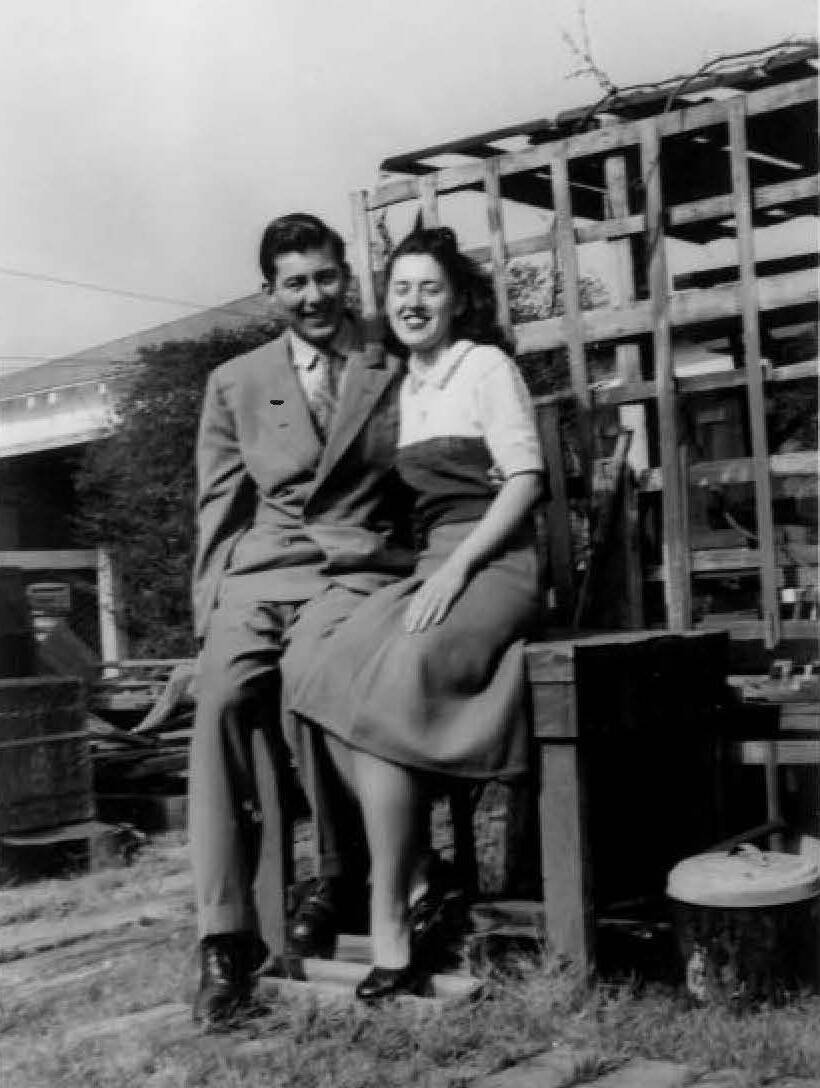
For the better part of a decade on the central Kenai Peninsula, the lives of Ira Little and Marvin Smith were inextricably linked. In fact, it was rare to read or hear about one without the other. It was usually “Smith and Little” this or “Smith and Little” that.
These two Soldotna homesteaders knew each other before they came north together in 1947. And even after one of them left Alaska about a decade later, they soon found themselves bound by family for the rest of their lives.
Best Friends
Early Ridgeway homesteader Rusty Lancashire, in a November 1948 letter to relatives Outside, once described the elation she felt when her husband Larry and their neighbor Dick Wilson shot a moose out of season on their property.
Food for the winter could be tough to come by, especially in an economy featuring few full-time, well-paying jobs. So, if a fine specimen of “Kenai beef” happened to wander up one’s driveway, and if the marshal or the game warden wasn’t around….
In this case, four rifle shots did the trick.
Although Lancashire was thrilled to have the meat, she was also cognizant of the dangers. If they were caught with their illegal bounty, the penalties could be harsh: fines, confiscations, even jail time. Consequently, she and Larry quietly passed the word to trusted friends and neighbors: Come share our harvest, but be discreet.
Two of those careful friends were Ira Little and Marvin Smith, who lived four miles away in a scattered settlement (soon to be called Soldotna) on the banks of the Kenai River. While Rusty began canning quarts of fresh meat, the two men — close friends and close neighbors — waited until dark, then donned their backpacks and began trudging through the snow along a section line to keep out of view.
Smith and Little lived on adjoining homesteads just downstream from the bridge that had been completed that summer. On Dec. 19, 1947, both men had walked into the Land Office in Anchorage to file on homesteads. Smith filed on 151.66 acres immediately west of Little’s 160-acre parcel, which lay immediately north of the homestead of Marcus Bodnar, one of the earliest settlers in the area.
They had arrived on the Kenai that spring. According to Katherine Parker’s chapter on Soldotna in “A Larger History of the Kenai Peninsula,” the duo had come by boat from California to Alaska, initially planning to work a gold claim in the Interior. “Conversation on the boat about land on the Kenai Peninsula made them change their minds,” Parker wrote.
Little’s son, Jeff, indicated that it was homesteading, from the beginning, that had spurred the men north. His father and Smith, he said, “knew about the homesteading opportunity in Alaska, and they were of kindred spirit … regarding adventure and decided to quit their jobs in the spring of 1947 to travel north.”
They made their way first to Seattle, said Jeff Little, “and caught a freighter up the coast, winding up on the Kenai…. They weren’t really prepared for the conditions but were both used to hardships and could hunt and live simply in the outdoors. They got a surplus army personnel carrier (6×6) to drive on the unpaved dirt/mud roads.”
Jeff Little said he is unsure when his father and Marvin Smith first became acquainted, but he is more certain about where they met: on the job at North American Aviation, in Inglewood, California.
North American Aviation began in 1928. Over the years, it became a major American aerospace manufacturer responsible for the design and construction of numerous notable spacecraft and military aircraft. When Ira Little first began working for the company as an aircraft mechanic in the early 1940s, it was in full war-preparation mode, specializing in combat fighters and bombers.
Little, four years older than Smith, worked for North American until 1944, when he enlisted in the U.S. Army. A year earlier, Smith had come to San Diego to train with the U.S. Navy. Although the exact timing is unclear, it is likely that Smith and Little met at the aviation company after their military service in the war had concluded.
In mid-1942, while the brown-haired, hazel-eyed Little was laboring for North American, the blond-haired, blue-eyed Smith was still in his home state of Nebraska, working at a car dealership in Wayne County. In the Navy, Smith became an electrician’s mate, third class. He remained stateside and was soon training other recruits to be electricians at sea.
Little, on the other hand, found himself fighting overseas. He was injured in battle in early 1945 and spent February and March recovering in a hospital.
By March 1946, both men had received honorable discharges, and they soon became coworkers, then friends, at North American Aviation.
Although it was during this year that some friends of Little introduced him to the woman he would eventually marry, he and Smith were not deterred from their Alaska adventure. They likely had no inkling that their north-country diversion would be so enduring.
Backstory
Both Smith and Little came from rural beginnings. As such, they were comfortable outdoors and accustomed to hard work.
Ira Louis Little was born April 23, 1920, in Kellyville, Creek County, Oklahoma, to farming parents Otis Andrew and Stella Mildred (Davidson) Little. Ira had only one sibling, a sister named Phyllis, who was born eight years later and would one day become key to binding her brother’s family to the Smith clan.
Marvin Edsel Smith was born Feb. 16, 1924, in Laurel, Cedar County, Nebraska, to Robert A. and Ella (Kennedy) Smith. Marvin had an older brother and a younger brother and sister. His father worked in a lumber yard and later became a carpenter.
When the 1940 U.S. Census was enumerated in Kellyville, 20-year-old Ira Little was still living with his parents; however, his son Jeff believes that it was shortly after this time that Ira left the farm and moved to California, seeking “opportunity coming out of the Great Depression.” Shortly thereafter, he went to work for the aviation company.
By 1950, 21-year-old Phyllis Little — and her parents — had also ventured west and were living in Hawthorne, in Los Angeles County. While her mother worked as a cook at a public grade school, Phyllis toiled as a waitress at a drugstore.
Meanwhile, Ira was living in Anchorage with Marvin Smith, despite having both received patent to their Soldotna homesteads on July 13, 1949. The problem was that simply owning a homestead didn’t necessarily equate to the generation of income, so the pair moved to Anchorage and became co-owners of a building-construction business.
Back on the Kenai, Rusty Lancashire sensed that changes were coming for the two friends. In early 1949, she had written to family that Smith and Little were about to head Outside to get a truck “and, I think, wives!” Lancashire was a bit premature in her forecast, but wedding bells were definitely on the horizon — for Little, at least.
Taking a break from the construction business in late summer 1950, Little returned to California and, in a Catholic ceremony on Aug. 31, married the woman he’d been seeing off and on for four years, a registered nurse named Odette Ann Finley.
Ann, as she preferred to be called, had been born in Nebraska seven years after Ira and was one of six daughters in the Finley family. By 1940, the Finleys had moved to southern California, where Ann’s parents ran a real estate office.
According to an informational sign at the Ira Little Cabin on the grounds of the Soldotna Historical Society’s Homestead Museum, Ira “married his California sweetheart.” Ira and Ann lived part time in Alaska and part time in California until 1953, when they moved to Alaska “on a more permanent basis,” said Jeff. Fortunately for Ira, said Jeff, Ann “embraced Alaska life.”
Despite Rusty Lancashire’s enthusiastic predictions, Marvin Smith’s own nuptials took a few more years.
In October 1952 in Hawthorne, Phyllis Little married Ralph Joseph Southworth Jr. Less than three years later, she divorced him and took back her maiden name. By the time Marvin Smith came a-courting in 1958, her brother Ira and his family had moved out of Alaska, and she was once again working as a waitress.
Thirty-four-year-old Marvin and 30-year-old Phyllis tied the knot on Sept. 23, 1958, in Kenai. Their certificate of marriage was signed by U.S. Commissioner Stanley F. Thompson, a future mayor of the future Kenai Peninsula Borough.
Thus, the offspring of close friends Ira Little and Marvin Smith would become first-cousins.
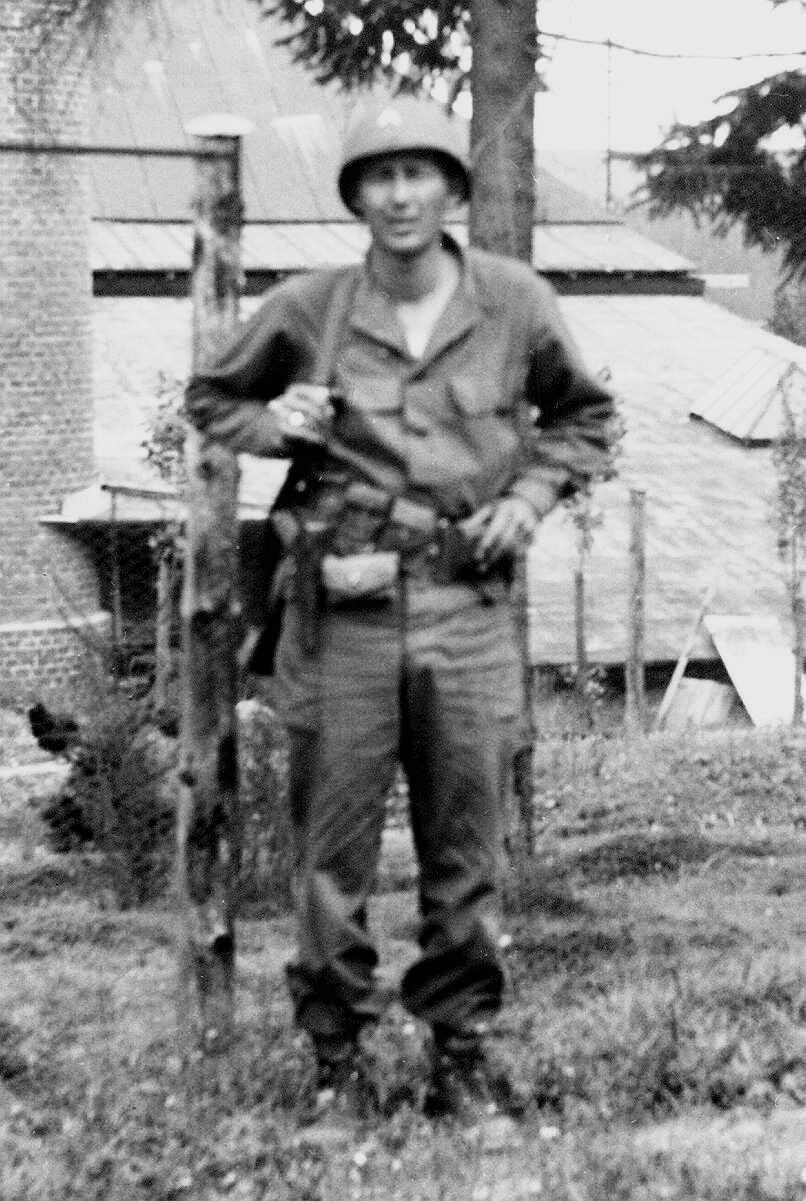
Between employment stints with a California aviation company, Ira Little enlisted in the U.S. Army and served overseas during World War II. (Little Family photo courtesy of the Soldotna Historical Society)
![[1c—letter to editor—]While visiting his home state of Nebraska in 1949, Marvin Smith wrote to the editor of a local paper to stump for Alaska statehood. (Image from the Evening World-Herald in Omaha)](https://www.peninsulaclarion.com/wp-content/uploads/2024/06/36361156_HOM_051624_smithlittle-clark-part1-3_1.png)
Between employment stints with a California aviation company, Ira Little enlisted in the U.S. Army and served overseas during World War II. (Little Family photo courtesy of the Soldotna Historical Society)
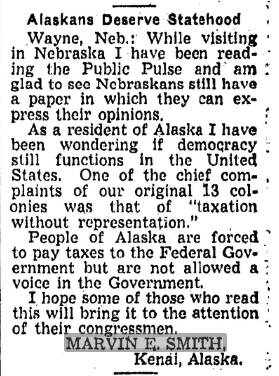
While visiting his home state of Nebraska in 1949, Marvin Smith wrote to the editor of a local paper to stump for Alaska statehood. (Image from the Evening World-Herald in Omaha)
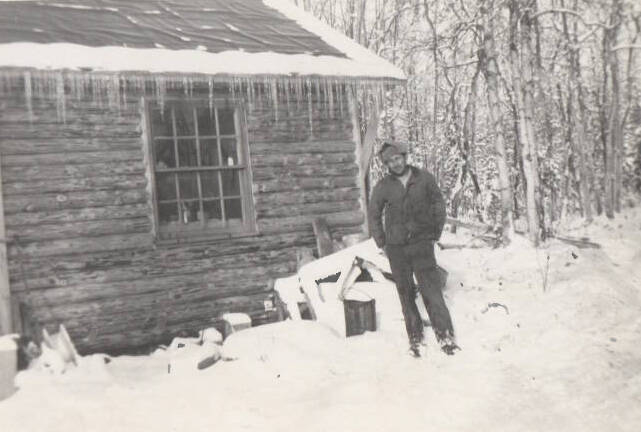
Ira Little poses outside of his recently completed Soldotna homestead cabin in 1947. (Little Family photo courtesy of the Soldotna Historical Society)
