
AUTHOR’S NOTE: In Part One, William N. “Bill” Dawson, a trophy hunter and a spinner of yarns who came to the Kenai Peninsula in the 1890s, frostbit his feet so badly that all the toes on one foot required amputation. Part Two featured a glimpse of Dawson’s pre-Alaska personal history and some of the connections and machinations in which he engaged once he settled in Kenai.
Sister Trouble
Alice and Willietta Dolan came to Kenai in 1911 on a three-year teaching contract. Three decades later, they penned a memoir, “The Clenched Fist,” about their experiences in the village. Generally speaking, the sisters had mostly kind words to say about everyone they met. One blatant exception was William N. Dawson, a man they referred to as “Old Bible Bill.”
Although the memoir was written by both sisters, its text is largely in first-person and makes no secret of Alice and Willietta’s loathing of Dawson: “While we were young and naïve, we were not so credulous as to believe everyone ‘exuded sweetness and light.’ … If I were to designate the meanest character I ever met, I should name ‘Old Bible Bill,’ an Ozarkian.”
Dawson himself provided the “Bible Bill” nickname, informing the sisters that he privately went by that name because he had read the Bible so many times. “Why I have read it through from page to page fifteen times,” he said, according to the sisters. Alice and Willietta opined that it was a shame, then, that he had still missed the whole spirit of the book — “God is love” — despite so many readings.
They offered a long list of grievances against and bitter references to Bill Dawson, starting with physical and character descriptions: “so innocuous looking, you were taken in, at first”; “a dehydrated old chap…. His skin had the color and quality of a dried tobacco leaf”; “The lines on his face were myriad, etched there by time and wickedness”; “He was a garrulous old man whose favorite topic was himself”; “There was no deviltry afoot that he didn’t have a hand in fomenting.”
The local Natives, they said, “knew and despised him.” The sisters called him “a consummate hypocrite.”
“If he wished to injure someone for a fancied slight or coveted something that belonged to [that other person],” they wrote, “he worked in devious ways to arouse the wrath of his followers against his enemy. They, then, did his evil work. He appeared not to be involved in the affair, but he was the instigator of all the ‘dirty work’ of Kenai. It was inconceivable to believe that any man so dehumanized could exist.”
Two stories best illustrate their negative view of Dawson.
Soon after the sisters arrived in Kenai, they “adopted” a malamute, a lame dog named “Choni” that appreciated their kindnesses and followed them happily around the village. Once, the dog followed them to the post office, which lay inside the trading post being managed by Dawson. When the dog saw Dawson, he curled his lips and bared his teeth. Dawson snarled in turn and informed the sisters that he hated Choni and wanted him gone.
“Once,” Dawson told them, “he came thieving around my cabin. I throwed my axe at him. Instead of killing him, I almost cut his foot in two.” Some miners heard of the injury he had caused Choni and forced Dawson to promise never to harm another dog.
“But I do not forget,” he said. “Someday, I’ll get him … and no one will know it was me who done it.”
Another event — “one of his meanest pieces of rascality” — involved Dawson inciting his followers against Alex Ryan, often considered the “bully of Kenai,” and helping to send him to prison. The sisters said Dawson even bragged to them about how he’d accomplished the task.
“One of the crowd about Bible Bill coveted Alex’ wife, who was the daughter of Chief Alexis,” they wrote. “So old Bible Bill conceived the idea of getting Alex out of Kenai.” His cronies planted evidence and offered trumped-up charges, and in 1908 Ryan was sentenced to two years in a federal prison in Washington state. By the time, Ryan returned to Kenai, his wife had died, and his cabin had been stripped of most of its furnishings.
But the Dolan sisters’ troubles with Bill Dawson didn’t end with an injured dog and tales of past meanness. Social, judicial and ethical issues were on the horizon.
Exerting Control
Dawson’s relationship with Alexander “Paddy” Ryan was complicated. It had its ups and downs, although Dawson himself seldom seemed to suffer any of the low points.
In late May 1903, after Ryan was arrested for shooting a rifle at a cannery agent, Dawson was sworn in as a “special deputy” to escort the prisoner to the grand jury in Valdez. The two men returned to Kenai together in late June, with Ryan no longer in custody.
In August 1906, three Kenai white men, including Ryan and Dawson — Natives were not even granted the opportunity to seek citizenship until 1915 — were named as “election judges” for all polling places in the Kenai precinct during balloting to elect an Alaskan delegate to the U.S. Congress.
In October 1908, when Dawson helped arrange Ryan’s two-year imprisonment, his friend and future business partner, Peter F. (“Frenchy”) Vian, was the complaining witness at the grand jury trial.
Despite what many might consider backstabbing actions by Dawson, the two men apparently reconciled — or perhaps Ryan never learned the depth of Dawson’s involvement. By December 1917, as a small group of white men fought for control of Kenai’s school—populated primarily by Native students — school principal Cleveland Magill named Dawson and Ryan as the ringleaders of the opposition.
“W.N. Dawson,” Magill wrote to the governor of Alaska, “in order to secure control of the school, has been a frequent visitor to these [female teachers’] home. It is all very clear to the board and the people living here, and it is a general belief, that [an] effort to ruin our school is being made. Dawson is assisted by one A.P. Ryan. These men are not only enemies to the school, but to everything lawful and decent.”
Four months later, there were two fatal shootings in Kenai. Magill killed Ryan during a school board election. Later that day, a friend of Ryan’s gunned down Magill. Bill Dawson happened to be out of town at the time.
Few people ran afoul of Dawson’s plans without a paying a price. Those who gained a brief upper hand — like the Dolan sisters during their tenure in Kenai — soon discovered that Dawson also thrived on retribution.
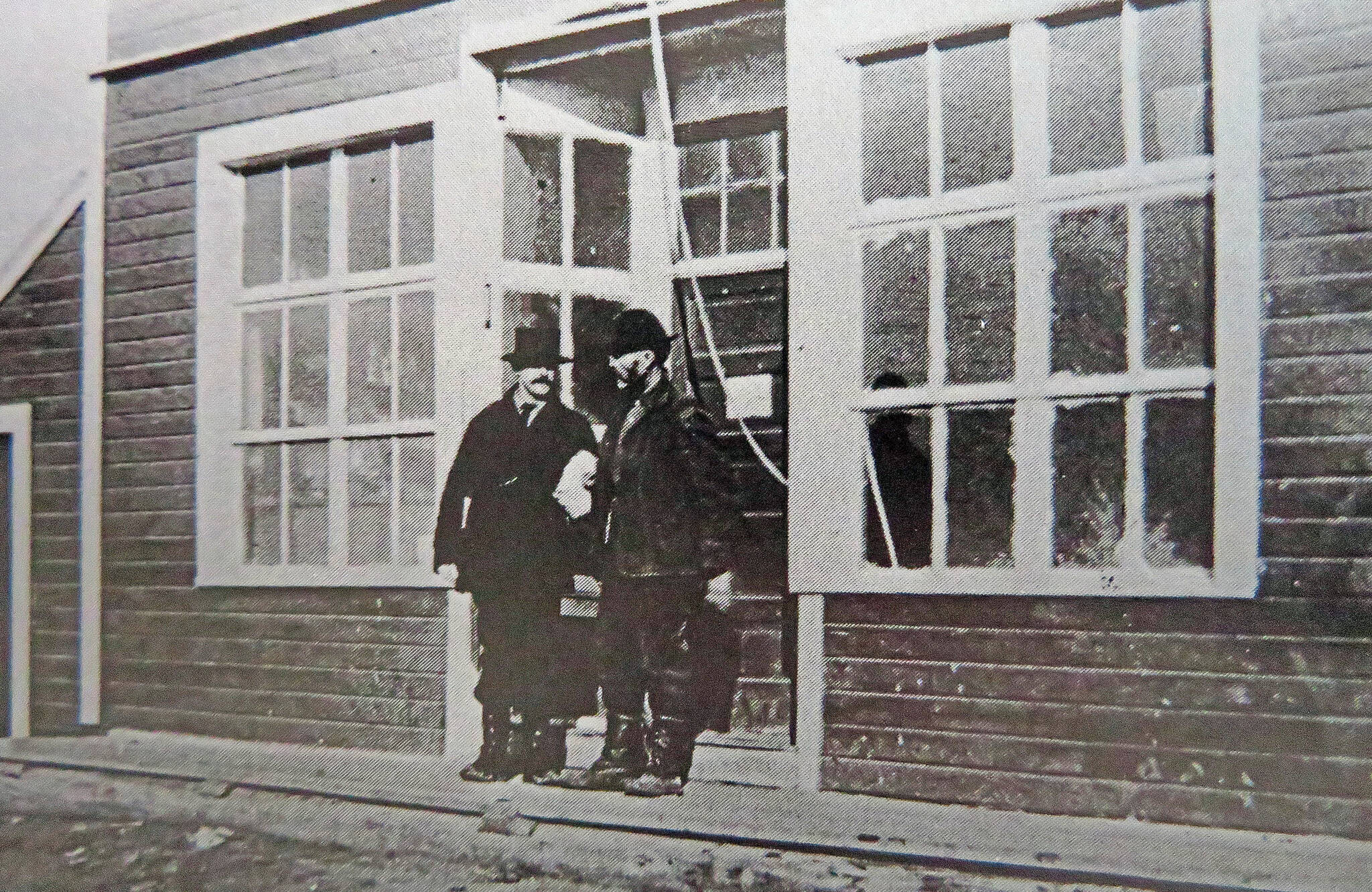
Photo from “Once upon the Kenai” Captain Rose of the S.S. Tyonic, a coal-hauling vessel operating out of the Seldovia area, speaks with Bill Dawson in front of Dawson’s Kenai trading post in 1915.
