
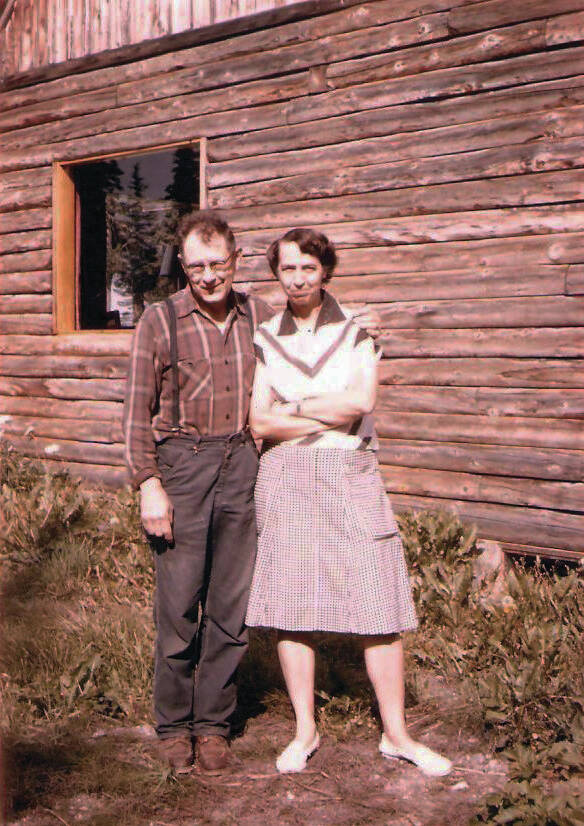
AUTHOR’S NOTE: Rex Hanks served in World War II, then left his home state of Washington and came to Alaska to seek new opportunities. After working and searching for a couple of months, he found property that pleased him near the waterfall at the mouth of Happy Creek, between Ninilchik and Anchor Point on the southern Kenai Peninsula. He filed for a homestead there at the end of May 1946 and began planning the life he would live in his chosen new home.
Neighbors and Making Money
In Homer in the spring of 1946, Happy Valley homesteader Rex Hanks met Clyde William Thomas, a native Nebraskan and bachelor farmer who was 12 years his senior. Hanks talked up the beautiful country near his place at the mouth of Happy Creek and convinced Thomas to check out the other open land in the area.
Less than a week after Hanks filed on his homestead, Thomas filed on a 155.71-acre parcel immediately to the north. As Thomas erected a modest cabin for himself and began clearing land for a haying operation, Hanks built a one-story log cabin in a small meadow above his Happy Creek waterfall.
Over the next two to three years, a neighborhood of sorts began to materialize around the two men. Early on, Hanks’s nearest neighbor to the south along the beach was Joseph Hoffman, another bachelor, who filed on a homestead in April 1947. By March 1948, however, Hoffman had relinquished that parcel and filed on another one away from the beach and farther up Happy Creek.
Next to arrive, along the beach but to the north of Hanks and Thomas, was Wayne Jones, who filed on a homestead in July 1947. In relatively quick succession, to the north and south of Happy Creek, came George Welch, Frank Larson, Homer Crosby and William McGowan.
Welch sold out to William Nutter, who sold out to Wayne Jones’s brother, Gordon. Nutter’s brother, James, also filed on a homestead but soon relinquished the land to Wayne Stanbaugh.
Other homesteaders also came and went. Some departed because they disliked the relative isolation or the difficulty of the proving-up process. The creation of the Sterling Highway ameliorated some of those concerns, but well-paying employment — except in road construction or seasonally with salmon fishing — could be difficult to come by. A lack of work meant no income for staples and building supplies.
In 1951, during the winter, Hanks’s friend Clyde Thomas died. His homestead was purchased the following year during a public auction at the Kenai office of U.S. Deputy Marshal Allan Petersen. An Anchorage doctor purchased the place for $4,000.
Hanks, meanwhile, had traveled to his home state of Washington to purchase a sawmill that he could power with the waterfall on his property. “I sawed lumber for a few of the neighbors,” he told Ella Mae McGann for her book, “The Pioneers of Happy Valley, 1944-1964.” “They would come in by boat and place their orders. I would give them a date to come by boat to pick it up. I made a little cash that way.”
But the sawmill business was tricky. Good trees for lumber were not plentiful in the lower Happy Valley, and soon other men along the Cook Inlet beach were setting up sawmills of their own and cutting, literally, into his business.
“During the next few years, several families were building and breaking land around (the area),” Hanks said. “I tried to make a living from my sawmill but didn’t do that well.”
When the fledgling Sterling Highway was punched through near the eastern edge of his homestead, he tried changing tactics to improve his business. “I set up a conveyor belt to bring the cut timber up to the road,” he said. “That never did work well, so I moved the whole operation up on top (away from the falls and the beach).” To substitute for the water power he’d had at the falls, he ran his mill off a small Ford engine.
He cut flooring and roofing materials and even made furniture for new arrivals, but business remained middling. He moved the sawmill north to Frank Larson’s place and they worked on shares. Later, he moved the mill again, even farther north to Wayne Jones’s homestead. “The timber we were cutting was not first class,” he said, “but it served its purpose while we were so far away from a lumber yard.”
Hanks also attempted to diversify. He became an employee with the Soil Conservation Service, and he worked at small-scale farming. The Anchorage Daily Times ran a small article describing how Hanks had purchased a new International Farmall tractor in Anchorage, then, averaging 18-20 miles per hour, had driven it along the highway 200 miles to Frank Larson’s place.
Finally, Hanks bailed out of the homesteading game entirely, selling all of his property through a local real estate man named Red Smith. He then purchased from Homer Crosby two acres near the beach, along Crosby’s southern property line. “Two acres,” he figured, “were just right to build a house and raise a garden.”
The sale of his own homestead provided the cash for him to buy the Crosby land and to afford his first car on the Kenai. In order to fund his dreams of a new home and garden in Happy Valley, he then moved to Seward and found work at the docks there as a longshoreman.
Change of Life
“In my spare time from the docks,” Hanks recalled, “I began to whittle on small pieces of wood. From working in the Forest Department in Washington state and (at) my sawmill at the falls, I (had developed) a fascination for wood. It has such a good, clean smell, and you never knew what design might come from it. On my days (off) from dock work, I roamed around the forests to find and identify the different types of woods to use in my carvings.”
It turned out that Rex Hanks excelled at carving and would actually make money at it, but at first it was primarily a hobby. Besides, he also had found something else to occupy his time: a love interest.
A bachelor all his life until his time in Seward, the 42-year-old Hanks married on June 29, 1953. His bride, Irmgard Ernest Matz, was a 36-year-old registered nurse at the hospital in Seward.
Matz, a Connecticut native, had graduated from the School of Nursing at St. John’s Riverside Hospital in Yonkers, New York. Like Hanks, she had been in the U.S. Army Medical Corps during World War II. Before coming to Alaska, she had been a staff nurse at the New York State Reconstruction Home, a hospital setting for the care of handicapped children.
Also living in Seward was Irmgard’s sister, Ingabord Gertrude (Matz) Machado. Gertrude, as she preferred to be called, was a nurse’s aide and had married a semaphore man named William Machado in Seward a few months before Rex and Irmgard tied the knot.
By the end of the 1950s, stillborn daughters of the Hankses and the Machados had filled three of the four graves in the private cemetery near the Hanks homesite in Happy Valley. The only child of either sister to survive was born in 1955 and adopted by Gertrude and William. Of the four full siblings in the Matz family, only their sister Agnes produced children of her own to survive infancy. Their brother, Rudy, contracted polio as a child and never married.
Over the first few years of his marriage with Irmgard, Rex began leaving Seward on his off-days and making the drive to Happy Valley, planning and building the two-story log house in which he hoped that he and Irmgard and their family would one day thrive. Sometime after burying his second daughter there in 1958, they moved to their new home, living as a childless couple for the next three decades.
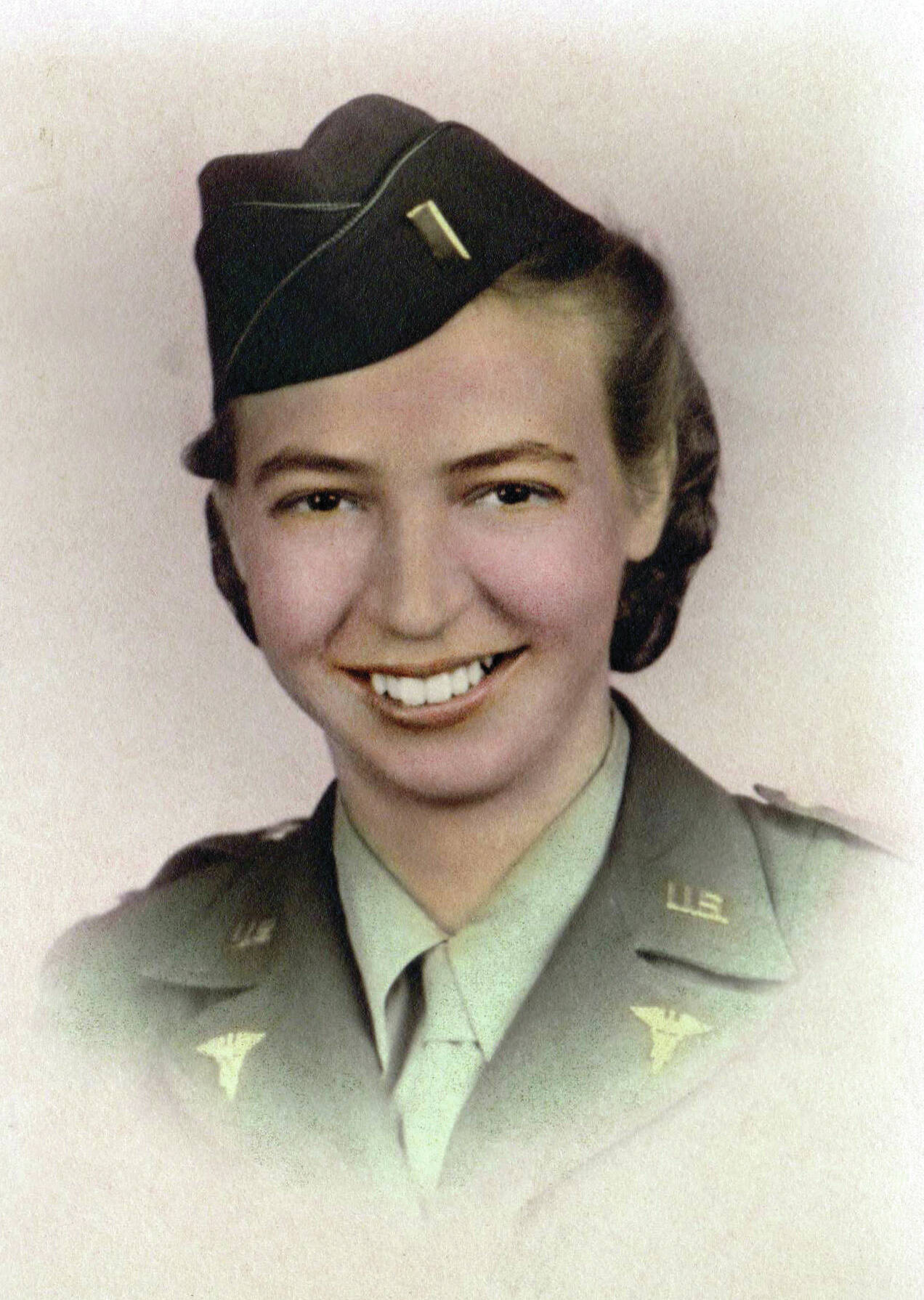
Photo courtesy of Mary Butts on familysearch.org Like her husband Rex Hanks, Irmgard (Matz) Hanks also served in the U.S. Army Medical Corps during World War II.
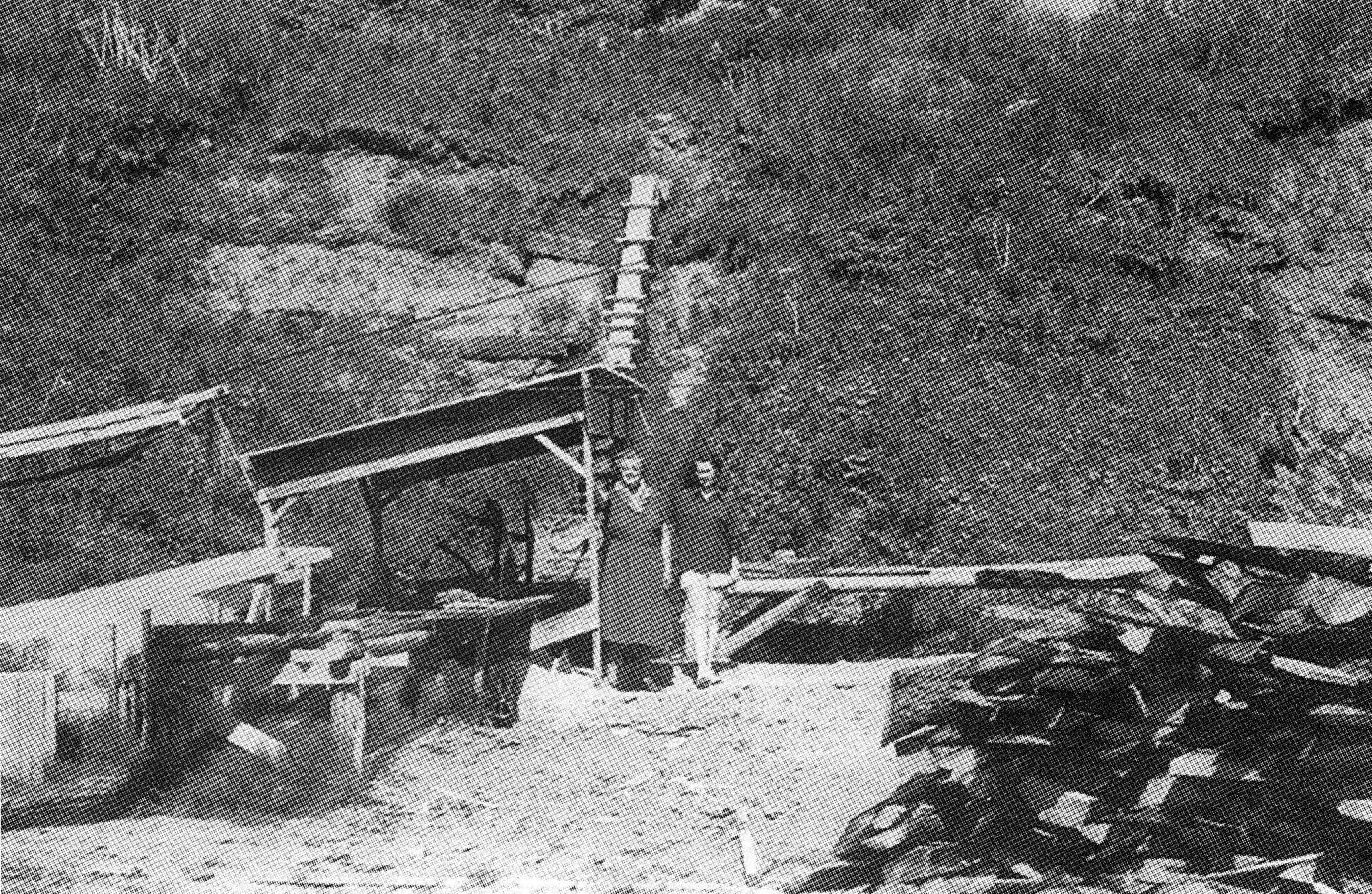
Photo from “Snapshot at Statehood,” by the Kenai Peninsula Historical Association Two unidentified women pose near Rex Hanks’ sawmill operation near the mouth of Happy Creek, circa 1950.
Two unidentified women pose near Rex Hanks’ sawmill operation near the mouth of Happy Creek, circa 1950. (Photo from “Snapshot at Statehood,” by the Kenai Peninsula Historical Association)
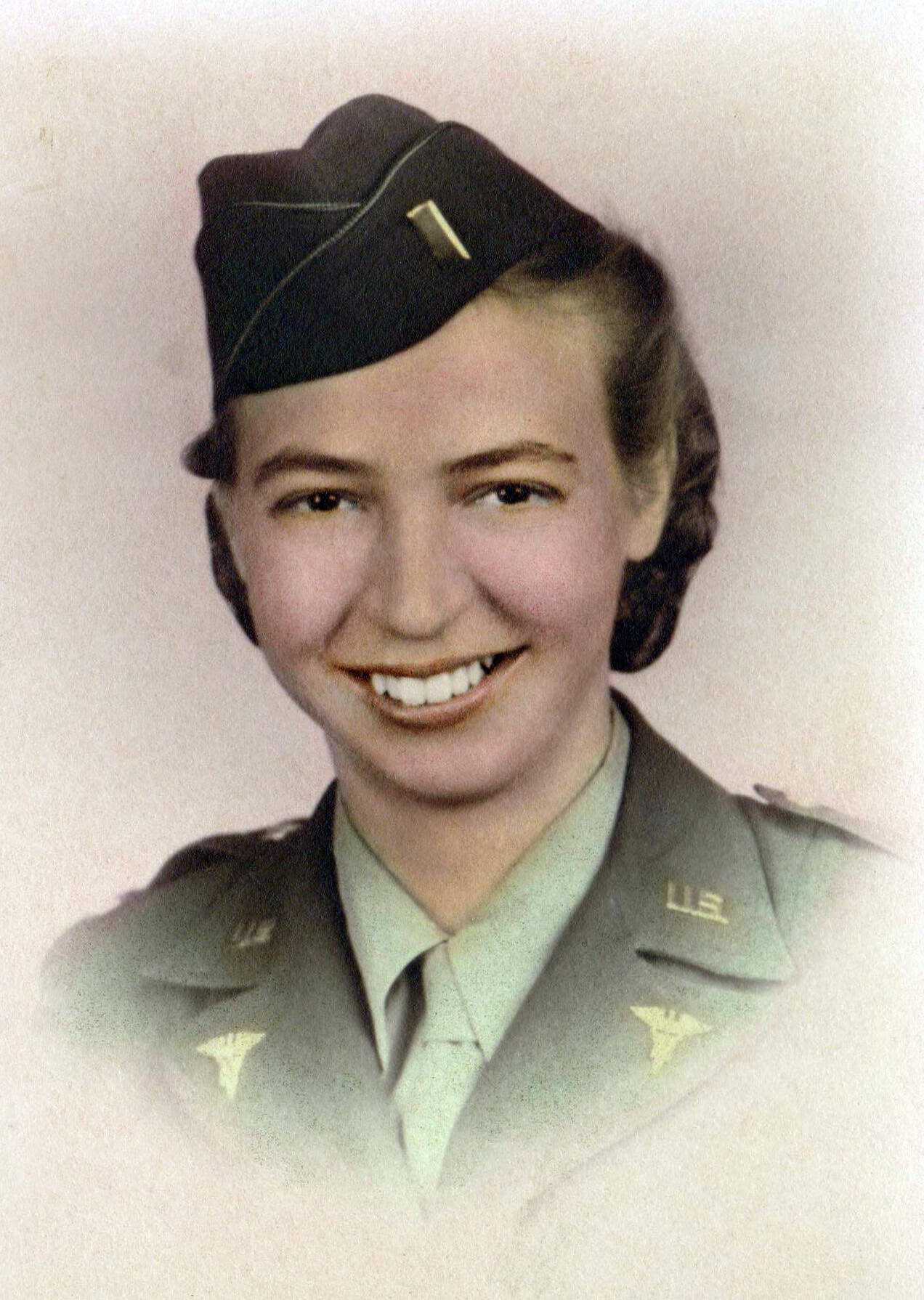
Like her husband Rex Hanks, Irmgard (Matz) Hanks also served in the U.S. Army Medical Corps during World War II. (Photo courtesy of Mary Butts on familysearch.org)
