
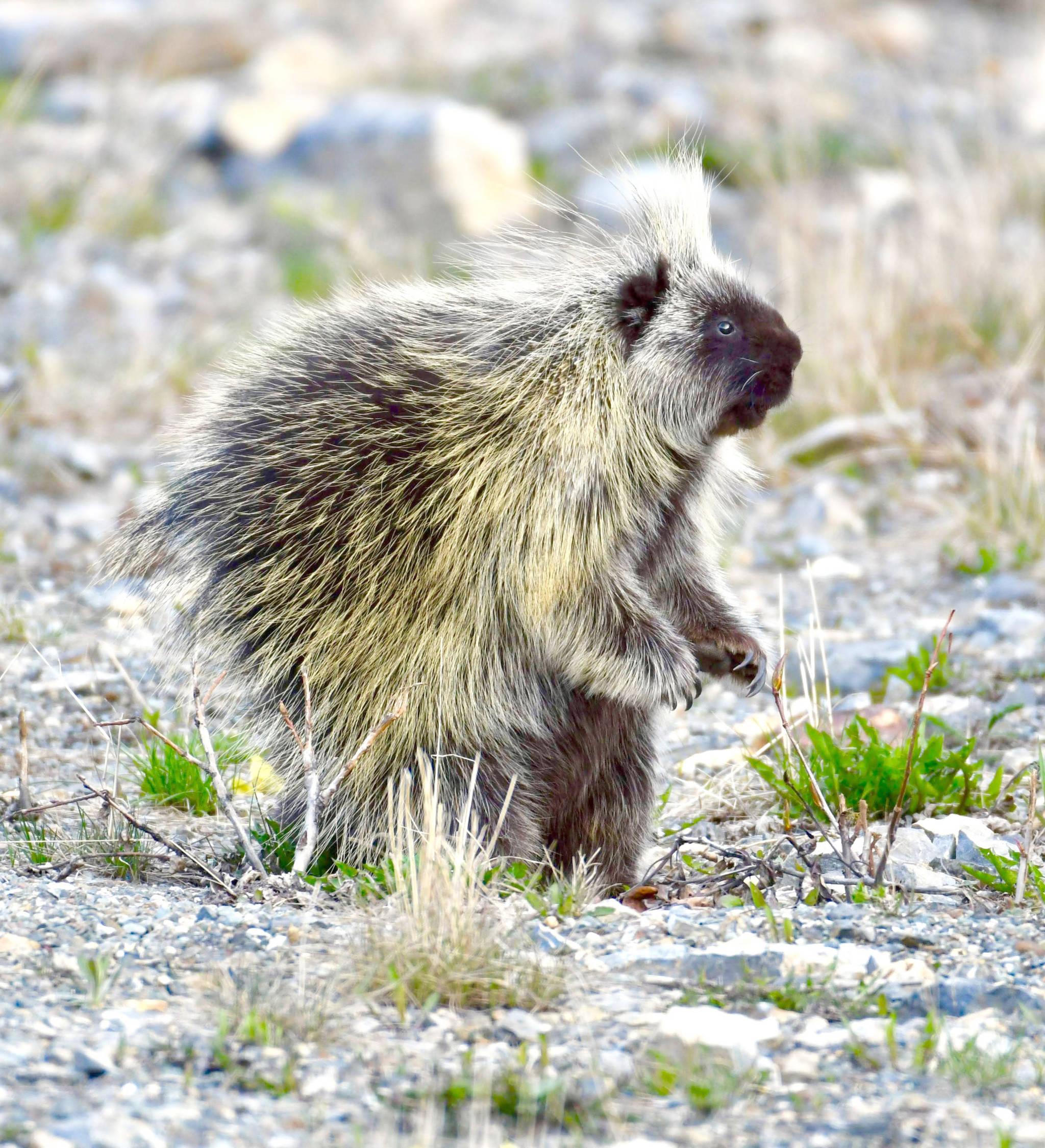
Sauntering my way, the animal halted and gazed in my direction. It appeared uncertain about my status. Was I a threat? Or, was I anything at all? Pondering what the next move might be, the standoff commenced.
It peered up at me with beady black eyes, on what was a rather small head for an otherwise stocky body. Blond streaks ran through its dark brown fur. A pair of stained yellow teeth were exposed below a short, brown nose that moved from side to side as it tried to catch my scent.
I heard a faint clicking sound, which I interpreted as a warning to stay back. It reared up on a pair of squatty hind legs, providing me a view of some very impressive, long, curved claws. The most distinguishable feature was a phalanx of quills covering most of its body, excluding the feet, belly, and head.
By now, you most likely guessed what stood before me was none other than the North American porcupine (Erethizon dorsatum).
Porcupines are the second largest rodents in North America after the beaver. They typically weigh around 15 pounds, with some large males close to 30 pounds. With short stocky legs, long claws and a thick, muscular tail, they are adapted to climbing trees and clinging to branches.
They have roughly 30,000 quills, with most lying flat along the back and tail. By contracting muscles near the skin, the quills can erect, protecting them from would-be attackers. Contrary to a common misconception, the quills are not thrown, but loose quills can fall off when thrusting its tail in defense.
The quills are modified hairs with microscopic barbs on the tip that aid in lodging the quills farther into an antagonist’s flesh. The quills are coated with an antibiotic layer to prevent infection from self-quilling.
In another line of defense, porcupines release olfactory signals from a skin gland on the lower back called the rosette. When in distress, they secrete a pungent smell to warn predators to stay back or get whacked by a quill-laden tail.
Many predators feast on porcupines, including bears, coyotes, lynx, American marten and great horned owls.
The fisher is one predator that keys in on porcupines. By circling the porcupine as it tries to defend itself, the agile fisher is able to get around the defensive position of porcupines and deal lethal blows to the face. Weakened and brought to exhaustion, the fisher flips and consumes its prize.
Porcupines are found from northern Mexico to the Arctic Ocean, typically inhabiting coniferous and mixed forests of the northeast and western United States and also spreading widely throughout Canada. They have been found in nonforested habitats varying from tundra to desert shrub, sagebrush and juniper.
With such an extensive native range, porcupines have to be generalist herbivores. Diets are typically low in nitrogen, high in fiber,and often contain high tannin levels. The region in which porcupines are present determines what vegetation they will consume, and they will mainly go for what is most available to them. Those in the northeast U.S. feed on a wide variety of trees.
In contrast, there are far fewer options in Alaska, where they typically feed on the cambium layer of paper birch trees and white spruce, as well as white spruce needles.
With seasonal changes, they can access more nutritional options such as berries, acorns, stems and roots in spring and summer. With winter’s onset, feeding rate increases in preparation for the scarcity of higher quality foods.
Courtship and mating generally take place in late autumn. Males venture out of their home territory in search of females in heat. The female releases an odorous mucus along with urine to attract potential suitors.
Upon finding a female, the male may have to wait days for her to ovulate. The male positions himself on a lower tree branch and routinely sprays the female with urine to accelerate estrus.
While guarding her, other males may be drawn in by the female, in which case fierce battles may ensue with males biting and quilling each other with risk of serious injury or death. Seven months after mating, females give birth to a single “porcupette,” seldom two. The newborn’s quills are soft but start to harden within an hour.
During winter, porcupines den in areas that provide adequate protection from the elements, such as hollowed-out tree trunks and crevices in rocks. They do not hibernate but venture out to feed on nearby trees. Normally solitary animals, the dens may be occupied with other porcupines for increased warmth.
There is a long history of Alaska Natives using quills for designs and decoration. Athabaskans of the Interior still utilize quills to adorn clothing, earrings and other forms of artwork. Being relatively slow-moving and easy to chase down, they also provided a valuable food source when other game was scarce.
With the occasional quilling of a pet, demise of a tree by girdling or damage to human structures and supplies by chewing, they are often viewed as a pest. But as I sat and watched the massive rodent feeding before me, I came away quite captivated by it. They seem to be another animal that is just a bit unappreciated.
Finally, determining that I was no threat, it passed by, digging up and consuming some roots before climbing over a rocky knob and out of sight.
Colin Canterbury is a seasonal biological technician at Kenai National Wildlife Refuge. Find more Refuge Notebook articles (1999-present) at https://www.fws.gov/Refuge/Kenai/community/Refuge_notebook.html.
