
Science is more than the five-step method we learn about in grade school — science is a philosophy of questions.
As a budding graduate student who is interning at the Kenai National Wildlife Refuge, I am beginning my training in that philosophy by asking questions about species distributions and interactions. Knowing where species live is essential to effective conservation, and species’ distributions can depend just as much on other animals as they do on their habitat.
Just imagine a food web with all the organisms that live in an area as diverse as the Kenai Peninsula – it gets pretty complicated. But animals interact in more ways than just eating one another. Some species compete for similar resources. Competition can be a strong driver of animal distributions across an area.
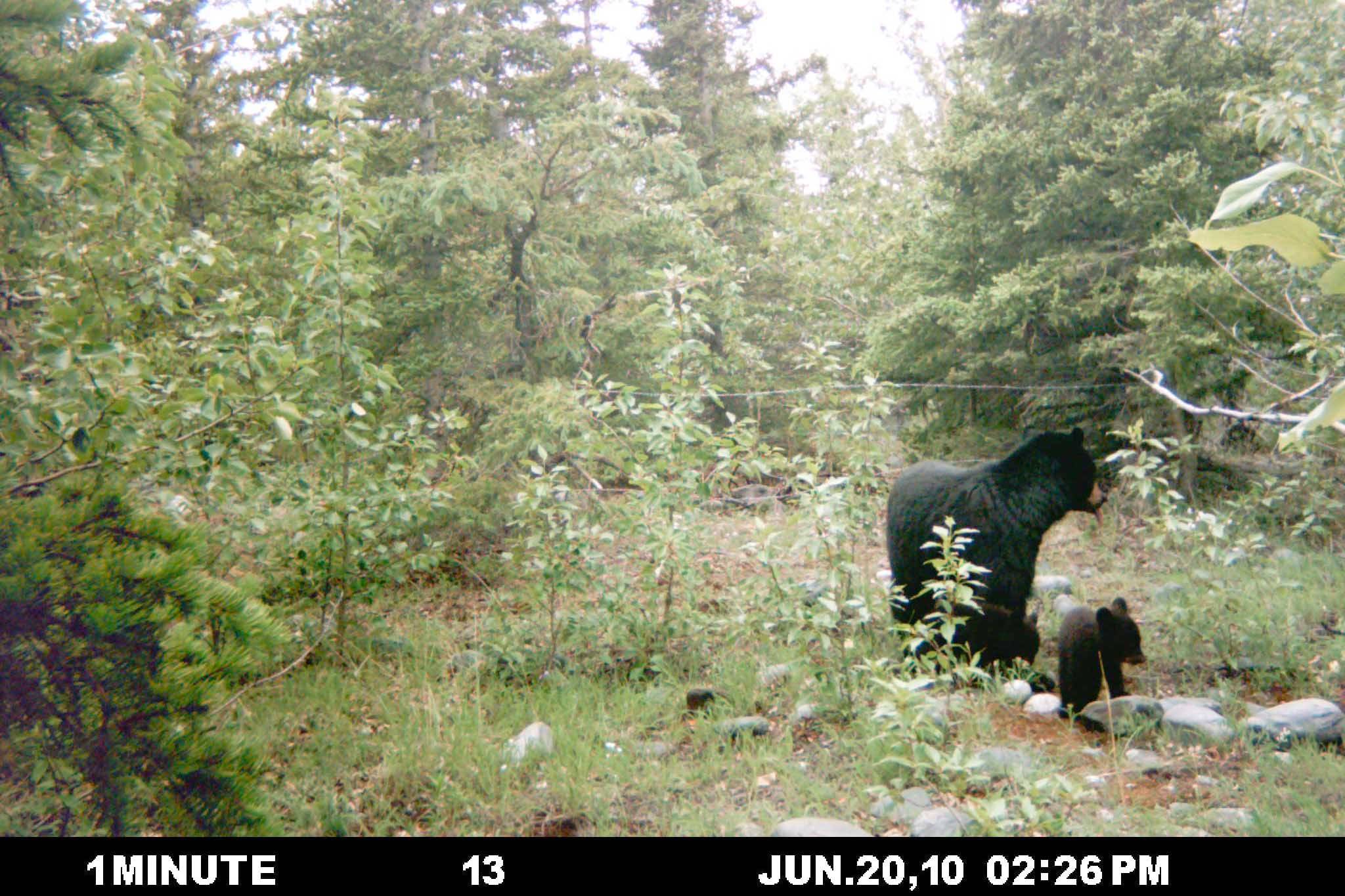
Competitive exclusion between brown and black bears is well-documented wherever the two species overlap. In my graduate research, I will explore to what degree brown bears influence the spatial distribution of black bears on the Kenai Peninsula. I plan on doing so by constructing occupancy models from bear hair data.
So what is an occupancy model? Occupancy modeling is used to assess the proportion of sites occupied by a species across an area given that the species is imperfectly detected.
In 2010, supervisory refuge biologist John Morton led an interagency effort to estimate the brown bear population on the Kenai Peninsula. They arrayed 144 hair traps in a grid across the Kenai refuge and Chugach National Forest.
The “traps” were triangular, barbed-wire exclosures around a false carcass cache scented with a cow blood-fish oil lure. When bears step under or over the double-stranded wire in their effort to get to the “cache,” their hair (and DNA) is left on the barbs.
The “traps” were checked five times each during June, meaning there were five opportunities for bear hair to be snared at each trap. Occupancy models depend on these repeated assessments of species presence or absence, since odds of detection can change over time.
In total, over 11,000 hair samples were collected from both brown and black bears. After an initial sort by color, bears were identified by species, sex and individuals from their hair DNA.
However, those data are not a perfect representation of bears around each survey site. Imperfect detection can result from false positives and false negatives.
In this case, some false negatives (not detecting a bear when it was actually present at a site) were practically guaranteed. Some bears never entered the exclosure, a behavioral phenomenon called “trap shy.” Some bears likely entered but did not leave any hair, while others entered the exclosures and left hair, but the samples were inadequate for genetic analysis.
A false positive (detecting a bear when it was actually not present) is possible if a hair sample was visually identified as a black bear when it was actually a brown bear.
Occupancy models will allow me to look at where we found black bear hair and where we didn’t to examine how black bear presence depends on certain habitat features, such as distance from the hair station to the nearest salmon stream. Additionally, I can use the presence or absence of brown bear hair to see to what degree brown bears may competitively exclude black bears.
Occupancy studies rely on this presence-absence perspective. I want to identify black bear spatial patterns across the Kenai rather than track individual bears or estimate their population size, although that work is being done too.
In this case, in a paper subsequently published in the Journal of Wildlife Management, Dr. Morton and his colleagues estimated almost 600 brown bears on the Kenai Peninsula in 2010 based on another modeling approach called mark-recapture.
Black bear hair data could be used to estimate the number of black bears using a mark-recapture model as well. In fact, genetic analysis of the collected hair identified 511 individual black bears, but since every single black bear wasn’t detected, we know there are many more.
The Alaska Department of Fish and Game estimates 3,000 black bears may live on the Kenai Peninsula, but that number could be grossly off.
That estimate was based on a mark-recapture study of black bears in two relatively small areas on the Kenai Lowlands during a year with high moose productivity, potentially overestimating the black bear population when extrapolated to the much larger and more diverse Kenai Peninsula landscape. Conversely, black bear densities in the Sitka spruce rainforest on the eastern side of the peninsula may be higher than in the lowlands, so the extrapolated population estimate could be low.
All in all, understanding how many bears we have, where they live and how the two species interact is crucial to effectively managing both species on the Kenai. The most important part of conservation science (and graduate school), however, is to keep asking questions.
Cullen Anderson is a biological intern at Kenai National Wildlife Refuge this summer. He will be a graduate student in Natural Resource Science at Washington State University this fall. Find more Refuge Notebook articles (1999–present) at https://www.fws.gov/refuge/Kenai/community/refuge_notebook.html.
