
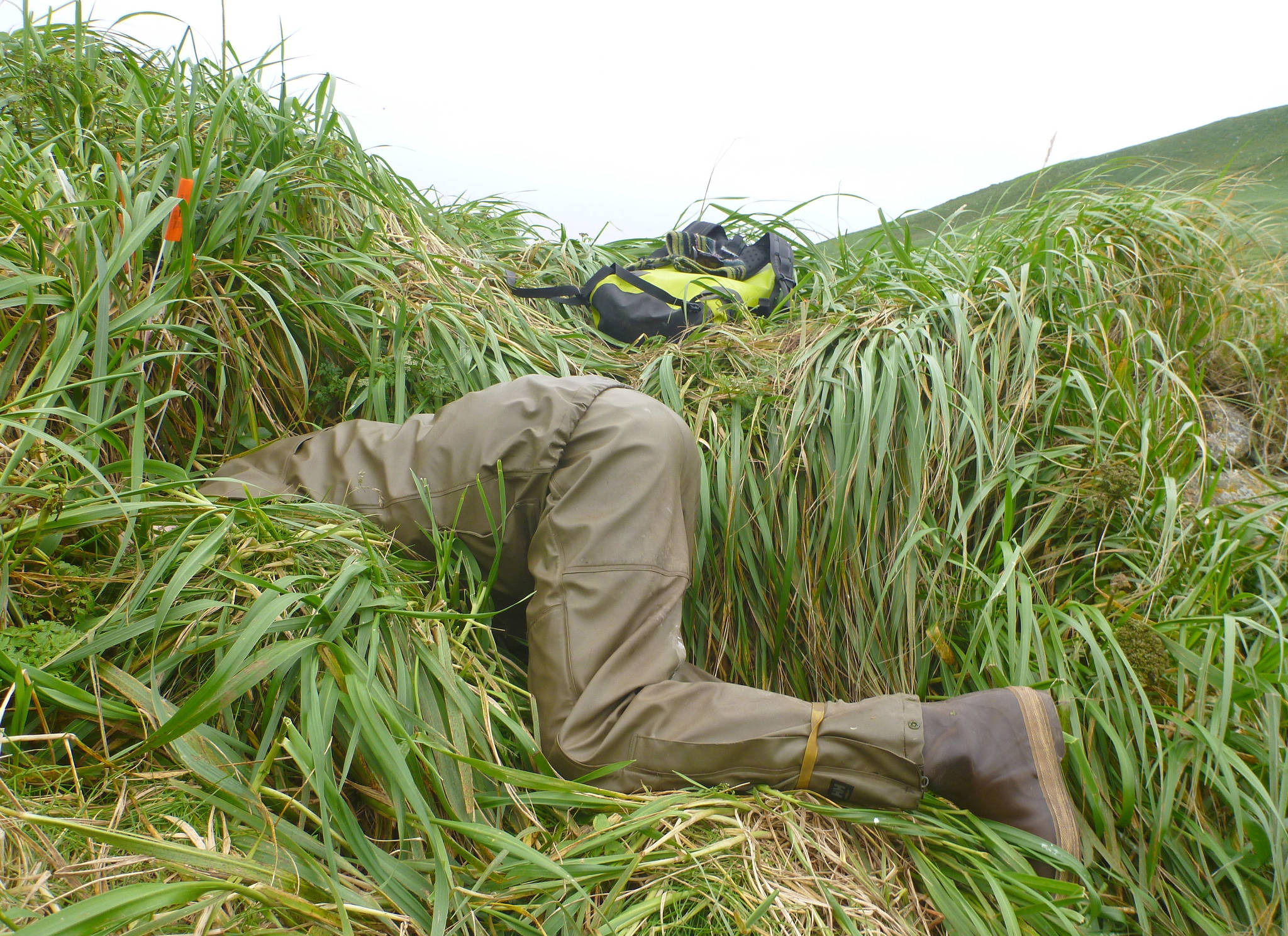
It’s summer in Alaska when the daylight hours are long and nearly countless wildlife is reproducing. Nearly countless, but not entirely.
A crew of biologists is scattered on islands hundreds of miles from harbors, doing their best to count and study seabirds. The birds and the biologists may hold the keys to understanding our vast ocean.
Alaska Maritime National Wildlife Refuge sends a suite of curious scientists each year to explore its far-flung territory. The refuge extends from Cape Lisburne on Alaska’s North Slope, where walrus haul out on the beach, to the uttermost islands in the Aleutian chain, reaching toward Russia. Islands in Alaska’s southeastern panhandle are also under its purview.
It’s a huge area, incorporating lands and waters and cultural zones almost too vast to comprehend. Some of these places have been under federal protection for over a century for the sake of wildlife.
“But we still don’t have it all inventoried,” said Jeff Williams, Deputy Refuge Manager and a biologist who has spent many years exploring and working to understand the intricate web of life that connects land and sea so that we can make informed decisions on how we can protect it.
That’s the purpose of the refuge, in fact: to conduct research to understand the marine world it is charged with protecting.
But getting a look at the systems that shape life in the ocean isn’t easy. So how can researchers understand a world so difficult for land-living humans to observe?
We do this by looking at birds, especially the kind that eat fish and other tidbits from the water. But birds that make their living on the ocean are not always easy to find.
For much of the year, they bob, dive and soar over the trackless vastness that covers 71% of our planet. But in summer, birds come ashore to lay eggs, and that’s when biologists can best observe them.
It’s a hands-on process. Some birds, like rhinoceros auklets and fork-tailed storm petrels, dig into the dirt beneath trees and brush and lay their eggs at the end of branching tunnels.
Here’s how one researcher describes the experience of searching for an auklet tunnel: “To peer into these burrows with a flashlight (instead of reaching an arm in) definitely required a lot more face-in-the-mud action than usual. By the end of the day, I had a very full mud-beard and my hat had changed color from blue to brown.”
It’s not always storm petrels occupying the tunnels, as reported from a rain-drenched field camp in Southeast Alaska: “Have you ever shoved your arm down a tight, muddy hole in the ground, crawling your fingers down the tunnel, grasping blindly for a warm, feathery bird, only to make contact with a very slimy, very large banana slug?”
Other birds nest in well-concealed niches in rocks, like puffins, or even, as in the case of murres, lay their eggs directly on a rock ledge with no nesting material at all. Common murre eggs are more elongated than chicken eggs, a shape that tends to roll in a tight circle, preventing it from falling off a ledge.
They are also very large, at 11% of the size of the females who lay them. That’s about the same as a 140-pound woman giving birth to a 15.4-pound baby!
Biologists observe nests on ledges and count the number of birds “rafting” (floating together in the water) from vantage points with high-powered scopes, a task often complicated by weather: “Today we continue life in the fog. Not sure we recall what sun was like. For the raft count, the fog pulled back just enough to see the cove; then as we suited up with high hopes for a possible expansion of our visual range, the fog closed in once more.”
In addition to the weather, research is seldom glamorous. Biologists collect diet samples, which might require working at night, trapping birds en-route back to their nests and getting them to upchuck their stomach contents. But sometimes these less than glamorous activities can bring on the unexpected. “It was a very dark night with dense fog and crashing surf as whiskered auklets, Cassin’s auklets, and ancient murrelets took turns crashing into us in the dark. Jillian couldn’t help but get her first good look at a Cassin’s auklet when it bounced off her stomach.”
Other diet samples are collected around the nests. One researcher noted that a black oystercatcher nest with three chicks can, over the course of a week, “produce enough mussel, limpet, chiton, snail, gooseneck barnacle, and mollusk shells to completely fill two quart-size baggies!”
The birds are often displeased with the human presence. They attack biologists who venture close to investigate whether eggs are hatching: “No gull chicks yet, but some good head bonkin’ and a poop to the face let us know the eggs are cooking along nicely and the chicks should be here soon.” Some birds are so aggressive that biologists must wear hardhats for protection.
Later, field crews take refuge in tiny cabins or rugged tents, hunching over balky kerosene heaters, tallying data on laptops from inside sleeping bags. Daily living can be cramped, wet and smelly. “Drenched, dripping, and otherwise doused in island water, we worked our way home. Now all our clothes and gear hang outside in the breeze, hopefully not getting wetter. Nope, now it’s drizzling.”
But the enthusiasm they have for their work leaps from the words of their daily reports. “A wet and windy but satisfying day.” Another writes, “The Kamchatka rhododendron have begun to bloom in the tundra, leaving little pink explosions among the lichen.” While another asks, “Can someone who speaks storm-petrel please tell the adorable little creatures their chicks are the most precious thing on the planet?”
The data they gather provides a look at seabird populations year to year, measuring the health of the birds and their young, and the success of their breeding. All of which gives us a way to see change as it occurs. Are the populations increasing, declining or stable? The biologists in the field might be cold and wet and muddy for all the weeks of summer; but they know their work is worthwhile. The view their research provides is a window into the sea and our own future.
Julia Pinnix is the Temporary Visitor Services Manager at Alaska Maritime National Wildlife Refuge and helps the U.S. Fish and Wildlife Service fulfill its mission – working with others to conserve, protect and enhance fish, wildlife, plants and their habitats for the continuing benefit of the American people. We aim to be both a leader and trusted partner in fish and wildlife conservation, known for our scientific excellence, stewardship of lands and natural resources, dedicated professionals and commitment to public service. For more information on our work and the people who make it happen, visit www.fws.gov
By JULIA PINNIX
Alaska Maritime National Wildlife Refuge
