
Around this time of year I start to include a pair of binoculars in my checklist of essentials for heading out the door on a walk, but I have a confession. I’m a bird-watcher, not a birder and not a bird biologist.
Some of you will have no idea what the distinction is, but if you’re in one of those three categories you know the subtle differences between them.
Bird-watchers, like me, are more casual hobbyists. I like watching the birds at my feeder or when I’m out walking or paddling. I don’t bother to sort out every sparrow, but I am nerdy.
I have spent hours on the beach in Homer watching bird behavior. Birds do cool stuff! Instead of just dismissing the ordinary by thinking, “Oh that’s just a gull,” I pay attention to what the birds and their prey are up to.
Here’s an example. Birds and marine mammals use a variety of strategies to take advantage of the tremendous protein resource that fish provide. Meanwhile, the fish are doing some pretty interesting things, too.
Under the waves, the slim, silvery fish form bait balls to confuse predators. When the tide is out they hit the beach, burying themselves in the sand tail first.
Small gulls called kittiwakes plunge-dive on balls of sand lance swimming in the bay. Other gulls tap dance at the water’s edge, slapping their feet on the wet sand to scare the little fish up. Crows use their bills to dig the sand lance up on the beach.
I once watched a very confused looking juvenile gull following a crow around, seemingly unable to understand how the crow was so efficiently plucking fish from the sand.
In contrast to bird-watchers like me, birders are more systematic. Birding is more like a sport. Birders tally their sightings, perhaps for the competition aspect of trying to see how many birds they can spot in a location or period of time, like a Big Year.
They’ll take the time to learn and study birds to recognize them by their habitat, behavior, voice and plumage. Truly crazed birders attempt to sort out puzzles like the identity of a gull, requiring infinite patience since their plumage changes so much over their first few years of life.
Compared to the other categories, bird biologists are more like detectives. The Alaska Maritime National Wildlife Refuge’s seabird biologists study a narrow slice of the avian world to answer questions about the health of the ocean.
While I’m free to look through the kaleidoscope and just appreciate the beauty of all birds, my seabird biologist colleagues are looking at a suite of species and specifically focusing on their success rates during the breeding season on islands across Alaska.
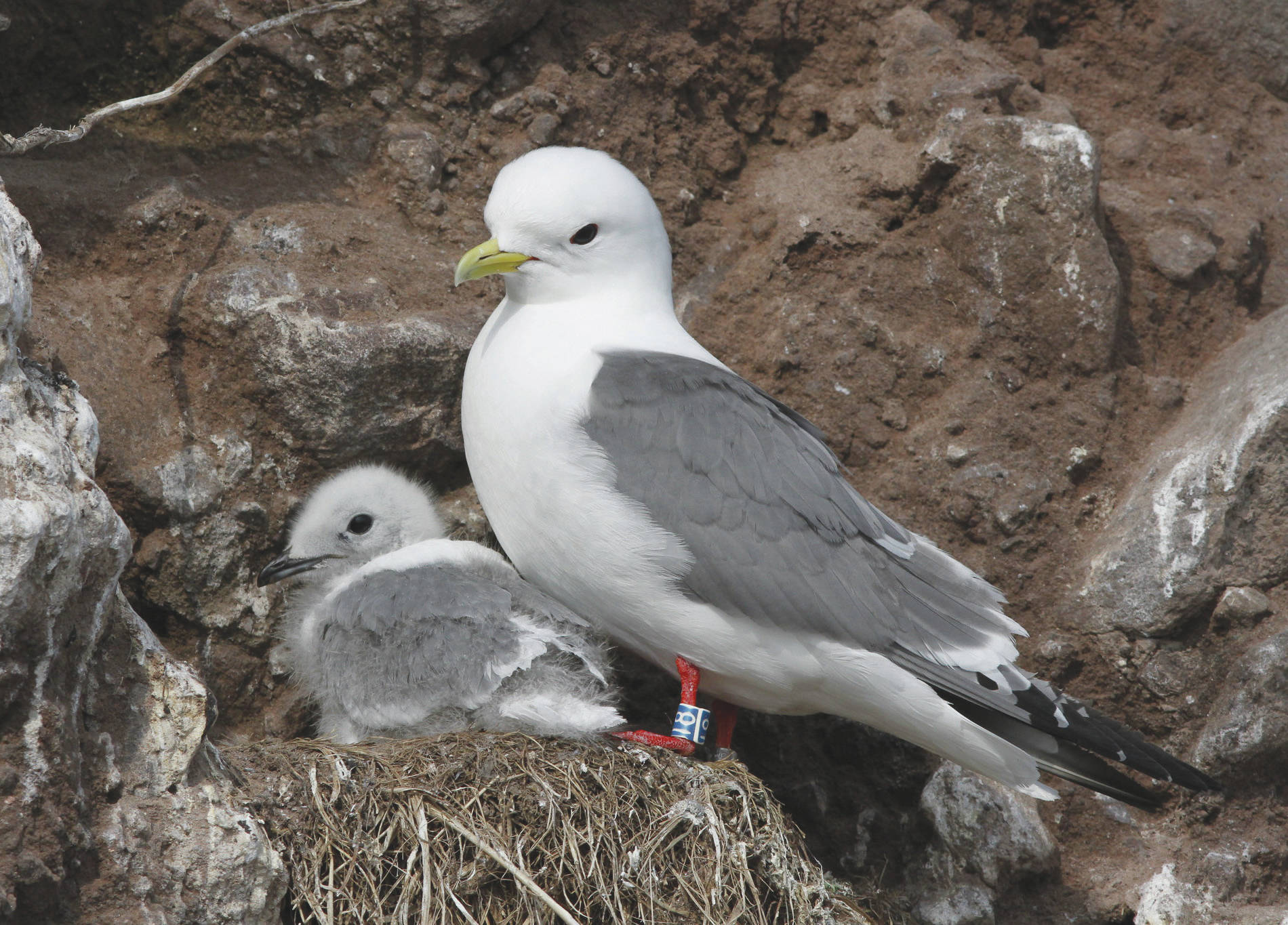
If you live on the Kenai Peninsula, you’re probably familiar with one of the birds that we study, the black-legged kittiwake. They occur across the northern hemisphere and most of our annual monitoring sites from the Gulf of Alaska, across the Aleutians and up to the Chukchi Sea.
During the winter months kittiwakes leave our shores and head out to sea, but spring has called them back and they’re already staking claim to the spots where they hope to build nests.
Black-legged kittiwakes have a cousin with fire-engine red legs. In contrast to the ubiquitous black-legs, red-legged kittiwakes are rare bird with a very limited range. They nest only in the Bering Sea, with most of their population breeding in the Pribilof Islands. The only other places that they nest are a few sites in the Aleutian Islands and on Russia’s Commander Islands. Until now.
Although some red-legged kittiwakes winter in the northern Bering Sea, they are rarely observed in this region during the breeding season. Marc Romano, a refuge biologist, was surprised in 2018 when we began documenting these birds nesting on St. Matthew Island, a 240-mile northward extension of their breeding range.
Why the dramatic shift in habitat? We’re not sure. Climate chaos is mixing up natural interrelationships on a warming planet, and for some species that means that they can’t find the food they need to survive.
In 2015–16, a warm water ocean blob resulted in massive murre die-offs. More seabirds met the blob and found starvation in successive years. Could a warming ocean also be affecting the red-legged kittiwakes? Are they responding to climate change by moving northward?
Red-legged kittiwakes have had some bad years recently. Some colonies have had multiple years of near complete breeding failure and adult survival may be declining. While we understand a lot about what’s happening to red-legged kittiwake colonies during the short breeding season, the eight-month period when they are at sea is more of a mystery.
With our partners at Oregon State University we’re using geolocators to track winter distributions of birds from two of the largest red-legged kittiwake colonies: Buldir and St. George Islands. Combined with our long-term seabird colony monitoring program, using tools like geolocators gives us a broader perspective on what’s driving the health or decline of this rare bird species.
Our seabird biologists will continue to study seabirds across the refuge, spanning Alaska’s vast coastline. I’ll also be keeping an eye on the birds with my fellow bird-watchers and birders. At a time when so many of us are feeling isolated, watching our feathered friends returning with the spring is a wonderful way to feel connected to nature and the rest of the world.
Marianne Aplin is the Visitor Services Manager for Alaska Maritime National Wildlife Refuge. Find more Refuge Notebook articles (1999–present) at https://www.fws.gov/refuge/Kenai/community/refuge_notebook.html.
By MARIANNE APLIN
Alaska Maritime National Wildlife Refuge
