
With the new snow and temperatures dipping into the single digits, you might find yourself hunkering down or replacing your summer outdoor gear for winter gear. As you go through the equipment and come across your bear spray, you may think about putting it away for the winter, assuming bears are denning.
Instead, however, you might consider keeping it in your winter gear. While the odds are not as strong that you will see a bear in winter as it is the rest of the year, you shouldn’t rule it out.
Why? Bears, like us, alter behavior to fit local conditions, causing biologists to use words like “tend to” and “appear to.” We know those terms can be frustrating to people, but with uncertainty and changing conditions year-to-year and season-to-season, there isn’t a hard or fast rule.
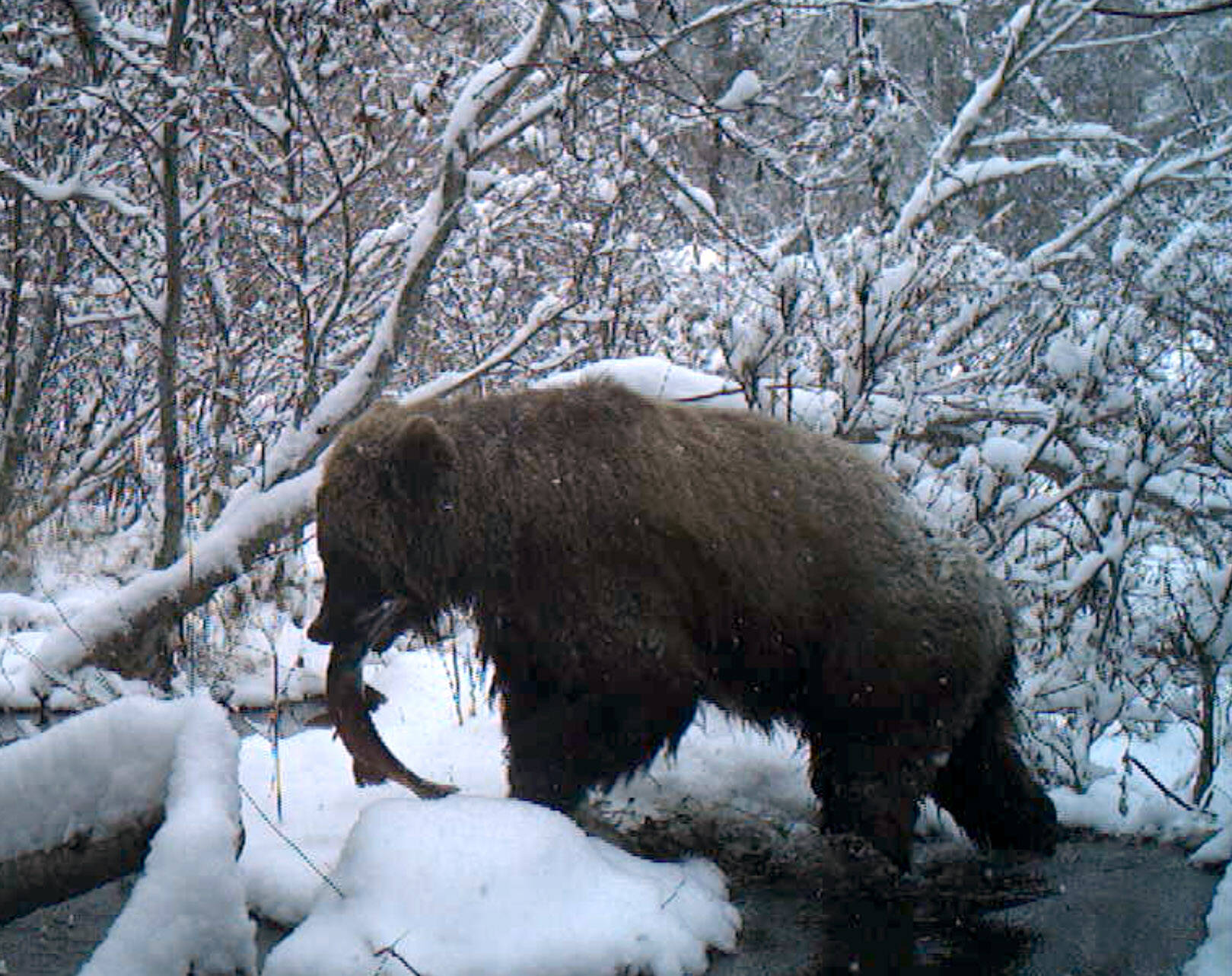
So, while bears “tend to” den from October through April, when there is enough food around or a particularly warm fall, bears may delay den entry or may not even den at all, as seen in some male bears on Kodiak Island. In a place like the Kenai, where salmon are still found in the streams at the start of winter, bears may not den as early as you might expect.
I saw this phenomenon play out long ago while studying black bears in Virginia. Following a good fall crop of acorns, where acorns were like marbles under your feet on north and eastern slopes in the forest, our radio-collared male bears entered dens later than previous years. Couple the abundant fall food source with a low snow year, and throw in the milder climate of the south, and not surprisingly, some adult radio-collar males never denned at all.
Here on the Kenai, you may have heard stories or seen for yourself bears still fishing or feeding on a moose carcass in the dead of the winter when you assumed they were safely tucked away.
So, if the timing of den entry can vary, why den at all? One reason is that dens provide pregnant female bears with a safe place to give birth. Cubs are considered altricial young; like felids and canids, they are born hairless, with their eyes closed, and unable to move, and denning provides good security for their start in life.
Hibernation is also a critical physiological adaptation for winter survival when food tends to be naturally scarce and conditions, such as deep snow and cold temperatures, are energetically tasking. Their metabolic system slows down, and they rely on food stores for the five to seven months they are denning.
Bears acquire these food stores during hyperphagia, a period when bears eat excessively, typically from August to October. Incredibly, during this time, bears consume 15,000 to 20,000 kilocalories per day!
In addition to consuming an impressive amount of calories, which is converted to fat, allowing the bears to survive through the denning season, bears have unique physiological mechanisms that make denning possible.
While denning, a bear’s heart rate and respiration slow, body temperature drops a few degrees, and metabolism decreases almost by half while the bear lives off fat reserves. The fat is converted into protein so the bear can make it through the long winter months.
How do we know this? Advancements in technology, used on other bear studies across the nation, including a study at the University of Alaska Fairbanks, have helped us gain more insights into a bear’s physiological changes and cycles.
Subcutaneous heart-rate monitors in radio-collared black bears have found heart rates follow a seasonal cycle that tracks the denning season. Heart rates are at the highest in summer, with 70 to 90 beats per minute.
As summer moves into fall, the hyperphagic period, the rate begins a slow decline to approximately 40 bpm. During hibernation, heart rates are at their lowest — an average of 20 bpm — which incrementally rises to 30 to 45 bpm in the spring during “den emergence.”
Bears also only lose a surprising 15 to 25 percent of their body mass, and they don’t get bedsores or osteoporosis while denning. Instead, they emerge from their dens in the spring with a slowly returning metabolic rate and body temperature, lean muscle mass that hasn’t atrophied, and normal bone density.
This surprising fact led researchers from NASA to want to learn more about this physiological mechanism. As a young biologist working on a bear study in Maine, it was my first look at the range of physiological adaptations that make sleeping for five to seven months possible. A small team from NASA came along with us as we visited radio-collared bears in their dens.
We collected blood from the denning bears to try and understand these physiological adaptations and ultimately apply them to humans. Additionally, recent work on wild black bears in Michigan also sought to evaluate the mechanisms in which bears do not run the risk of blood clots in their veins during periods of reduced activity, as seen in humans. Through investigations like these, we may see improvements in human well-being as researchers continue to disentangle the mysteries of the natural world.
While bears are uniquely and impressively built to survive the winter, they also adjust to local conditions. This leads scientists to use that pesky phrase “tends to,” which means that some bears on the Kenai may already be denning, but some may take advantage of the late salmon and delay den entrance.
So, remember, there is no time of the year when bears are not inactive. As we recreate in and live adjacent to bear habitat, we can do a few things year-round to reduce interaction with bears. While recreating, think of bear spray like a fire extinguisher; it is always better to have it and not need it than to need it and not have it at all!
Alaska Game and Fish recommends to reduce attracting bears at your home or cabin, use a bear-resistant trash can or keep it secured in a building, don’t leave salmon smokers unattended or place an electric fence around it, and keep windows and doors locked when you are not at home. For additional tips visit https://www.adfg.alaska.gov/index.cfm?adfg=livingwithbears.bearharmony.
Kris Inman is the Supervisory Wildlife Biologist on the Kenai National Wildlife Refuge. Earlier in her career, Kris worked on black bear research projects throughout the Lower 48. Find more Refuge Notebook articles (1999–present) at https://www.fws.gov/refuge/Kenai/community/refuge_notebook.html.
