
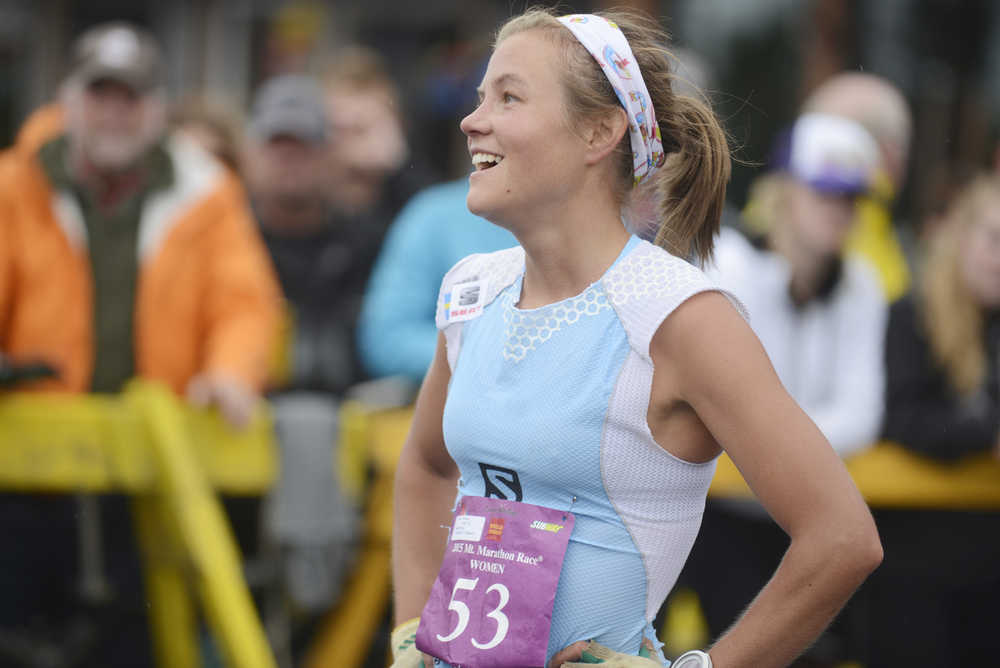
The power of competition was easy to behold at the 88th running of Mount Marathon in Seward on Saturday. The power of joy proved harder to explain.
So we’ll do competition first, and talk about how a slow start to the Cook Inlet sockeye run in 1969 forever changed the 3.1-mile race up and down a 3,022-foot peak.
Patricia Schultz, who would become Patricia Gates, was planning on making money at a cannery in Kenai to keep fueling her hitchhiking adventures across the country. But due to the slow salmon run, she thumbed it to Seward, where she found that telling restaurants she would race Mount Marathon resulted in free food.
Schultz finished second in the race, and the framed mementoes would watch over her son, Rickey Gates, for the first two decades of his life, as Gates recounts in an April 2014 magazine article in DIRT: The Trail-Running Life.
In 2013, Gates, by that time a runner accomplished enough to earn sponsorship from Salomon, would trace those mementoes to Seward to compete in the race himself.
He found an event with two hallowed records — Bill Spencer’s 43:21 in 1981 and Nancy Pease’s 50:30 in 1990.
Would they ever be broken?
“Oh, sure,” the thinking went. “Records are made to be broken. But the up trail on the top half of the mountain sure has degraded over the years, and the snowfield allowing a rest and swift descent isn’t as common or long as it used to be … .”
Then came competition, the oldest performance enhancer around.
In a runner-up performance mimicking his mother’s, Gates would spur Eric Strabel to a 42:55 with his 43:04 in 2013. That was two under Spencer’s standard.
Gates would then talk Salomon stablemates and international mountain running superstars Emelie Forsberg and Kilian Jornet into a Seward sojourn this year, not for the prize money — the race has none — but for the opportunity to discover a mountain race as pure as the stream cradled in Marathon’s bowl.
Forsberg, with an otherworldly 47:48, would lead Soldotna’s Allie Ostrander, in her senior debut, to cross the line two seconds better than Pease’s mark. And this was an Ostrander that had spent the month biking and swimming to heal a hip injury, an Ostrander that had been all the way to the top of the mountain just three or four times before Saturday.
The men’s race proved more testament to competition, with Jornet at he-did-what? 41:48, Gates at 42:56 and Anchorage’s Jim Shine at 43:11, all stepping ahead of Spencer.
Fourth-place finisher Strabel, at 43:26, would have won all but two of the previous 87 Marathons. Nick Elson of British Columbia had a 43:46 that was good for fifth this year, but would have put him on top in all but three of the first 87.
There is much to be learned from the standard-altering performances of Forsberg and Jornet, such as a downhilling technique in which the feet perform Riverdance while the upper body hang-glides down the steeps, hands flapping overhead nearly the whole time.
But the quality I most wonder about is joy.
Mount Marathon is supposed to be a towering, shale-topped slab of pain. Of thigh-pounding torture. Of rock-drawn blood. Of soul-sapped tears.
An ascent during which you feel like you’re going to die. A descent which can kill you.
So what’s with Jornet spidering down the base of the cliffs with the look of a child crashing down the stairs at Christmas?
What’s with Forsberg gathering herself just before the finish and dashing forth with the ebullient glee of kids bounding through a sprinkler on a scorching summer’s day?
There are many memorable moments from the couple’s master mountain class Saturday — the start of Jornet’s descent at the one-hour mark in KTVA’s coverage needs to be seen to be believed — but I think, or maybe I hope, that the most durable impression came about 20 minutes after the winners crossed the line in the women’s race.
I had finished my interviews and was trying to squeeze out of the crowded, barricaded finish area next to the medical tent. As I was plotting my egress — I should be able to slide between those two guys leaning over the wood barrier — I suddenly realized one of those “guys” was Jornet.
He’s doing as much as anybody right now to redefine what is possible for the human mind and body, but his 5-foot-7, 125-pound frame, cloaked in the standard outerwear one sees on the Fourth in Seward, had rendered him remarkably unremarkable.
It would have been easier for me if he’d stepped aside just a bit. But he wasn’t moving. Not because he was being rude, or arrogant, but because he was transfixed.
And that’s what I hope I’ll remember from this year’s Mount Marathon. Just how intensely his dark eyes were inquisitively winnowed in on the scene of exhausted, gritty triumph unfolding before him. He wasn’t cheering, wasn’t there to be seen. He was there to search. To learn.
What, though? What’s a guy who day-hiked Mount McKinley in under 12 hours, a guy who has achieved one-name status amongst mountain and trail enthusiasts around the world, got to learn from women crossing the Mount Marathon finish line at the 1:10 mark?
That’s when I thought of what Jornet wrote in 2011’s “Run or Die.” As she leaves him, Jornet’s former girlfriend notes that walls once plastered with Jornet’s sports idols now are solely devoted to Jornet’s accomplishments.
“Where have you put your myths?” she asks. “When did you change your idols?”
Jornet is faced with the realization that self-idolization is an endless, closed loop that swallows progress. But where to find idols now that he had achieved so much success in sport?
“… It gave me the strength to seek out new idols — the ones within each person,” Jornet writes. “It motivated me to find strength and inspiration from those around me, because the winner isn’t the strongest, but rather the one who truly enjoys what he is doing.”
When I asked Jornet later why he was so focused on the women’s finish area, he said it is because most of the races he attends have about 70 percent men, and he loved the way Mount Marathon had equal slots — 400 apiece — for the men’s and women’s races. He also got a kick out of watching the 300 entrants in the junior race, an event for which he had to volunteer to earn his spot in the men’s field.
Jornet looked to them for joy, a quality he deems essential for inspiring new levels of athletic performance.
I know, I know. Joy is an inadequate, and downright ludicrous, explanation for Jornet’s athletic talent.
What does joy have to do with Jornet’s lifetime spent at altitude to increase his red-cell count and lung capacity? His childhood spent walking in the woods with bare feet at night, honing balance and body awareness? The endless library of knowledge that comes from spending a lifetime doing one thing — in Jornet’s case running and skiing in the mountains?
But that misses the point. None of us will ever have a VO2 max — a measure of oxygen consumption — of Jornet’s 89.5 when, according to The New York Times, a college distance runner is normally a 60 to 70 and an average male is 45 to 55. It’s too late to grow up walking barefoot at 6,500 feet in the Pyrenees and spend a life in the mountains.
But each of us does have Jornet’s capacity to seek and savor the joy of athletic striving and achievement. And deep down inside, as much as culture tries to mask it, I think we know that. Thousands flock to roar and race in Seward each year not for the intense pain and extreme suffering, but for the inspirational elation that comes when that pain and suffering can’t bring runners down before the finish line.
They come for that joy.
“I have seen individuals who, though they have come in after the leaders have had time to shower, eat lunch, and even take a good siesta, feel that they are the winners,” Jornet writes. “They wouldn’t change that feeling for anything in the world. And I envy them, because, in essence, isn’t this a part of why we run?”
I believe him. I saw him searching for that feeling and saw Forsberg and Jornet, shamelessly, running with it.
This column is the opinion of Clarion sports editor Jeff Helminiak. He can be reached at jeff.helminiak@peninsulaclarion.com.
