
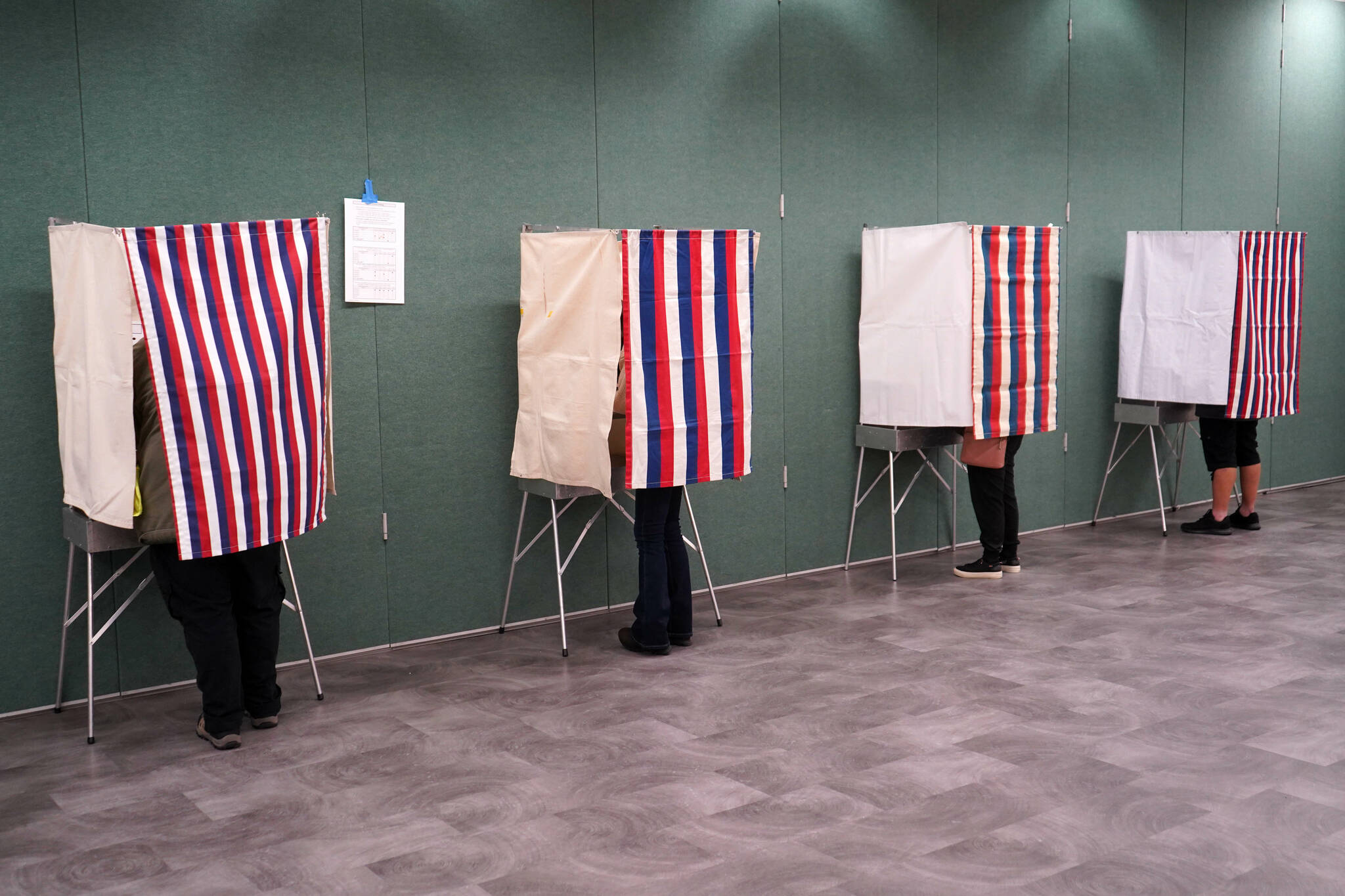
A signature drive is underway for a ballot measure officially titled the United States Citizens Voter Act. Supporters say it would “clarify” that only U.S. citizens may vote in Alaska elections. That may sound harmless. But Alaskans should not sign this petition or vote for the measure if it reaches the ballot. The problem it claims to fix is entirely imaginary and its real intent has nothing to do with election integrity.
Alaska already requires voters to be U.S. citizens. Election officials enforce that rule. There is no bill in Juneau proposing to change it, no court case challenging it, and no Alaska municipality contemplating noncitizen voting. Nothing in our election history or law suggests that the state’s citizenship requirement is under threat.
Which raises the real question: if there’s no problem to solve, what is this measure actually for?
The answer has everything to do with election politics. Across the Lower 48, “citizenship-voting” drives have been used as turnout engines and list-building operations — reliable ways to galvanize conservative voters, recruit volunteers and gather contact data. These measures typically have no immediate policy impact, but the downstream political payoff is substantial.
Alaska’s effort fits neatly into that pattern. The petition is being circulated by Alaskans for Citizen Voting, whose leading advocates include former legislators John Coghill, Mike Chenault and Josh Revak. But the group’s own financial disclaimer identifies a national organization, Americans for Citizen Voting, as its top contributor. The effort isn’t purely local. It is part of a coordinated national campaign.
To understand where this may be headed, look at what Americans for Citizen Voting is doing in other states. In Michigan, the group is backing a constitutional amendment far more sweeping than the petition: it would require documentary proof of citizenship for all voters, eliminate affidavit-based registration, tighten ID requirements even for absentee ballots and require voter-roll purges tied to citizenship verification. In short, “citizen-only voting” is the opening move — the benign-sounding front door to a much broader effort to make voting more difficult for many eligible Americans.
Across the country, these initiatives rarely stand alone. They serve to establish the narrative that elections are lax or vulnerable, even when they are not. That narrative then becomes the justification for downstream restrictions: stricter ID laws, new documentation burdens for naturalized citizens, more aggressive voter-roll purges and — especially relevant here — new hurdles for absentee and mail-in voters.
In the 2024 general election, the Alaska Division of Elections received more than 55,000 absentee and absentee-equivalent ballots — about 16 percent of all ballots cast statewide. Many of those ballots come from rural and roadless communities, where as much as 90 percent of the population lacks road access and depends heavily on mail and air service. Absentee voting is not a convenience in these places; it is how democracy reaches Alaskans who live far from polling stations.
When a national organization that has supported absentee-voting restrictions elsewhere becomes the top financial backer of the petition, Alaskans should ask what comes next.
Supporters say the initiative is common sense. But laws don’t need “clarifying” when they are already explicit, already enforced and already uncontroversial. No one has produced evidence that noncitizen voting is a problem in an Alaska election. We simply don’t have a problem for this measure to solve.
What we do have are real challenges — education, public safety, energy policy, housing, fiscal stability. The petition addresses none of them. It is political theater: an Outside agenda wrapped in Alaska packaging.
So if someone with a clipboard asks you to sign the Citizens Voter petition, say no. The problem is fictional and the risks to our voting system are real. And if the measure makes the ballot, vote no.
Stan Jones is a former award-winning Alaska journalist and environmental advocate. He lives in Anchorage.
