
Carl Benson’s last winter on Earth featured 32 consecutive days during which temperatures in his chosen town did not rise above zero degrees Fahrenheit.
“It’s cleansing,” the 98-year-old ice physicist said in December at the Fairbanks Pioneer Home. There, on Jan. 17, 2026, just after the cold snap broke, he passed away.
Benson found his place in Alaska as few people ever will. The tall Minnesotan arrived in Fairbanks in 1950 with the U.S. Geological Survey to perform reconnaissance geology in Naval Petroleum Reserve No. 4. He spent 1951 to 1956 with the U.S. Army Corps of Engineers Snow, Ice and Permafrost Research establishment, mostly in Greenland.
For three summers, Benson traversed the ice cap in a tracked vehicle known as a Weasel, digging hundreds of diagnostic snow pits with his grain shovel along the way.
Soon after, when Benson accepted an opportunity at the Geophysical Institute in 1960, he realized the unmatched value of the natural laboratory that is middle Alaska.
On the coldest days of winter, he drove around Fairbanks with a spatula, scraping into a vial the fallen residue of ice fog from plastic sheets he set out near busy intersections. In a paper that resulted, he calculated how much of that fog Fairbanks dogs emitted by exhaling (1,000 pounds of vapor each day).
On those same frigid streets, he drove with Sue Ann Bowling — the institute’s first female graduate student — with a thermometer suspended by a 6-foot pole from a car bumper. Bowling mapped out the city’s “heat island” when compared to the surrounding countryside.
Benson was fascinated with 14,163-foot Mount Wrangell’s volcanic interplay with the ice on its summit. He landed there 69 times in a plane piloted by Jack Wilson from Copper Center.
“(Benson) came back any time he could scrape up enough funding for some work on Wrangell,” Wilson wrote in his 1988 book, “Glacier Wings and Tales.”
“He was a real brute for punishment. A couple of times he stayed so long he lost weight and became a bit sick from constantly breathing sulfur fumes, as well as from the general hardship of remaining so long at high altitude.”
Back on the ground, Benson was politely pissed about affronts to his common sense, among them our country’s reluctance to embrace the metric system, daylight savings time’s misalignment with Alaska and the state’s lack of income taxes. In popular columns he wrote for the local newspaper, Benson described his Minnesota friend Bengt’s bewilderment at the Alaska state of affairs.
His mind was sharp as his ice axe for every minute of his near-century. Less than two weeks ago, from the bed upon which he passed, he worked with former graduate student Matthew Sturm on a paper in which they describe the significance of an atmospheric river that had drenched him on the Greenland ice sheet in the 1950s.
Benson is survived by his son Carl and daughters Sonja and Erika, as well as their families. His wife Ruth died in 2024. Benson’s many friends are now awash in memories. Here are the words of a few.
Matthew Sturm, a Geophysical Institute professor emeritus, a student and friend of Benson’s for 45 years:
“(Across Greenland from 1952 to 1955) Carl dug hundreds of individual snow pits, each precise — 3.75 meters long, 3 meters wide and 6 meters deep. In each pit he painstakingly measured the snow layers and their properties. From these pits and data, Carl began to put together in his mind a picture — a map really — of how snowfall in Greenland turned into a vast ice sheet.
“In 1993, using radar imagery from space, a group published an image of the entire ice sheet showing the facies (the characteristics, like wet and icy snow down low and pristine and dry snow up high). That satellite image was matched in uncanny detail by Carl’s 30-year-old hand-drawn map. He had figured out Greenland by shoveling snow.”
Carla Helfferich, writer of the Alaska Science Forum here at the Geophysical Institute for many years, including during Benson’s heyday:
“For me, there’s a feeling of a little less mischief in the world; good mischief, enlivening stuff now gone. My memory locks onto the image of Carl at institute Christmas parties, like a solemn choirmaster leading the assemblage in rousing renditions of the “Glaciologists’ Anthem,” which he had composed: ‘Ice is Nice … and good for you.’
“Pokerfaced, he once explained to me that Iowa should be referred to as Baja Minnesota. Then there was the time he handed me a book with a couple of grumpy-looking oldsters on the cover: ‘Swedish Humor.’ The book was blank.”
Roman Motyka, a Geophysical Institute professor emeritus and glaciologist:
“His fascination with Mount Wrangell Volcano bordered on an obsession. Carl and I (and others) spent years studying the volcanic heat and its effect on the glaciers. It became my Ph.D. dissertation. Carl taught me a lot about field work, especially about keeping accurate notes, and how to maintain levity and decorum despite working at high altitude and sometimes in stormy conditions.”
Martin Truffer is a Geophysical Institute glaciologist whom Benson greeted at the airport when Truffer first arrived in Alaska. Truffer inherited Benson’s fourth-floor office within the institute’s Elvey Building. There, Benson’s wood-handled ice axe still hangs from a chalkboard.
“My favorite thing about Carl was probably his great sense of humor,” Truffer said. “He made the same remarks on a very predictable basis and they never failed to bring a smile. Some examples — when he got on an elevator and somebody was already in there, he would always say ‘Thanks for stopping.’
“On winter solstice he sometimes called me up to point out that in only six months days would get shorter again.
“When he was studying ice fog (which forms at minus 30 degrees Fahrenheit) he would sometimes come in on a minus 20 day and complain, ‘One just can’t get any research done in this heat.’”
Ned Rozell is a science writer with the Geophysical Institute at the University of Alaska Fairbanks. Since the late 1970s, the institute has provided this column free in cooperation with the UAF research community.
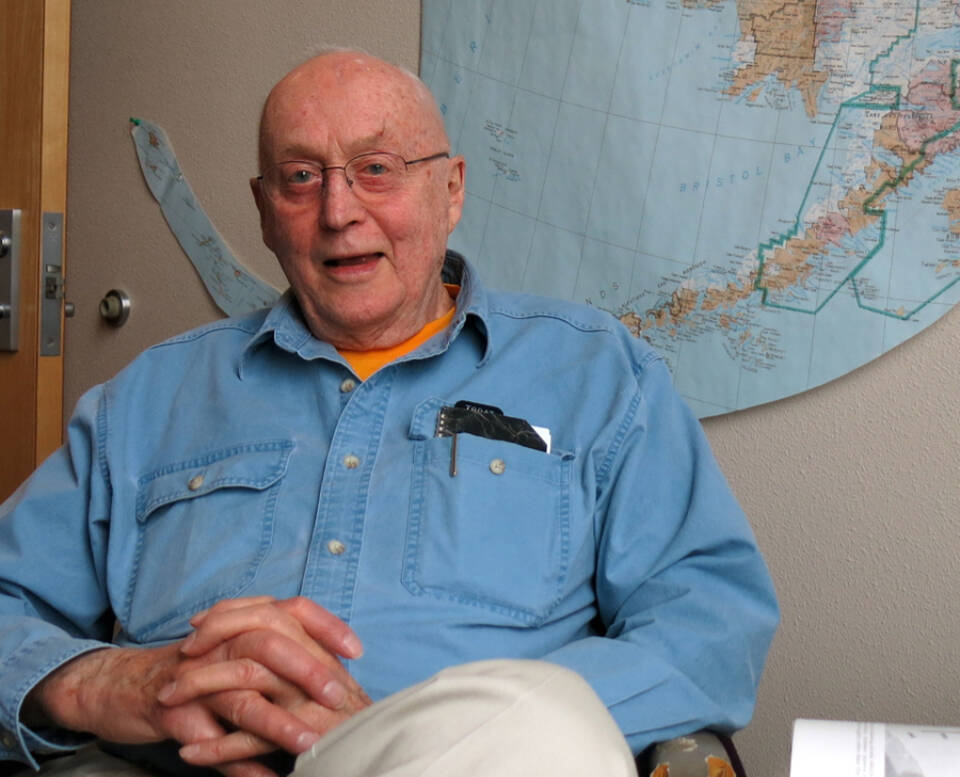
Carl Benson relaxes at the Geophysical Institute in Fairbanks in 2014. Photo by Ned Rozell
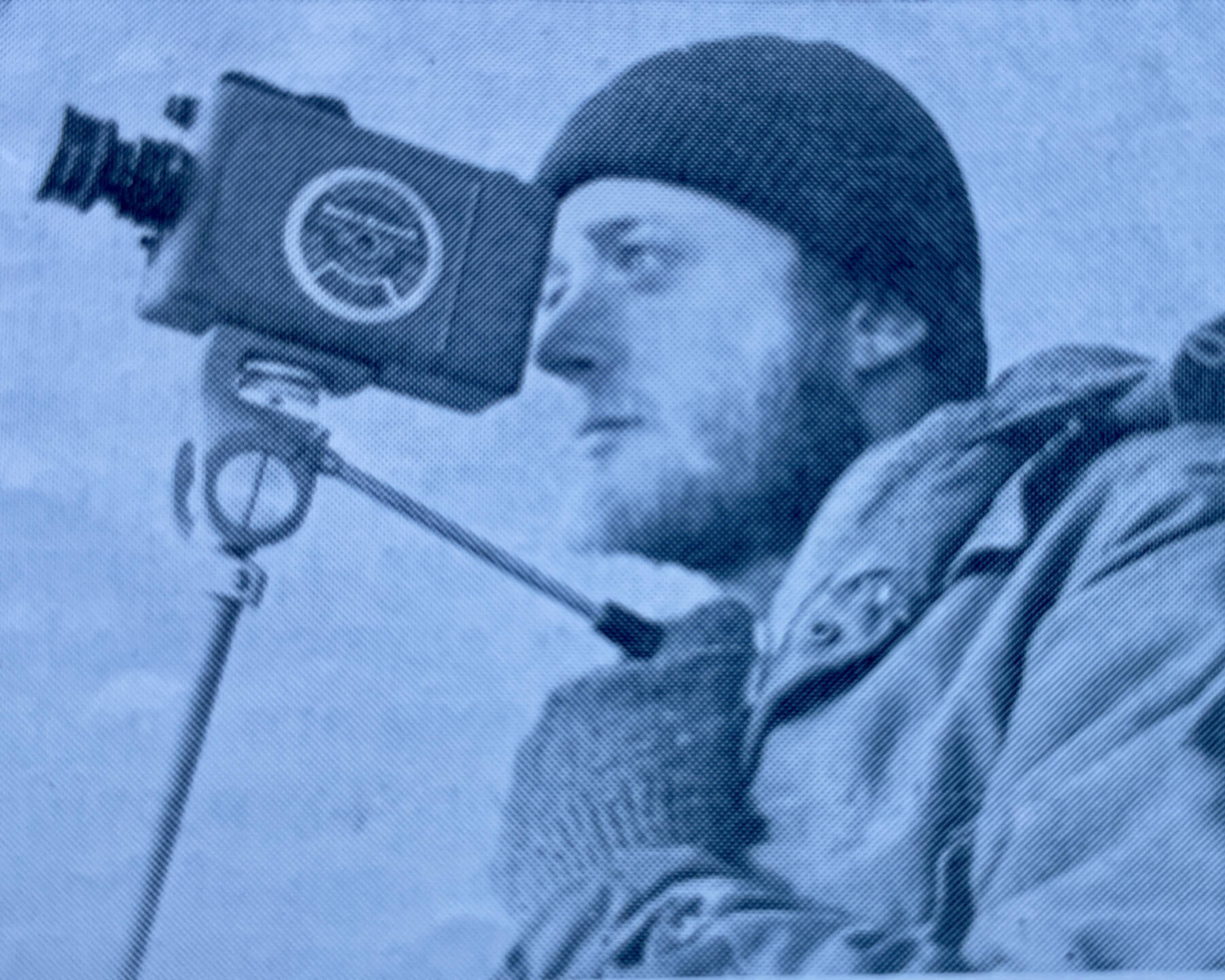
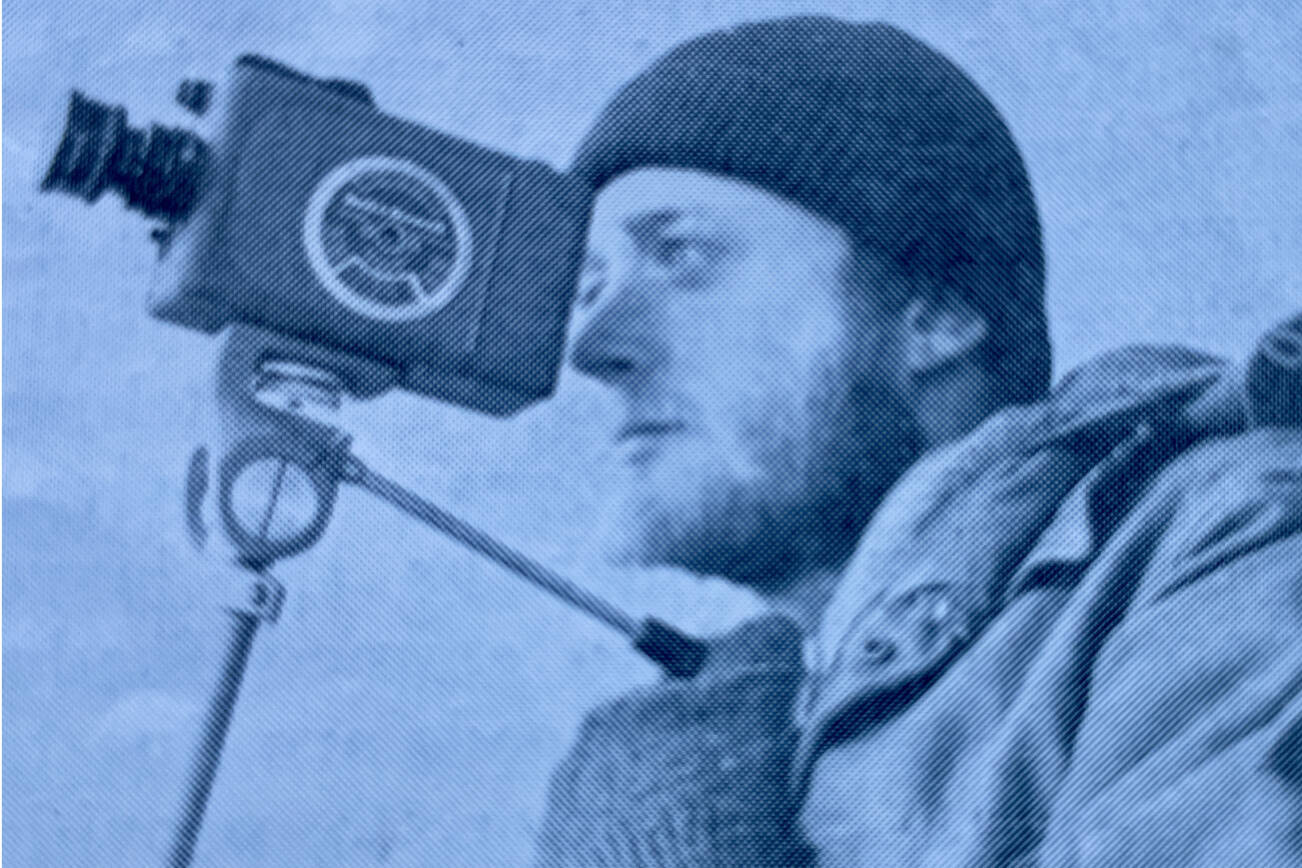
Carl Benson, born in Minneapolis in 1927, took this self-portrait of himself in Greenland when he was 28. Photo by Carl Benson
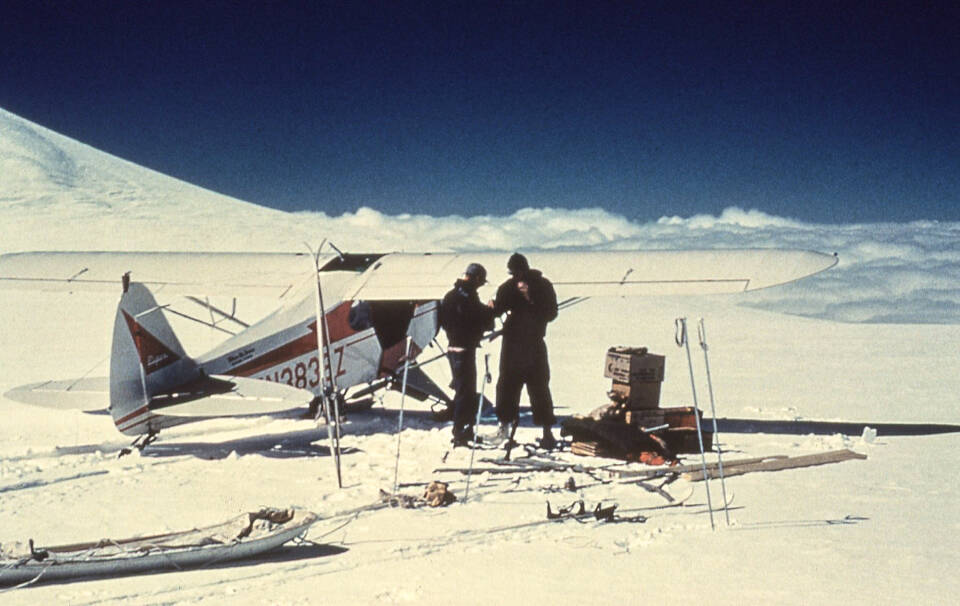
Carl Benson, right, and pilot Jack Wilson of Copper Center confer after landing near the summit of 14,000-foot Mount Wrangell. Photo courtesy of the UAF Geophysical Institute
Carl Benson, right, and pilot Jack Wilson of Copper Center confer after landing near the summit of 14,000-foot Mount Wrangell. Photo courtesy of the UAF Geophysical Institute
