
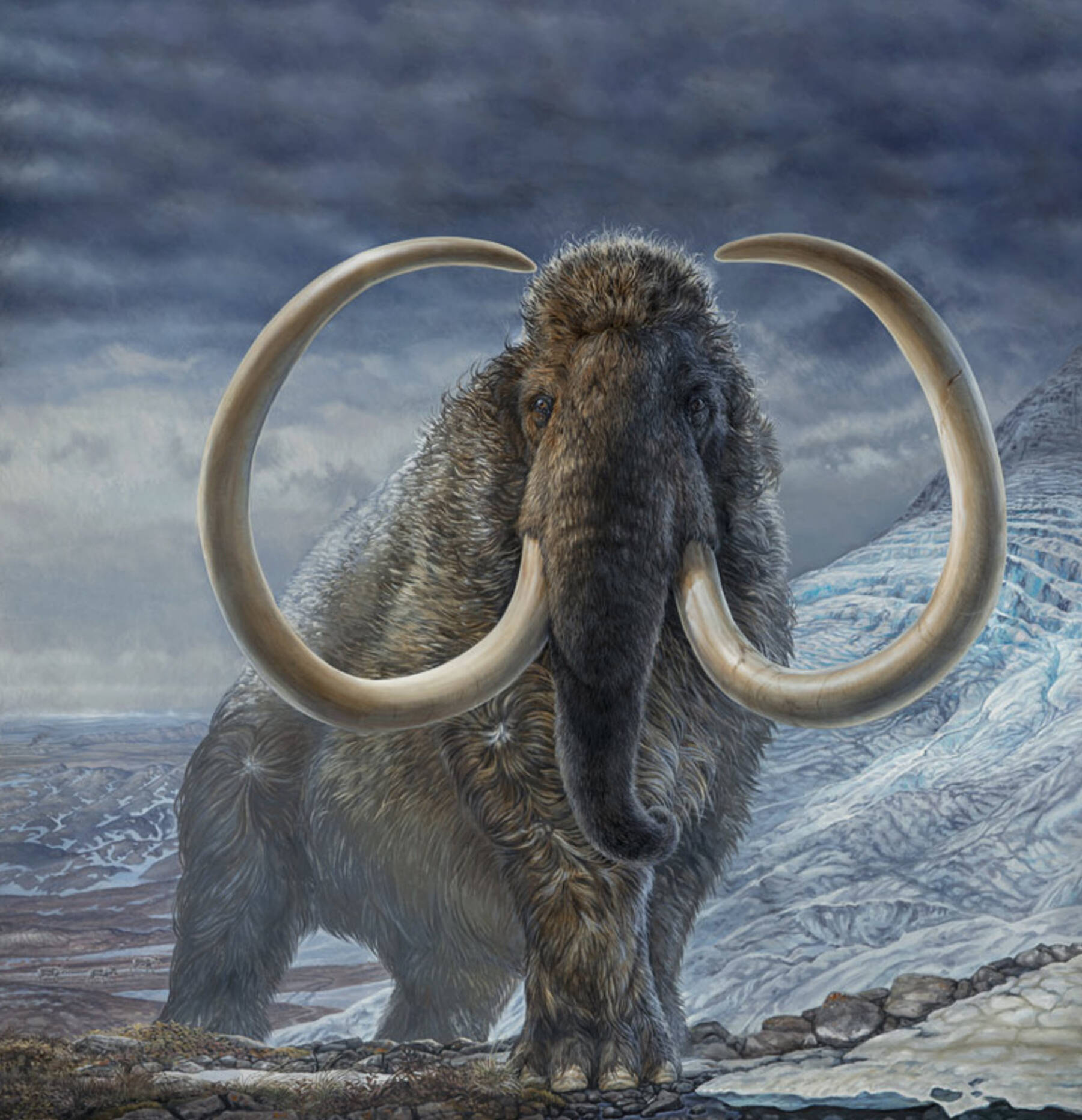
Matthew Wooller couldn’t believe his ears after a California researcher rang his cellphone recently.
The radiocarbon expert said a few of Wooller’s submitted fossils were from woolly mammoths that stomped the grasslands of middle Alaska thousands of years more recently than expected.
“I was pretty much gobsmacked,” Wooller said. “But then the rational science side of my brain kicked in — ‘We’ve got to do more forensic work here.’”
Wooller is a University of Alaska Fairbanks researcher and the driving force behind the Adopt-a-Mammoth project. He created that crowdsourcing effort to discover when the last woolly mammoth disappeared from mainland Alaska.
Adopt-a-Mammoth allows people — including me and my friend LJ Evans — to sponsor the radiocarbon dating of one the 1,500 or so mammoth fossils now resting in drawers within the UA Museum of the North’s Earth Sciences Collection.
Wooller knows that mammoths lived on Alaska’s St. Paul Island until about 5,600 years ago and on Russia’s Wrangell Island 4,000 years ago. The youngest mammoth fossil ever found in mainland Alaska is from a creature that died 13,000 years ago.
That’s why Wooller was puzzled to learn that two mammoth bones found amid the gravel in the gold-mining town of Dome City might be only 2,000 years old.
He and his colleagues, including the museum’s director and paleontologist Patrick Druckenmiller, were professionally skeptical.
“My first thought was, ‘Well, that ain’t right,’” Druckenmiller said.
The researchers then waited for DNA results on the two mammoth fossils, brown discs that were part of the mammal’s backbone.
They soon found that the genetic information showed the fossils were not from mammoths. They were whale bones.
“Here we had two whale specimens — not just that, but two separate species of whale,” Wooller said. “It just kept getting weirder and weirder.”
It turns out that mammoths and whales — in this case minke whales and right whales — each have similar, spongy connector bones in their vertebrae shaped like dinner plates.
That explained the scientists choosing them to extract a plug for the mammoth project, but what the heck were whales doing in Dome City, today a ghost town in a tight spruce drainage hundreds of miles from the ocean?
Wooller and Druckenmiller sketched out some possibilities.
One: Maybe the whales had swum hundreds of miles up the ancient Yukon and Tanana rivers to ground out at Dome Creek.
Two: Maybe bears or wolves or wolverines had carried the remains of their meals about 300 miles inland from the coast.
The scientists thought those two notions were far-fetched. They then consulted with archaeologists who told them that yes, ancient people valued those types of whale bone.
“It might have been used as a plate, a platter or for carving,” Druckenmiller said, “but (the bone) hasn’t been modified.”
There is another possible, ever-too-common explanation to the mammoth-whale mystery: human error.
Explorer and naturalist Otto Geist enriched the university museum with thousands of bones from the 1920s to the 1960s. He collected the fossils in question. The discs still bear his white paint script with the year, 1951, and sample number.
On July 7, 1951, someone at the museum processed a pile of bones donated by gold miners at Dome Creek. On the very same day, he or she also labeled and tucked away more than 20 fossils Geist had collected by from Norton Bay on Alaska’s western coast, where whales are common. Maybe the whale vertebrae found their way to the wrong bin.
“It is possible they got juggled,” Wooller said.
Wooller prefers to imagine an intrepid trader, alive at the same time as Jesus Christ, carrying the bones from the Alaska coast and exchanging them for a few shards of Interior obsidian.
“I like that one more than the accessing error,” he said. “That’s no fun at all.”
Ned Rozell is a science writer with the Geophysical Institute at the University of Alaska Fairbanks. Since the late 1970s, the institute has provided this column free in cooperation with the UAF research community.
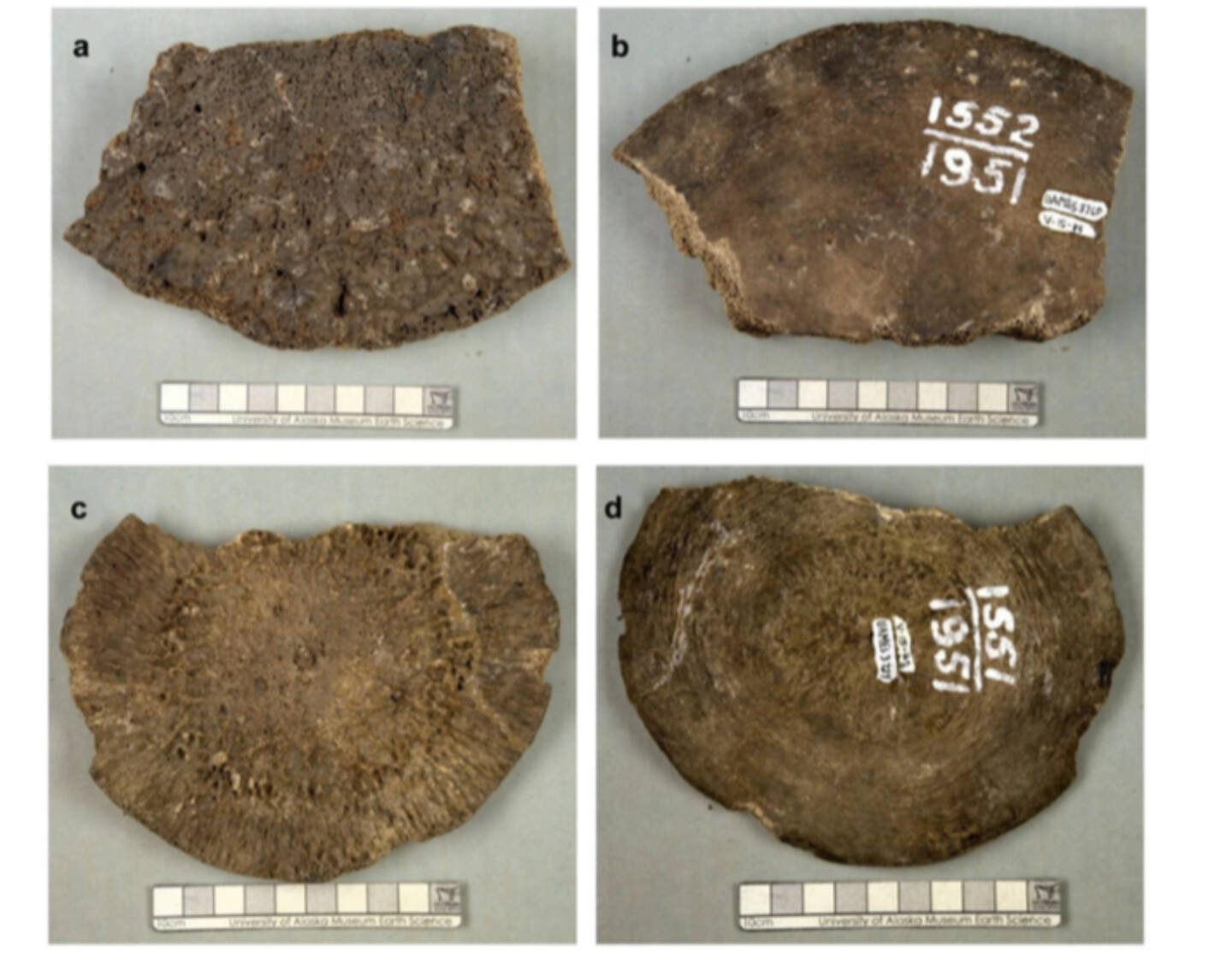
The late naturalist/explorer Otto Geist collected and labeled these fossils of whale vertebrae. Photo courtesy Univeristy of Alaska Museum of the North
The late naturalist/explorer Otto Geist collected and labeled these fossils of whale vertebrae. Photo courtesy Univeristy of Alaska Museum of the North
