
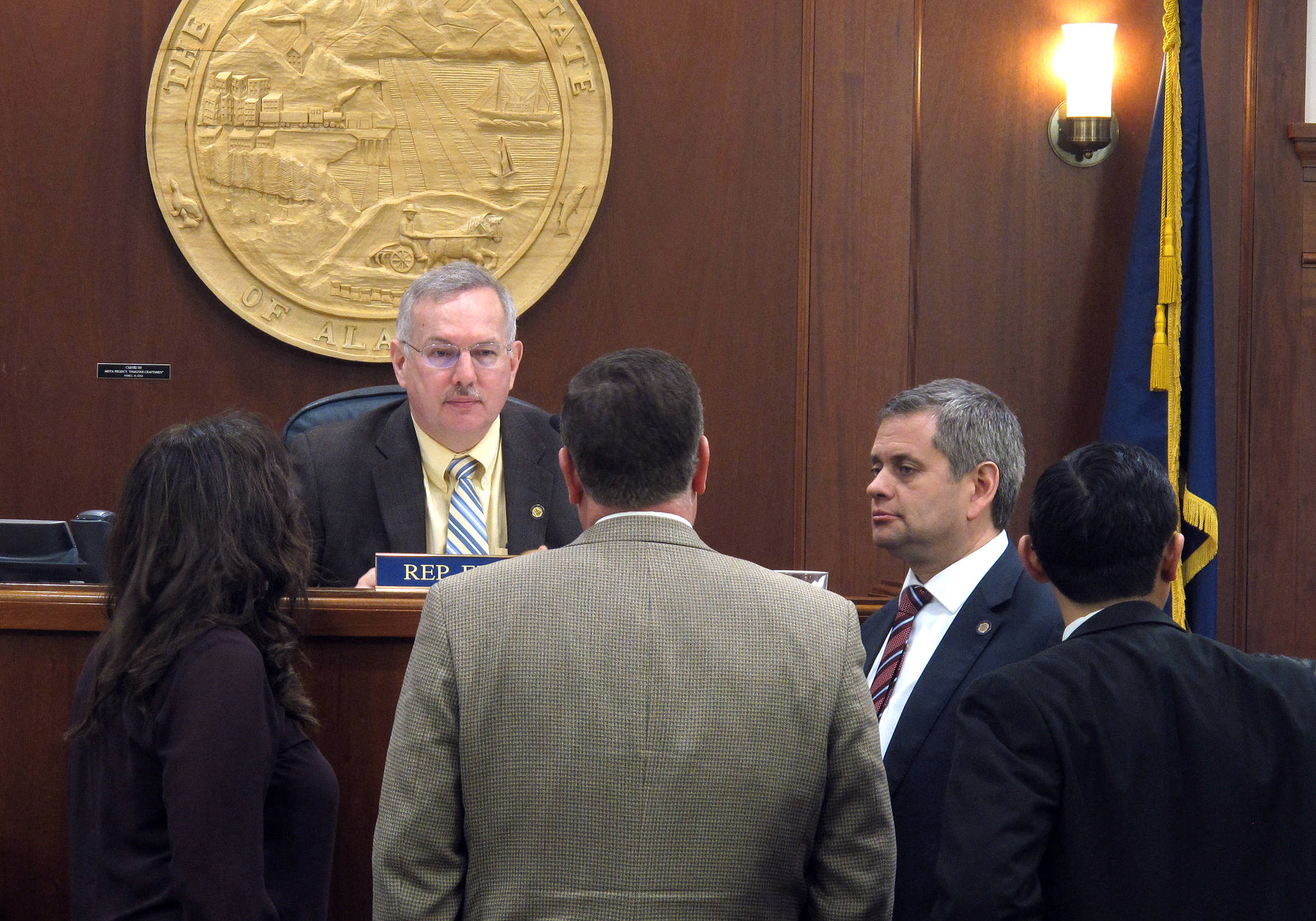
Several Alaska state representatives gather in front of state House Speaker Bryce Edgmon during a break in a House floor session on Wednesday, May 17, 2017, in Juneau, Alaska. (AP Photo/Becky Bohrer)

Several Alaska state representatives gather in front of state House Speaker Bryce Edgmon during a break in a House floor session on Wednesday, May 17, 2017, in Juneau, Alaska. (AP Photo/Becky Bohrer)

With deadline near, Alaska Legislature eyes taking more time

JUNEAU — Wednesday marked a constitutional deadline for Alaska lawmakers to end their regular session. But with a budget and plan for addressing Alaska’s multibillion-dollar deficit unresolved, more time was needed.

Options included extending the session for another 10 days, which requires two-thirds support in each chamber, or looking to Gov. Bill Walker to call a special session. House Speaker Bryce Edgmon said Wednesday there didn’t appear to be sufficient support to extend the session.

As of press time on Wednesday, both the House and the Senate remained in session.

House Minority Leader Charisse Millett said Tuesday that the House majority coalition, composed largely of Democrats, had failed during an already extended session to stay focused on the budget and a fiscal solution and that her Republican caucus was not inclined to support an extension. Support from within Millett’s caucus was needed to meet the two-thirds threshold in the House.

“At this point, obviously, we need the governor to lead the House majority to narrow the focus,” Millett said Tuesday. Under a special session called by the governor, the agenda would be limited to items he puts on it.

Edgmon, a Democrat from Dillingham, said that ideally the House would be working on fiscal issues with the Senate. But the two sides are at odds over how best to move forward.

“We’re going to stay here until we get the package that puts Alaska in the best shape to go forward and we don’t have to continue cutting schools and other important public services,” Edgmon said.

Lawmakers in April blew past a 90-day, voter-approved regular session limit. Wednesday marked the 121-day constitutional limit.

Over the last month, work has continued, particularly in the House, on bills not related to the budget or a fiscal fix. Bills on the House’s lengthy floor calendar Wednesday included a measure that would bar wolf hunting and trapping in certain areas adjacent to Denali National Park and Preserve and legislation that included what were seen as technical fixes to a sweeping criminal justice measure passed last year.

Edgmon said his coalition committed to staying busy and addressing other bills of importance while the Legislature was meeting. Bills that are alive at the end of the regular session will remain in play when the next regular session opens next year.

The Republican-led Senate, meanwhile, Wednesday approved allowing ride-share companies, like Uber and Lyft, to operate in Alaska. That bill now goes to Walker for consideration.

When it comes to a fiscal plan, there’s general agreement about using earnings from Alaska’s oil-wealth fund — the Alaska Permanent Fund — to help fill the deficit. But there is sharp disagreement over what else should be done.

The House majority has insisted on a broad-based tax, like an income tax, and changes to oil tax and credit policy as part of an overall solution. The Senate, meanwhile, has rejected the income tax bill passed by the House and proposed limits on future state spending.

The Senate also has proposed cuts to public education and the university system that the House majority considers too deep.

While lawmakers have moved to end future cashable oil tax credits, seeing the program that financially rewards oil exploration and production as too expensive, House majority members favor further changes to the state’s oil tax system than the Senate has supported.

Jessica Geary, finance manager for the Legislative Affairs Agency, said she did not have accurate reporting for extended session costs so far.

The new fiscal year starts July 1.
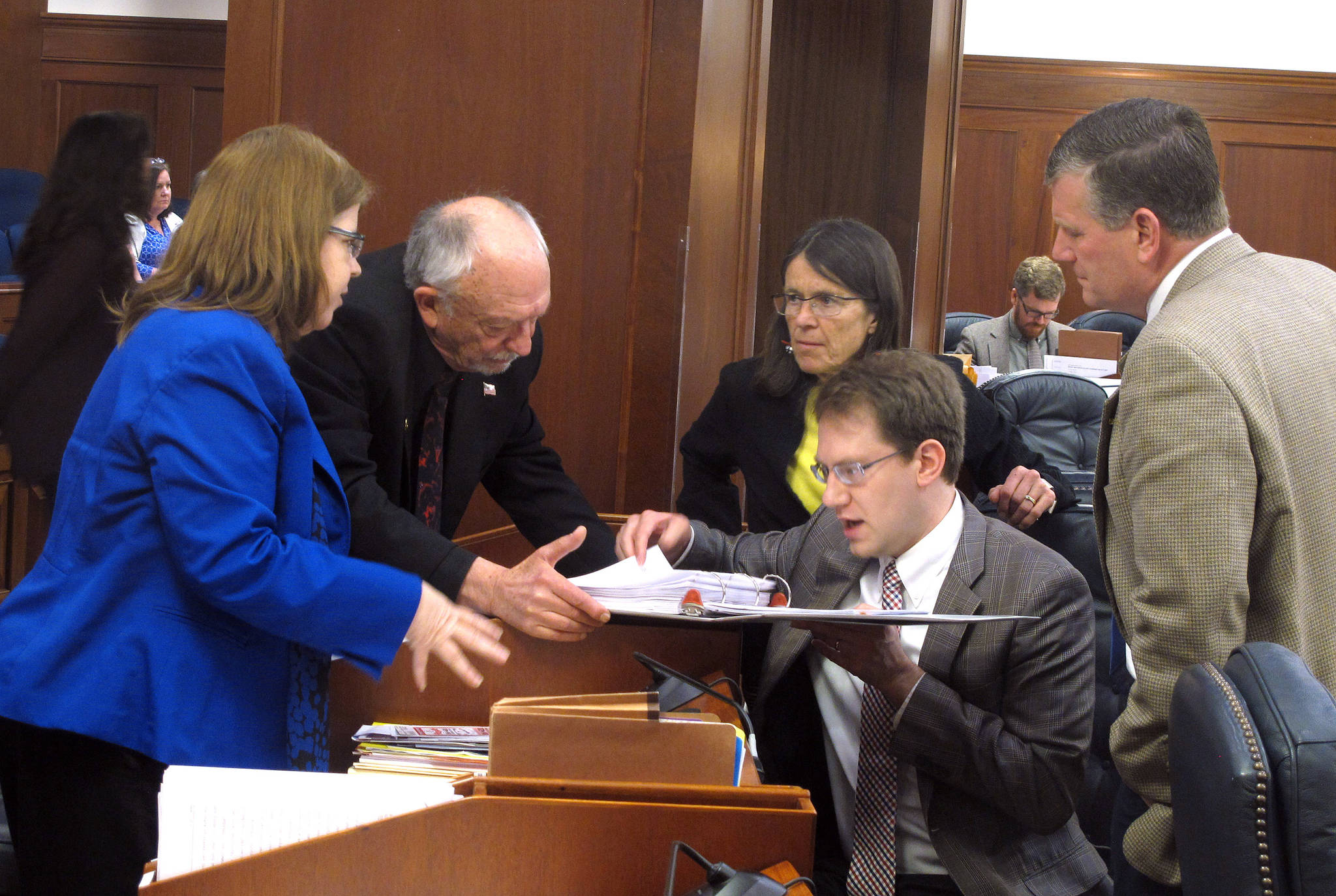
Several Alaska state representatives gather around Rep. Lance Pruitt, seated, during a break in a House floor session on Wednesday, May 17, 2017, in Juneau, Alaska. Shown are, from left, Reps. Tammie Wilson, Steve Thompson, Jennifer Johnston, Pruitt and Chuck Kopp. (AP Photo/Becky Bohrer)

Several Alaska state representatives gather around Rep. Lance Pruitt, seated, during a break in a House floor session on Wednesday, May 17, 2017, in Juneau, Alaska. Shown are, from left, Reps. Tammie Wilson, Steve Thompson, Jennifer Johnston, Pruitt and Chuck Kopp. (AP Photo/Becky Bohrer)

More in News

A diagram presented by Seward City Manager Kat Sorenson during a Kenai Peninsula Borough Assembly meeting on Dec. 2, 2025, shows the expected timeline for the Port of Seward Vessel Shore Power Implementation Project. Screenshot
Seward shore power project moves into preliminary design phase

The project will create jobs, reduce cruise ship emissions and provide a backup power grid.

The U.S. Forest Service Porcupine Campground offers gorgeous views of the Kenai Mountains and Turnagain Arm, as seen here on July 20, 2020, near Hope, Alaska. (Photo by Michael Armstrong/Homer News)
Department of Natural Resources seeks public input on proposed Kenai Peninsula State Forest

DNR is gathering community perspectives during several meetings this week.

David Ross is sworn in as Kenai Police Chief on Tuesday, May 31, 2016 at Kenai City Hall. The Alaska Association of Chiefs of Police named Ross the 2025 Police Chief of the Year, recognizing over two decades of service. Photo by Megan Pacer/Peninsula Clarion
Kenai police chief named 2025 Police Chief of the Year

The Alaska Association of Chiefs of Police recognized David Ross for his more than two decades of leadership.

The cast of Nikiski Middle School’s upcoming performance of “Alice in Wonderland” is pictured on Dec. 2, 2025. The upperclassmen-directed play opens on Friday, with additional showtimes Saturday and next weekend. Photo courtesy of Carla Jenness
Nikiski Middle School debuts student-led “Alice in Wonderland”

The show opens on Friday, with additional showtimes this weekend and next.

On Tuesday, the Kenaitze Indian Tribe unveiled Kahtnu Area Transit, a public transportation service open to the entire Peninsula Borough community. Photo courtesy of Kahtnu Area Transit
Kenaitze Indian Tribe unveils Kahtnu Area Transit

The fixed bus route offers 13 stops between Nikiski and Sterling.

The Kenai Chamber of Commerce and Visitor Center hosts the annual Christmas Comes to Kenai on Nov. 28<ins>, 2025</ins>. The beloved event began over 40 years ago, and this year over 1,000 attendees enjoyed hot chocolate, fireworks, pictures with Santa and shopping. Photo courtesy of the Kenai Chamber of Commerce
 Photo courtesy of the Kenai Chamber of Commerce
The Kenai Chamber of Commerce and Visitor Center hosted the annual Christmas Comes to Kenai on Nov. 28. The beloved event began over 40 years ago, and this year over 1,000 attendees enjoyed hot chocolate, fireworks, pictures with Santa and shopping.
Kicking off a month of holiday festivities

Last weekend’s holiday events, including the annual Christmas Comes to Kenai and the Soldotna Turkey Trot, drew folks from all over the Kenai Peninsula.

Starting Dec. 2, Aleutian Airways will offer roundtrip flights between Anchorage and Unalakleet every Tuesday, Friday and Sunday.
Aleutian Airways to offer roundtrip flights between Anchorage and Unalakleet

Starting Dec. 2, Aleutian Airways will offer three roundtrip flights per week.

The Trump administration’s “Big Beautiful Bill” act requires the Bureau of Ocean Energy management to hold at least six offshore oil and gas lease sales in Alaska between 2026-2028 and 2030-2032. The first of these sales — known as “Big Beautiful Cook Inlet 1,” or BBC1— is scheduled for March 2026. Photo courtesy of the Bureau of Ocean Energy Management
Cook Inletkeeper launches petition against federal government

The organization is calling for transparency in Cook Inlet offshore oil and gas sales.

Winter dining has always carried more weight than the menu might suggest. In the off-season, eating out isn’t just about comfort food or convenience; it’s a way of supporting local businesses as they hold steady through the slower months. Photo credit: Canva.
The ripple effect: How local spending builds stronger communities on the Kenai Peninsula

From cozy cafés to fine-dining bistros, purchases made close to home sustain local jobs and services

Most Read