
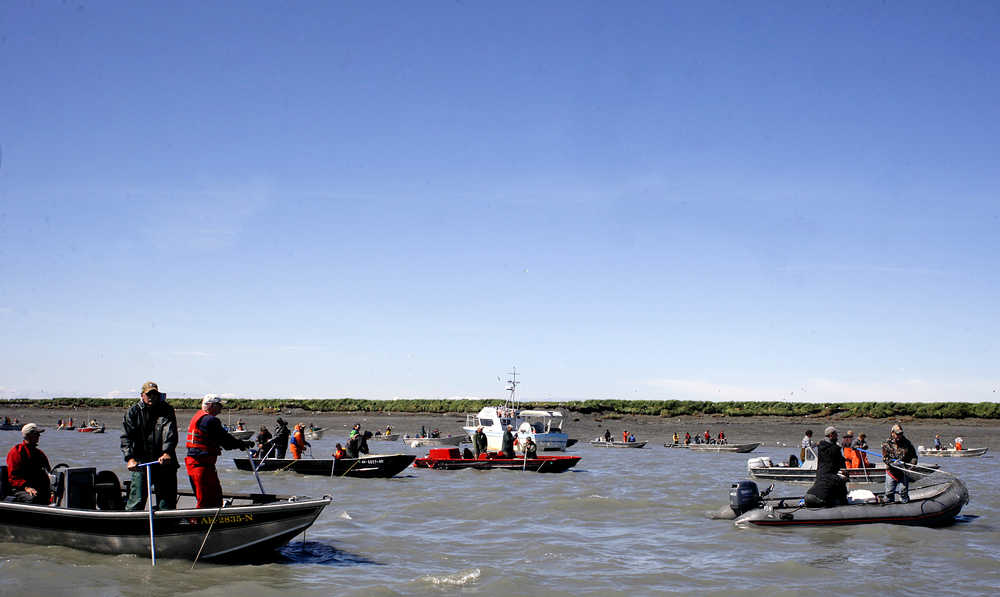
With thousands of dipnetters on the water in anticipation of the peak sockeye salmon runs on the Kenai River, the Alaska Wildlife Troopers have increased their presence in the area for the rest of the month.
In addition to the 13 wildlife troopers already assigned to the Soldotna post, six troopers arrived Wednesday to patrol the Kasilof and Kenai river personal-use fisheries, said Alaska Wildlife Trooper Lt. Paul McConnell. The Soldotna post is short on manpower with two vacant positions unfilled, wildlife troopers from around the state have been brought in to help enforce fishery regulations, he said.
This year the Alaska State Legislature added $175,000 to the troopers’ budget to aid in the enforcement of the Cook Inlet fisheries. McConnell said the extra funds have allowed the troopers to provide a more significant presence.
Wildlife Troopers have issued 30 citations to dipnetters on the Kenai River since July 10 when the fishery opened, according to troopers dispatch. McConnell said despite lower crowds for the opening weekend, a majority of violations issued to dipnetters for failing to record their catches and fishing during closed periods.
“The biggest thing people need to remember is record and mark your fish before you leave your fish site,” McConnell said. “We ask people to make sure they all know the regulations. It is better to ask questions before you go out because it’s a lot less expensive when you get yourself into trouble.”
Alaska Department of Fish and Game regulations state, “the salmon must be marked before the salmon is concealed from plain view, such as put in a cooler, or before the salmon is transported from the fishing site, such as your vehicle.”
Marked catches should have both lobes of the tail fins cut off, he said. The fine for failure to mark a fish is $75, while the failure to record a fish is a $100.
Unlike the Kasilof River, which has a 24-hour dipnet fishery, the Kenai River is open to dipnetting from 6 a.m. to 11 p.m. Wildlife troopers issued eight citations to people for fishing during closed periods. The fine for fishing during a closed period is $100 and an extra $5 per minute before the fishery opens or after it closes.
McConnell said in years past, troopers have issued a more citations for people fishing late more than any other. He said one of troopers’ area of emphasis is making sure people don’t catch more than their limit.
State personal-use regulation allows the head of the household to keep 25 sockeye salmon with 10 added for each member of the household.
This year dipnetters have been prohibited from keeping king salmon in an effort to conserve the sought-after fish after years of dwindling returns. Wildlife Trooper Sgt. Ken Acton said so far three people have been issued citations for keeping kings. One person was caught the day the fishery opened, he said. The fine is $260.
Four people have been cited for not releasing Dolly Varden, one of the resident Kenai River species — a $130 violation.
Including citations on the Kasilof River, a total of 44 violations were issued from July 8-14. Of those, 11 people were cited for failure to record their catch. Troopers issued six citations for dipnetting in closed waters on the Kasilof River.
Markers have been posted on the outside of mouth of the Kasilof River to about 1 mile upstream to notify dipnetters of the open boundaries, McConnell said. The markers are yellow and placed on wooden boards with arrows pointing to the fishery area.
So far one non-resident was fined $210 for dipnetting. On July 13, troopers issued a citation to Khamphouvane Vichitvongsa, 42, of Fairbanks, for not living in Alaska long enough.
Another was issued a misdemeanor for falsification of an application for a commercial crewmember license. During a traffic stop on July 12, wildlife troopers discovered Andrew Nelson, 33, of Kenai, did not qualify as a resident, despite having a resident commercial fishing crewmember license.
To deal with the influx of visitors to Kenai for the personal-use fishery, Kenai police have added six temporary officers who have helped enforce codes and provide information for people on the north and south beach and at Kenai harbor.
Sgt. Scott McBride with the Kenai Police Department said the biggest issues officers have dealt with has been parking and letting people know their passes expire at midnight. Day use parking costs $20 while overnight parking is $45 and valid from noon to noon the following day.
“People have been calm and behaving themselves for the most part,” McBride said.
Kenai City Manager Rick Koch said the police department has done a good job informing dipnetters of code changes like the no-wake zone area during high tide and no camping in front of privately owned land on south beach. Since parking has been closed in Old Town, he said that area is much more pleasant.
“The critical part of the fishery is getting through the first week because the high and low tide has been a challenge for everybody,” Koch said. “At low tide the boat launch is closed and at high tide people can’t camp anywhere on the beach without getting wet.”
As the Kenai River personal-use fishery enters the second weekend, Koch said dipnetters are waiting for when the salmon run jumps from 80,000 to 200,000.
“We have a lot of people down here ready and waiting,” he said. “Nobody wants to miss it.”
Reach Dan Balmer at daniel.balmer@peninsulaclarion.com.
Alaska Wildlife Troopers have issued 44 citations from July 8-14 for the Kenai River and Kasilof River personal-use fisheries.
Fail to record 11
Fail to mark fish 5
Fail to release snagged salmon 2
Fishing during closed period 8
Dipnetting in closed waters 6
Sport fish guiding without a guide license 1
Not releasing king salmon 3
Not releasing Dolly Varden 4
No dipnet permit 1
No boat registration 1
Non-resident 1
Falsification of license 1
