
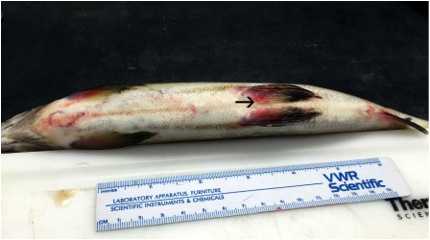
Hundreds of dead Arctic grayling washed up on the shores of Scout Lake in August, and the Alaska Department of Fish and Game is still puzzling over the reasons why.
The fish died of ichthyophthiriasis, known as white spot disease, a relatively uncommon condition in Alaska, according to the laboratory report. The condition is deadly and can wipe out populations of fish quickly. This is the first incident on the Kenai — there have been a five documented cases in Meadow Creek, Big Lake, Six Mile Lake and Cheney Lake.
An infected fish will first show white spots on the skin and become restless, rubbing against objects as if to itch. Sometimes, hemorrhaging occurs at the base of the fins, on the sides and near the mouth. Fish eventually become lethargic, stop feeding and swim near the water’s surface, according to an experiment conducted in 2006 by researchers in Michigan State University’s veterinary department.
In Scout Lake, it was mostly large fish that were turning up on the shore. Fish and Game biologists collected the carcasses for testing. Some other schools of grayling were swimming near shore and showed signs of lethargy, but the biologists noticed that the smaller grayling and rainbow trout seemed to be unaffected.
Upon further testing, the rainbow trout showed no sign of the disease, even though they were equally vulnerable.
“We were real shocked after we found out that the rainbows didn’t have it,” said Robert Begich, the area management biologist for the Division of Sport Fish in Soldotna.
The lake was treated in 2009 with rotenone, a piscicide, and restocked from the state hatchery in 2010. The disease would have had to been introduced after that, but it probably didn’t come from the state hatchery, as the same grayling have been stocked in different lakes around the state without a problem, Begich said. It’s possible that someone dumped an aquarium with an infected fish in the lake, but the Fish and Game lab report also identified water temperature as a possible contributing factor, he said.
“Grayling are a cold water species, so it’s possible that they were more strongly affected by the water temperatures,” Begich said.
The laboratory report credited it to a long period of higher water temperature and a high number of susceptible hosts, creating “the perfect storm for severe disease and mortality to ensue.” Warmer waters might also have allowed the parasite which causes the disease to reproduce more frequently.
Alaska lakes saw unusually high water temperatures this summer, especially in shallower lakes. Scout Lake has a mean depth of 13 feet, making it relatively shallow, and because grayling are cold-water fish, they may be more sensitive to temperature changes. The University of Michigan study linked temperature fluctuation to higher incidence of white spot disease.
Other lakes around the state also saw fish die-offs this summer that Fish and Game credited to warm water. Dead Arctic char in Anchorage and dead Arctic grayling in the Mat-Su Valley prompted habitat investigations. Those two species favor colder water.
Warmer water also carries less oxygen, and the bigger the fish, the more oxygen it needs. Begich said it’s possible that the larger fish needed more oxygen and weren’t able to get it because their gills were damaged by hemorrhaging caused by white spot disease, and the warmer water was poorer in oxygen. Rainbow trout tend to do better in warmer waters.
When Fish and Game staff took oxygen readings at Scout Lake in late August, the dissolved oxygen level was adequate, according to the laboratory report. A second reading showed the oxygen level slightly lowered but still adequate near the shoreline.
However, the warming water temperature wouldn’t explain why the rainbow trout and the younger Arctic grayling in Scout Lake don’t also have white spot disease. It also wouldn’t explain how the disease got into the lake in the first place, if it did not come from the hatchery. The laboratory report theorizes that the smaller fish might swim in different areas of the lake and not have had contact with the parasite.
The peninsula has seen some other die-offs possibly related to water temperature in the past. Some dead Arctic char turned up at Island Lake near Nikiski, and Fish and Game biologists thought it might be related to water temperature. But the lake is deep and would not be as affected by warming air temperatures as a shallower lake, Begich said, so the cause of that incident was unclear.
Some of the grayling in the lake could still have the disease, Begich said. The laboratory report recommended that all equipment used to catch the fish in Scout Lake be thoroughly cleaned to avoid spreading the disease anywhere else it is used. White spot disease has to have a fish host to spread, so it is not as easily communicable as a water-borne pathogen.
One positive side effect of the incident, is that the Soldotna Fish and Game office is now equipped to diagnose it locally. It’s a fairly simple outfit, only including a dissecting microscope, some textbooks and an employee who has received the training, but it could speed up the process in identifying and diagnosing the condition on the peninsula, Begich said.
Reach Elizabeth Earl at elizabeth.earl@peninsulaclarion.com.
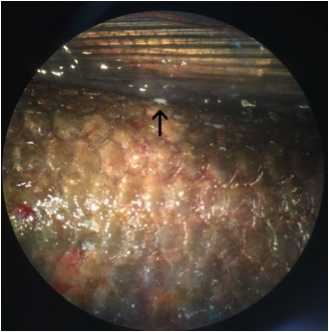
Photo courtesy the Alaska Department of Fish & Game
