
What’s at stake: The debate over Arctic drilling

  • By DAN JOLING and MARK THIESSEN
  • Thursday, May 14, 2015 9:15pm
  • News
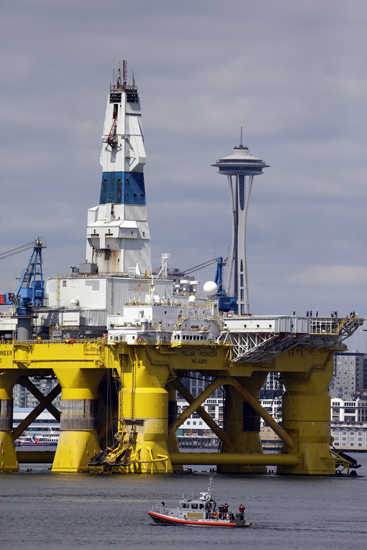
The oil drilling rig Polar Pioneer is towed toward a dock and in view of the Space Needle Thursday, May 14, 2015, in Elliott Bay in Seattle. The rig is the first of two drilling rigs Royal Dutch Shell is outfitting for oil exploration and was towed to the Port of Seattle site despite the city's warning that it lacks permits and threats by kayaking environmentalists to paddle out in protest. (AP Photo/Elaine Thompson)

The oil drilling rig Polar Pioneer is towed toward a dock and in view of the Space Needle Thursday, May 14, 2015, in Elliott Bay in Seattle. The rig is the first of two drilling rigs Royal Dutch Shell is outfitting for oil exploration and was towed to the Port of Seattle site despite the city's warning that it lacks permits and threats by kayaking environmentalists to paddle out in protest. (AP Photo/Elaine Thompson)

ANCHORAGE — Royal Dutch Shell is parking two massive Arctic oil drilling rigs in Seattle’s waterfront before they head north. The first drill rig, the Polar Pioneer, arrived in Seattle waters on Thursday, with the other — the Noble Discoverer — at a nearby port awaiting transit.

Here’s a look at the debate over Shell’s plans to drill in the Arctic:

How much fuel is at stake?

The U.S. Geological Survey estimates Arctic offshore reserves at 26 billion barrels of recoverable oil and 130 trillion cubic feet of natural gas.

Shell says developing these reserves could increase domestic oil supplies by more than 1 million barrels a day.

Shell has already spent nearly $7 billion in preparing to recover this oil, and plans to drill up to four exploratory wells over two years in the Chukchi Sea to determine whether there are commercial quantities of oil and gas.

Why is Shell preparing its rigs in Seattle and not Alaska?

Alaska doesn’t have the infrastructure in place to stage Shell’s Arctic fleet.

Shell stored equipment in Seattle for the 2012 drilling season and again wants to use its deep-water port, loading space and workforce to load drilling rigs and the accompanying fleet with supplies and personnel. Seattle provides not only a port but also facilities to load pipe, drilling mud and everything else needed for a complex underwater drilling operation.

Why are conservation groups opposed?

People concerned with a warming planet object to additional fossil fuel development. They worry that industrial development and a catastrophic spill would ruin a fragile region far from responders.

Environmental groups contend the oil industry has never demonstrated companies can clean up a major spill in water choked with ice. The Arctic is more than 1,000 miles from the nearest Coast Guard base. The northern Alaska coastline lacks deep-water ports, major airports and the most basic infrastructure for spill responders.

The Arctic Ocean’s open-water season begins in July and closes a few months later in cold, dark, conditions with some of the most treacherous storms on the planet.

How do Alaskans feel about Arctic offshore drilling?

State officials welcome drilling. Alaska receives upward of 90 percent of its revenue from the oil industry, and a drop in capacity or a dip in crude oil prices can mean multi-billion dollar state government deficits. Alaska is experiencing both.

Though Shell is drilling in federal waters, Alaska hopes the federal government will share revenue and that Shell and other companies will transport crude through a pipeline system connected to the trans-Alaska pipeline.

Is exploratory drilling safe?

Shell says yes. Wells would be drilled in the relatively shallow outer continental shelf at three to five times less pressure than the Deepwater Horizon explosion and spill in April 2010, spokesman Curtis Smith said. In the “unlikely” event of a blowout, Smith said, Shell has drilling mud to plug a well, a containment system that could funnel spilled crude to the surface, a second drill rig stationed nearby to drill a relief well and other tools to minimize damage.

Drilling foes says Shell’s 2012 drilling season, which ended with one rig aground off Kodiak and the other fined $12.1 million for breaking maritime law, shows Shell is not prepared to meet Arctic challenges.

What else is needed before shell can drill?

The company cleared a major hurdle on Monday when the U.S. Bureau of Ocean Energy Management approved the company’s multiyear drilling plan. However, it still needs several approvals from state and federal agencies before it can drill.

These include a land-use permit for Goodhope Bay from the state of Alaska. Shell spokesman Curtis Smith says he expects that permit to be issued within the next few weeks. The public comment period on this ended April 30.

Shell also is awaiting a drilling permit from the federal Bureau of Safety and Environmental Enforcement and authorizations related to wastewater discharge from the U.S. Environmental Protection Agency, among others.

More in News

Kevin Ray Hunter is actively sought by Alaska State Troopers on Friday, Dec. 19, 2025. Photo courtesy of Alaska State Troopers
Update: Troopers arrest Kenai man accused of sexual abuse of a minor

A judge issued an arrest warrant for Kevin Ray Hunter, who was indicted on Wednesday for allegedly abusing multiple juveniles.

Staff at Soldotna Senior Citizens, Inc. are pictured on Dec. 17, 2025 in Soldotna, Alaska, in front of a new 15-passenger van purchased with funds the Rasmuson Foundation and several local businesses donated to the nonprofit organization. Photo courtesy of Soldotna Senior Citizens, Inc.
New van will expand Soldotna senior center’s service capacity

Soldotna Senior Citizens, Inc., recently purchased a 15-passenger van using funds donated by the Rasmuson Foundation and several local businesses.

Sen. Jesse Bjorkman, R-Nikiski, speaks at a town hall meeting in the Moose Pass Sportsman’s Club in Moose Pass, Alaska, on Friday, Feb. 28, 2025. (Jake Dye/Peninsula Clarion)
Bjorkman, Ruffridge and Elam host town hall

The lawmakers wanted to hear from constituents before the legislative session begins.

tease
Soldotna chamber lights up the town

Hundreds of folks gathered at the visitor center for the Holiday Christmas Tree Lighting last week.

The KBBI Public Radio office and studio is on Kachemak Way, as seen in this photo taken July 2, 2019, in Homer, Alaska. (Photo by Michael Armstrong/Homer News)
Peninsula radio receives ‘stabilization’ funds from national nonprofit

The Public Media Bridge Fund awarded an “initial” round of stabilization grants equaling $26 million to 74 organizations nationwide impacted by the loss of federal funding.

A map presented by the Alaska Department of Natural Resources during a virtual meeting on Dec. 11, 2025, shows the location of a potential Kenai Peninsula State Forest. The Division of Forestry and Fire Protection must gather community perspectives before creating a proposal, and so far they’ve received “mixed” input. Screenshot.
DNR receives “mixed” public input on proposed Kenai Peninsula State Forest

The potential proposal would expand the Tanana Valley State Forest by 600,000 acres.

Cook Inlet Region, Inc. President and CEO Sophie Minich speaks during a ribbon cutting ceremony at the Nikiski Shelter of Hope on Friday, May 20, 2022 in Nikiski, Alaska. (Ashlyn O’Hara/Peninsula Clarion)
Peninsula organizations awarded mental health trust grants

Organizations in Nikiski and Kenai received funding from the Alaska Mental Health Trust Authority.

Potholes are seen on Wildwood Drive on Thursday, April 22, 2021, in Kenai<ins>, Alaska</ins>. (Ashlyn O’Hara/Peninsula Clarion)
Kenai moves to purchase rights-of-way from Kenai Native Association

The Kenai City Council last week authorized $200,000 for the Wildwood Drive Rehabilitation Project.

Jake Dye / Peninsula Clarion
Kenai Peninsula Borough Mayor Peter Micciche speaks during a meeting of the Borough Assembly in Soldotna, Alaska, on Tuesday, May 21, 2024.
Assembly will ask state legislature for authority to enact caps on real property tax assessments

Mayor Peter Micciche said a 34% increase over three years has created “real financial hardships” for many in the borough.

Most Read