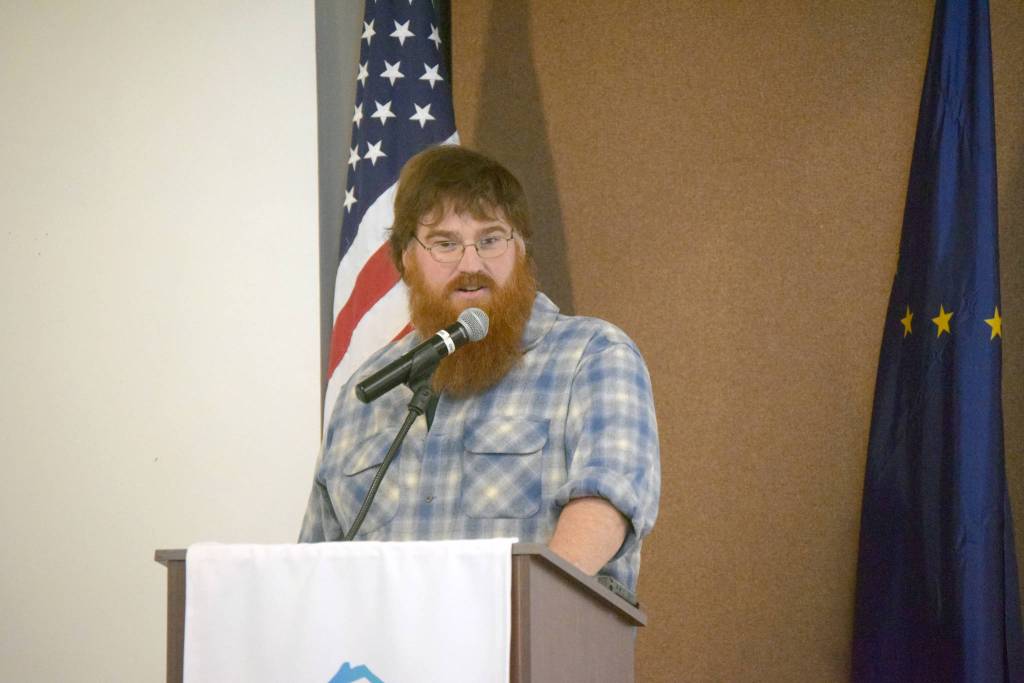
Drew Hamilton with the Friends of McNeil River gives a presentation to the Joint Kenai/Soldotna Chambers of Commerce in Kenai, Alaska on May 15, 2019. (Photo by Brian Mazurek/Peninsula Clarion)

Drew Hamilton with the Friends of McNeil River gives a presentation to the Joint Kenai/Soldotna Chambers of Commerce in Kenai, Alaska on May 15, 2019. (Photo by Brian Mazurek/Peninsula Clarion)

What about the bears?

Chamber discusses Pebble Mine’s impact on bear habitats

While much of the discussion over the proposed Pebble Mine project in Bristol Bay has focused on its impact to the area’s fishing industry, the project’s potential impact to another species was up for debate at yesterday’s Joint Kenai/Soldotna Chamber Luncheon.

During a presentation, Sam Snyder with the Wild Salmon Center and Drew Hamilton with Friends of McNeil River shifted the focus to how the mine would affect brown bears.

A professional bear-viewing guide who works out of Homer, Hamilton said that many of his colleagues in the bear-viewing industry fly to the western side of Cook Inlet — specifically areas in Lake Clark National Park, the Katmai National Park and Preserve and the McNeil River State Game Sanctuary and Refuge — for the bulk of their tours. Together, these areas are home to the largest concentration of brown bears in the world, with around 2,200 in Katmai National Park alone. Hamilton said that he has seen 78 brown bears in a single quarter-mile stretch along the McNeil River.

Hamilton said that bear viewing has been an industry on the rise over the last several years and broke down a recent economic study from the University of Alaska Fairbanks that illustrates this. According to the study, the bear-viewing industry reported $34.5 million in sales in 2017, and 371 new hires were made in the industry in that year alone.

Hamilton’s concern is that the Draft Environmental Impact Statement on the Pebble Project recently put out by the Army Corps of Engineers did not take brown bears or the bear-viewing industry into account when analyzing the potential impacts of the mine. Part of the proposed project includes a 38-mile road corridor stretching from the southern shore of Lake Iliamna to the Cook Inlet, and Hamilton said that a portion of that road would be just 250 yards from the boundary of the McNeil River Refuge and 13 miles from the McNeil Falls. While the Army Corps has looked at the impact on bears within 3 miles of the road, Hamilton argued that bears often travel much farther than 3 miles, sometimes over 20 or 30.

Hamilton expressed concern that the road will not only endanger the bear habitats, but will also diminish the “untouched wilderness” aspect of bear viewing that appeals to many tourists.

“When people come to Alaska, one of the first questions they ask is ‘where can I see a bear?’” Hamilton said. “And honestly, bears and roads just don’t mix.”

Hamilton said that he submitted several comments to the Army Corps regarding the impact of the mine and related infrastructure on bear habitats, but his concerns were not taken into consideration.

“The stuff I told the Corps is of concern to me, my colleagues, the pilots I fly with, the bed and breakfasts where my guests stay,” Hamilton said. “This is our livelihood. If I can’t fight for my livelihood, then why am I here?”

More in News

Potholes are seen on Wildwood Drive on Thursday, April 22, 2021, in Kenai<ins>, Alaska</ins>. (Ashlyn O’Hara/Peninsula Clarion)
Kenai moves to purchase rights-of-way from Kenai Native Association

The Kenai City Council last week authorized $200,000 for the Wildwood Drive Rehabilitation Project.

Jake Dye / Peninsula Clarion
Kenai Peninsula Borough Mayor Peter Micciche speaks during a meeting of the Borough Assembly in Soldotna, Alaska, on Tuesday, May 21, 2024.
Assembly will ask state legislature for authority to enact caps on real property tax assessments

Mayor Peter Micciche said a 34% increase over three years has created “real financial hardships” for many in the borough.

Ryan Tunseth speaks during a meeting of the Kenai Peninsula Borough Assembly in Soldotna, Alaska, on Tuesday, April 1, 2025. (Jake Dye/Peninsula Clarion)
Assembly accepts state funding for community assistance program

The funding will be disbursed to unincorporated communities in the Kenai Peninsula Borough for projects under the state Community Assistance Program.

tease
Soldotna artist awarded Rasmuson Foundation grant

Lester Nelson-Gacal will use the funds to create a handmade, illustrated book about his father’s final year.

State of Alaska Department of Law logo. Photo courtesy of the State of Alaska Department of Law
Kenai man sentenced for sexual abuse of minor, possession of child pornography

Joshua Aseltine was sentenced on Dec. 4 to serve 28 years in prison.

Alaska Department of Natural Resources logo (graphic)
State proposes changes to material sales regulations

The Department of Natural Resources is proposing changes to regulations related to material sales and conveyances to state agencies.

A map depicts the Cook Inlet Area state waters closed to retention of big skates through Dec. 31, 2025. Photo courtesy of the Alaska Department of Fish and Game
Cook Inlet area closed to big skate bycatch retention

The closure is effective in Cook Inlet Area state waters through Dec. 31.

A diagram presented by Seward City Manager Kat Sorenson during a Kenai Peninsula Borough Assembly meeting on Dec. 2, 2025, shows the expected timeline for the Port of Seward Vessel Shore Power Implementation Project. Screenshot
Seward shore power project moves into preliminary design phase

The project will create jobs, reduce cruise ship emissions and provide a backup power grid.

The U.S. Forest Service Porcupine Campground offers gorgeous views of the Kenai Mountains and Turnagain Arm, as seen here on July 20, 2020, near Hope, Alaska. (Photo by Michael Armstrong/Homer News)
Department of Natural Resources seeks public input on proposed Kenai Peninsula State Forest

DNR is gathering community perspectives during several meetings this week.

Most Read