
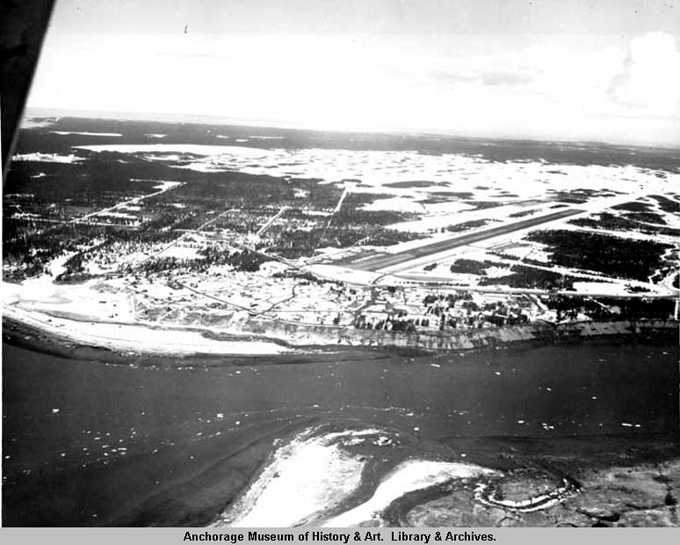
Nedra Evenson was making dinner for her family at her home at Mile 3 of the Kenai Spur Highway. Her husband Jim Evenson and their son, Thor, were also home.
Evenson had filled the sink with soapy water to clean up grease splatters from the french fries she was making.
BK Kivi, an eighth grader, was at her Nikiski home with her eight siblings. Her parents were still at work.
Joanna Hollier, who worked for Pacific Northern Airlines was at the Kenai Municipal Airport. Her husband, who was president of the parent-teacher association, was setting up for a school carnival. Their three kids were at their Beaver Loop Road home.
Also on Beaver Loop Road, Mavis Cone had invited another family over for dinner. The two families were looking at her new John F. Kennedy 50-cent piece before enjoying their meal.
In East Anchorage, Kit Hill, a high school senior, was at home making dinner with her sisters after spending some time downtown. Her dad wasn’t home yet and her mother was flying back to Anchorage from the Lower 48.
At 5:36 p.m. Alaska Standard Time, March 27, 1964, the ground began to move.
“We had so many of those little mini shakes all the time and you just sort of get used to them,” Hill said. “But then when the ground sort of turned elliptical and it kept going and going and going, we said, ‘This is not an ordinary earthquake.’”
Hill said she could hear her dad’s voice in her head and she immediately turned off the breaker box.
At the Cone’s the families sat down on the floor and watched two trees standing side-by-side moved in opposite directions.
As Hollier and the other airport employees watched the trees flip back and forth, the main thing on her mind was getting home to make sure her kids were OK.
Kivi remembers the ground rolling and rolling and rolling.
“And then there was this huge, loud boom,” she said. “And at that time on all the milk cartons and everything they were warning you about fallout. And I thought we were being bombed. It scared me to death.”
At the Evenson’s the two cars in the driveway bounced in unison. The highway moved like a wave, Nedra Evenson said, and the trees bent down to the ground and back up into the air and to the ground again.
The couple went outside when they were able to get the door un-jammed. Thor remained in the house trying to keep his books from falling.
“It really shook,” Jim Evenson said. “When we came out of our house, we couldn’t stand up.”
The house rotated like a big box, Nedra Evenson recalled, and the couple watched the chandelier hanging over the kitchen table swing and get closer and closer to the window, but it never got close enough to break the window.
The ground split open within inches of the Evenson’s home.
“It lasted so long,” she said, “so that you could say, ‘Look at that!’ And you had time to look at that.”
By 5:40 p.m. AST, it was over. It had lasted four minutes.
The 9.2 magnitude earthquake with an epicenter at the north edge of Prince William Sound rocked the state and caused $300-400 million in damage in Alaska in 1964 dollars.
The water that had filled the Evenson’s kitchen sink was all over the floor.
“We didn’t get dinner that night,” Nedra Evenson said.
Kivi flew to Anchorage a few days later for a spelling bee and saw the buildings downtown that had sunk into the ground.
Hollier arrived at home after the quake to find her kids had made sure to grab the birdcage and fish bowl and had tried to keep the china dishes from falling and breaking. The school carnival didn’t happen that night.
The Cone’s home was attached to a laundromat. In the dry cleaning room a glass bottle of chemical had fallen from the top shelf and the bottom shelf caught it so it didn’t hit the concrete floor and break. The floor in the Laundromat cracked about fourth of an inch wide and 110 feet long down the center, Cone said.
Hill’s mother’s plane landed in Vancouver, British Columbia, and had to turn around because the earthquake and taken down the air-traffic control tower at the international airport in Anchorage.
The Hills were without power for days and stayed at a friend’s home because they had a generator. Everybody slept in the same room.
“You’re really afraid to be separated,” she said.
Every little shake after the Great Alaska Earthquake had her wondering if it would be another big one.
With the Kenai area being mostly made up of sandy soil, Jim Evenson said the ground just shook, unlike Anchorage. The tsunami that followed the quake came into Cook Inlet at low tide, Nedra Evenson said, so it didn’t do as much damage as it would have at a high tide.
The peninsula was cut off from the rest of the state, except for air travel, due to busted roads and bridges.
The Evensons, who, like many, were without power for days, didn’t know what exactly had happened until they picked up a Canadian station on a battery-powered radio. In the days and weeks that followed, they learned not only about buildings sinking in downtown Anchorage, but also Seldovia losing its boardwalk — the town’s main street — and the tsunami dropping boats uptown in Seward.
“We were lucky here in Kenai,” Nedra Evenson said.
Kaylee Osowski can be reached at kaylee.osowski@peninsulaclarion.com.
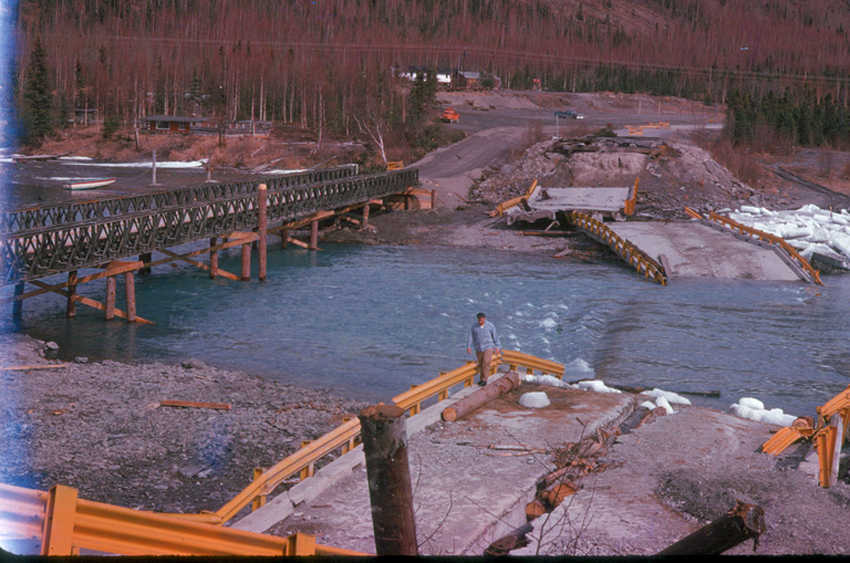
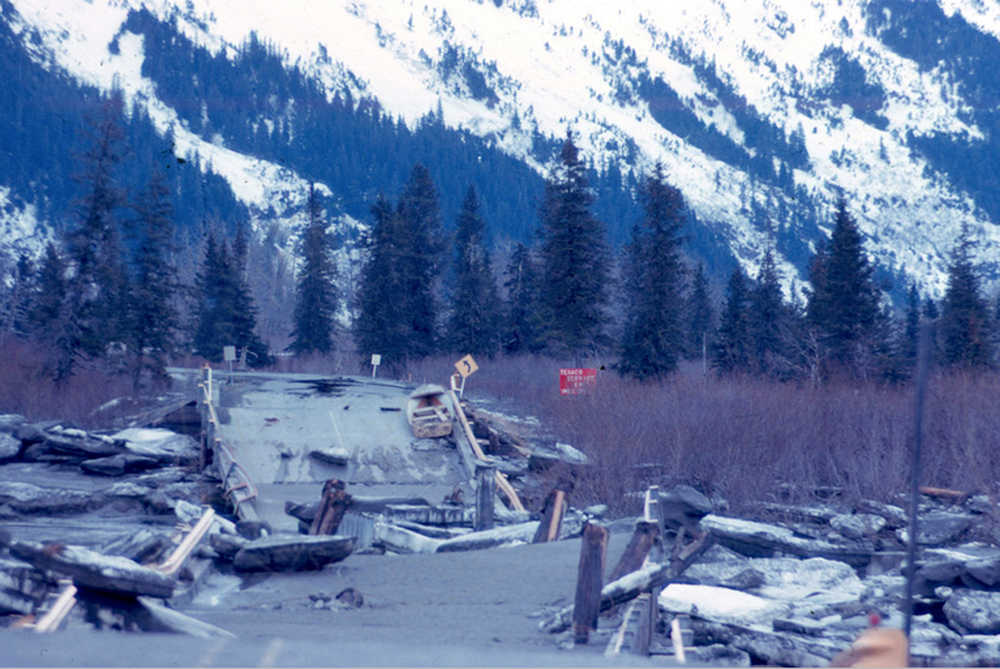
Contributed photo KPC Photo Archive Photographer Richard Mommsen shows the collapsed Cooper Landing bridge over the Kenai River and the Bailey Bridge that was constructed shortly thereafter.
Contributed photo KPC Photo Archive This Cheechako New photo show the effect of earthquake on the bridge over the Kenai River in Cooper Landing.
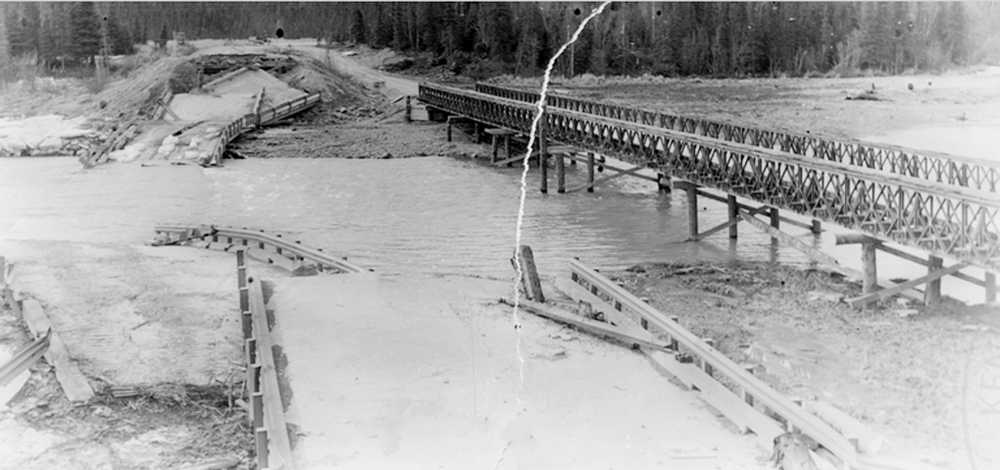
Courtesy photo KPC Photo Archive Photographer Richard Mommsen got this photo of one of several bridges heading south from Anchorage on the Seward/Sterling highway, damaged by the Good Friday Earthquake.
Alaska State Library,Alaska Earthquake Archives Committee, U.S. Army Photo,UAF-1972-153-350 The Seward Highway along Kenai Lake on March 30, 1964 following the Alaska Earthquake and Tidal Wave. A view of cracked lake ice near Cooper Landing. The ground has collapsed beneath a length of railroad.
Alaska State Library,Alaska Earthquake Archives Committee, U.S. Army Photo,UAF-1972-153-350 The Seward Highway along Kenai Lake on March 30, 1964 following the Alaska Earthquake and Tidal Wave. A view of cracked lake ice near Cooper Landing. The ground has collapsed beneath a length of railroad.
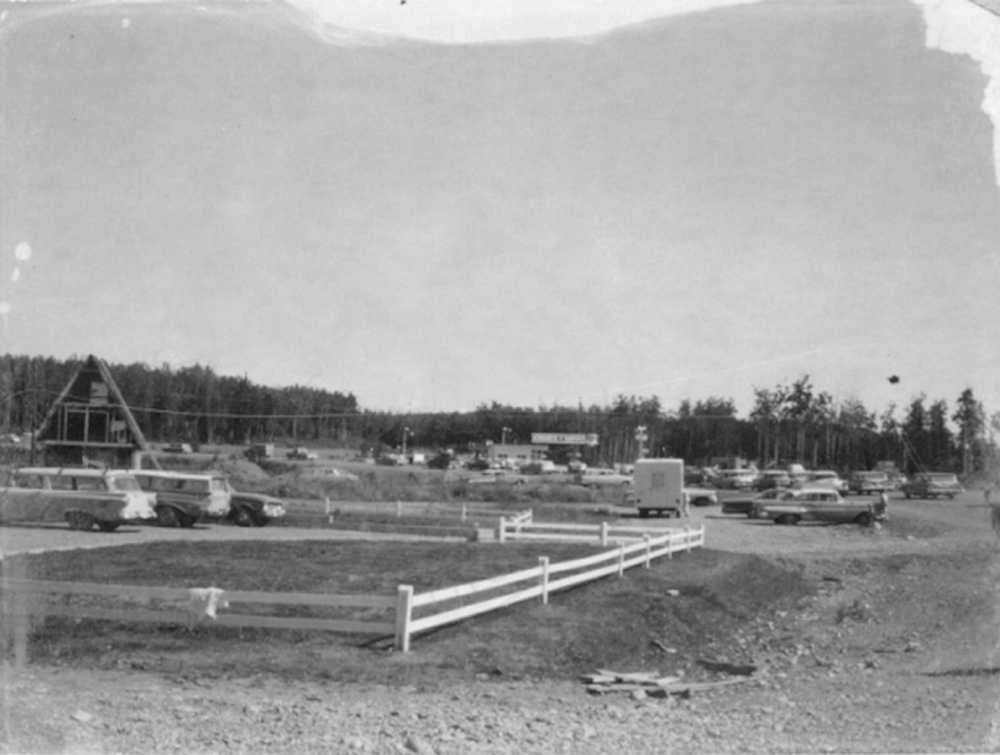
Contributed photo KPC Photo Archive This Cheechako News photo of Soldotna shows several relatively undamaged buildings and one – an unfurnished A-frame – which was one of the few structures damaged by the 1964 earthquake.

Photo by Rashah McChesney/Peninsula Clarion Kit Hill recalls her memories from grade school when the Good Friday Earthquake struck in Alaska.
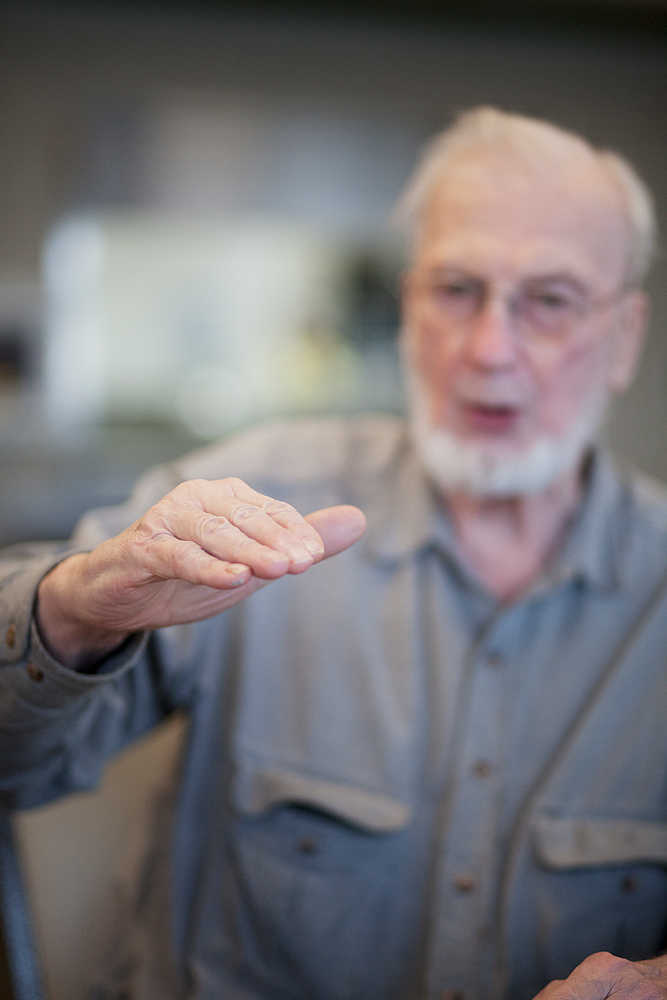
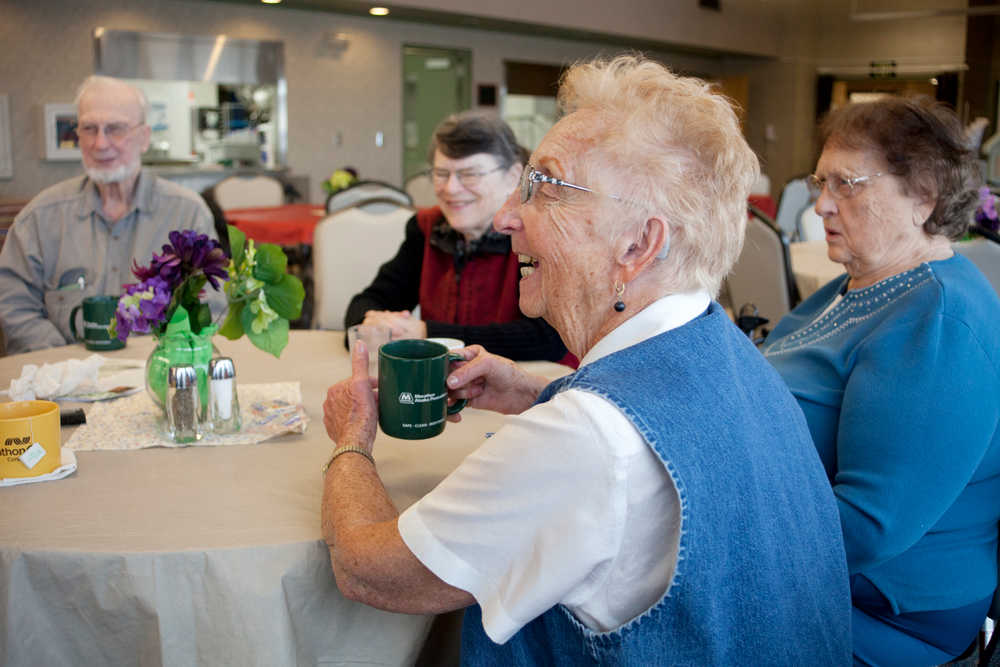
Photo by Rashah McChesney/Peninsula Clarion A group meets at the Kenai Senior Center to talk about their memories of the 1964 Good Friday earthquake.

Photo by Rashah McChesney/Peninsula Clarion Jim Evenson imitates the ground pitching and rolling as he talks about experiencing the Good Friday Earthquake in Nikiski, Alaska.
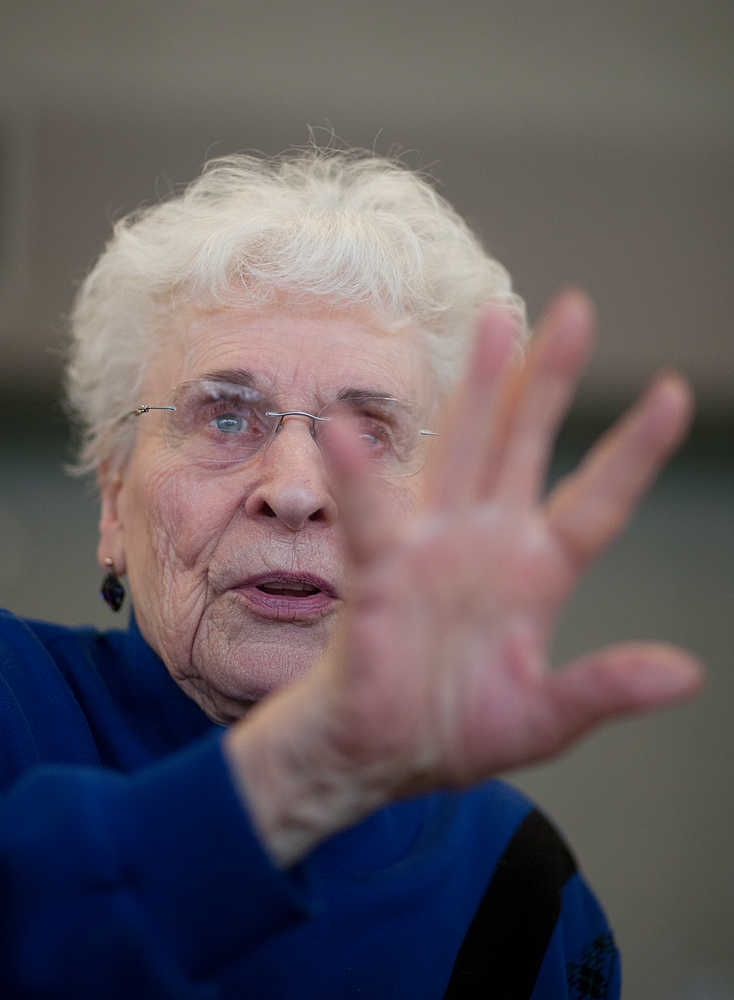
Photo by Rashah McChesney/Peninsula Clarion Mavis Cone recalls her memories of the 1964 Good Friday Earthquake with a group at the Kenai Senior Center.
