
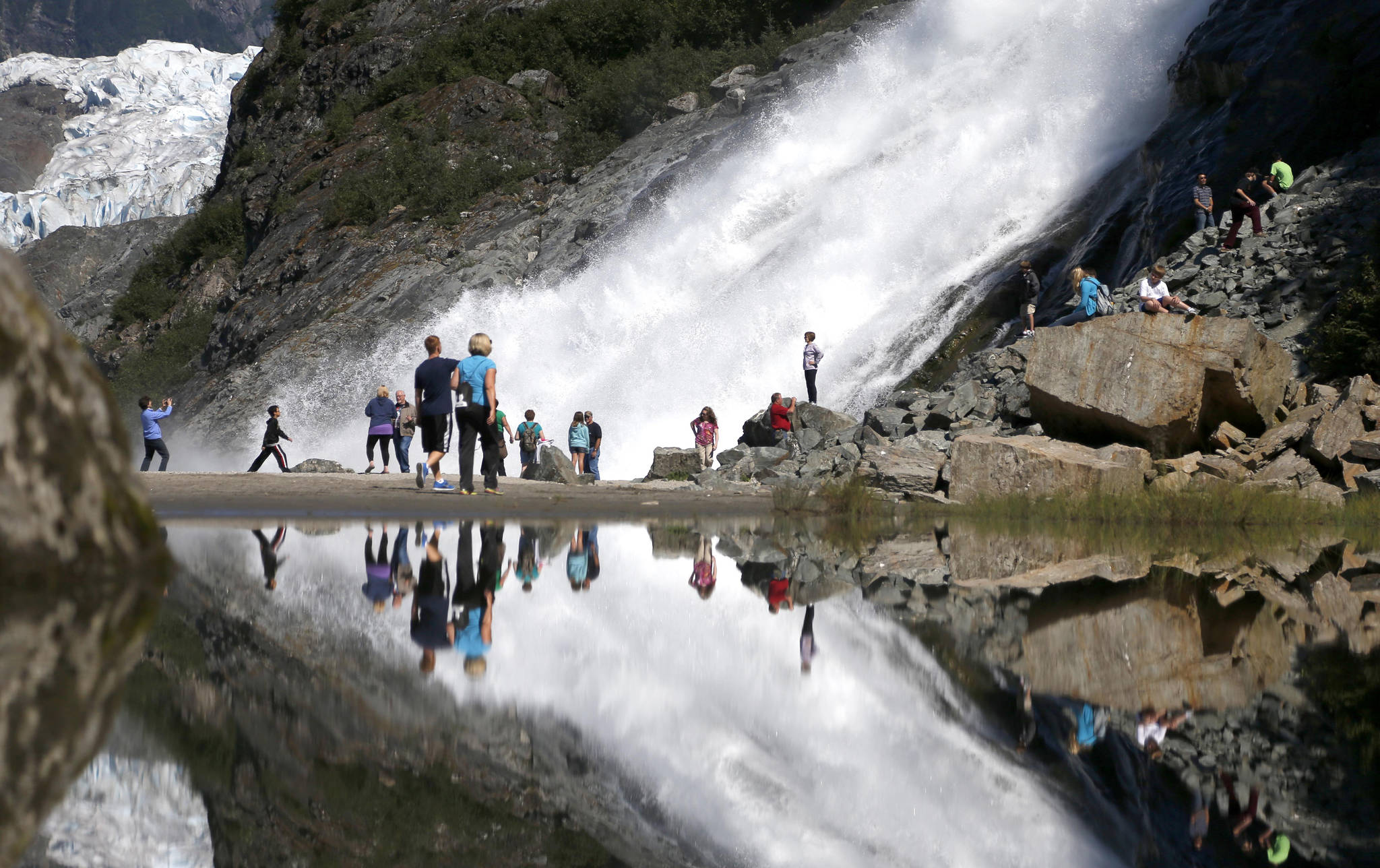
In this July 31, 2013, file photo, tourists visiting the Mendenhall Glacier in the Tongass National Forest are reflected in a pool of water as they make their way to Nugget Falls in Juneau. The federal government has announced plans to repeal or replace a decision by the Trump administration to lift restrictions on logging and road building in a southeast Alaska rainforest that provides habitat for wolves, bears and salmon. The U.S. Department of Agriculture’s plans for the Tongass National Forest were described as consistent with a January 2021 executive order from President Joe Biden that called for reviewing agency actions during the Trump administration that could be at odds with Biden’s environmental priorities. (AP Photo/Charles Rex Arbogast, File)

In this July 31, 2013, file photo, tourists visiting the Mendenhall Glacier in the Tongass National Forest are reflected in a pool of water as they make their way to Nugget Falls in Juneau. The federal government has announced plans to repeal or replace a decision by the Trump administration to lift restrictions on logging and road building in a southeast Alaska rainforest that provides habitat for wolves, bears and salmon. The U.S. Department of Agriculture’s plans for the Tongass National Forest were described as consistent with a January 2021 executive order from President Joe Biden that called for reviewing agency actions during the Trump administration that could be at odds with Biden’s environmental priorities. (AP Photo/Charles Rex Arbogast, File)

US will revisit Trump-era decision on Tongass

Conservationists cheered the announcement as a positive step.

  • By BECKY BOHRER Associated Press
  • Sunday, June 13, 2021 12:29am
  • NewsState News

By BECKY BOHRER

Associated Press

JUNEAU — The federal government announced plans Friday to “repeal or replace” a decision by the Trump administration last fall to lift restrictions on logging and road building in a Southeast Alaska rainforest that provides habitat for wolves, bears and salmon.

Conservationists cheered the announcement as a positive step. Republican Alaska Gov. Mike Dunleavy criticized it and vowed to use “every tool available to push back.”

The U.S. Department of Agriculture’s plans were announced on a federal regulatory site with little detail. They were described as consistent with a January executive order from President Joe Biden that called for reviewing agency actions during the Trump administration that could be at odds with Biden’s environmental priorities. The U.S. Forest Service falls under the Agriculture Department.

The Tongass National Forest is the country’s largest national forest. In a statement, Matt Herrick, an Agriculture Department spokesperson, said the Trump administration decision “did not align with the overwhelming majority of public opinion across the country and among Alaskans.”

“Future decisions about the role of the Tongass National Forest should continue to reflect the best interests of Alaskans and the country as a whole,” Herrick said.

The statement did not outline the next steps the Agriculture Department would take to repeal or replace the Trump administration decision.

The Agriculture Department last October decided to exempt the Tongass from the so-called roadless rule, which prohibited road construction and timber harvests with limited exceptions. The roadless rule, dating to 2001, has long been the subject of litigation.

In 2018, Alaska under then-Gov. Bill Walker, an independent, asked the federal government to consider an exemption. Dunleavy supported the request, as have members of Alaska’s Republican congressional delegation.

U.S. Sen. Lisa Murkowski, Alaska’s senior senator, said the Trump administration, through the Forest Service and Agriculture Department, “put considerable work and effort into the final rule and now the Biden administration is literally throwing it all away.”

“We need to end this ‘yo-yo effect’ as the lives of Alaskans who live and work in the Tongass are upended every time we have a new President. This has to end,” she said in a statement.

U.S. Sen. Dan Sullivan called the decision “misguided,” and U.S. Rep Don Young said it was “yet another nail in the coffin for economic opportunity” in Southeast Alaska. The region, heavily reliant on tourism, was hard-hit by the pandemic last year.

The congressional delegation, in a statement, said the exemption is needed “to restore balance in federal management on the Tongass.” Sullivan has said the roadless rule is a hindrance to activities such as mineral development, building energy projects and connecting communities.

The Biden administration earlier this month suspended oil and gas leases in Alaska’s Arctic National Wildlife Refuge, following a January lease sale that drew a tepid response. A law passed by Congress in 2017 called for two lease sales to be held.

But U.S. government attorneys also have defended a decision made during the Trump administration to approve a major oil project on Alaska’s North Slope that Alaska political leaders have supported.

The Agriculture Department in its decision about the Tongass National Forest last fall concluded that a policy change for the forest could be made “without major adverse impacts to the recreation, tourism and fishing industries, while providing benefits to the timber and mining industries, increasing opportunities for community infrastructure, and eliminating unnecessary regulations.”

More than 9 million of the Tongass’ roughly 16.7 million acres are considered roadless areas, according to a federal environmental review last year. The majority of the Tongass is in a natural condition, and the forest is one of the largest relatively intact temperate rainforests in the world, the review said.

Meredith Trainor, executive director of the Southeast Alaska Conservation Council, said those who supported keeping the roadless rule provisions in place for the Tongass “heartily encourage the administration to put this thing to bed by repealing the Trump rule once and for all.”

Josh Hicks, senior campaign manager with The Wilderness Society, in a statement said forests are “highly effective at sequestering carbon and, if left standing, are one of the strongest natural solutions to combating the climate crisis.”

More in News

Low clouds hang over Cook Inlet north of Anchor Point on Oct. 23, 2025. (Photo by Yereth Rosen/Alaska Beacon)
Inletkeeper condemns federal management of Cook Inlet oil lease sale

The agency alleges an environmental study by the Bureau of Ocean Energy Management was conducted with a “serious” lack of transparency.

The Kenai Chamber of Commerce announced the winners of the 13th annual gingerbread house competition on Dec. 20, 2025. This creation by Sierra won the 2-5 year old age category. Photo courtesy of the Kenai Chamber of Commerce
Wrapping up the holiday season

The Kenai Chamber of Commerce’s Angel Tree program and gingerbread house competition spread Christmas cheer to hundreds locally.

The Challenger Learning Center is seen here in Kenai<ins>, Alaska,</ins> on Sept. 10, 2020. (Photo by Brian Mazurek/Peninsula Clarion)
Kenai City Council considers possible uses for Challenger Center

One option would assess the facility’s potential as the new public safety building.

A snowmachine rider takes advantage of 2 feet of fresh snow on a field down Murwood Avenue in Soldotna, Alaska, on Monday, Dec. 12, 2022. (Jake Dye/Peninsula Clarion)
Ice fishing opens on some Kenai National Wildlife Refuge lakes

Snowmachines are permitted for ice fishing access on Hidden, Kelly, Petersen, Engineer and Watson lakes.

The waters of Cook Inlet lap against Nikishka Beach in Nikiski, Alaska, where several local fish sites are located, on Friday, March 24, 2023. (Jake Dye/Peninsula Clarion)
Kenai asks for fishery economic disaster declaration

The Kenai City Council requested that Gov. Dunleavy declare a disaster and support a recovery plan for the Upper Cook Inlet East Side Set Net fishery.

The Kenai Peninsula Borough School District logo. (Photo courtesy of Kenai Peninsula Borough School District)
District superintendent dispels rumors about student construction

Superintendent Clayton Holland said student involvement in Seward High School construction is “based on rumor, not fact.”

Anchorage-based singer and songwriter Keeley Boyle is pictured in Anchorage<ins>, Alaska,</ins> on Sept. 26, 2023. Boyle, who was raised on the Kenai Peninsula, will use a $10,000 grant she received from the Rasmuson Foundation to create an album of songs about her grandparents’ home in Nikiski. Photo courtesy of Jovell Rennie
Musician hailing from Kenai receives Rasmuson grant

Keeley Boyle will record an album of songs about her grandparents’ Nikiski home.

Commercial fishing and recreational vessels are docked in the Homer harbor on Oct. 23, 2025. The commercial fishing industry endured a series of challenges over the year, some of them imposed by the new Trump administration. (Photo by Yereth Rosen/Alaska Beacon)
Alaska fisheries in 2025: turmoil, economic and environmental challenges and some bright spots

NOAA cuts, economic headwinds and invasive species pose problems, but there was some recovery in crab stocks and salmon harvests.

Cook Inlet near Clam Gulch is seen on Oct. 23, 2025. (Photo by Yereth Rosen/Alaska Beacon)
Disputed oil lease sale in Alaska’s Cook Inlet upheld in new Trump administration decision

After completing a court-ordered environmental study, the Bureau of Ocean Energy Management said no changes are needed for the 2022 sale that drew just one bid.

Most Read