
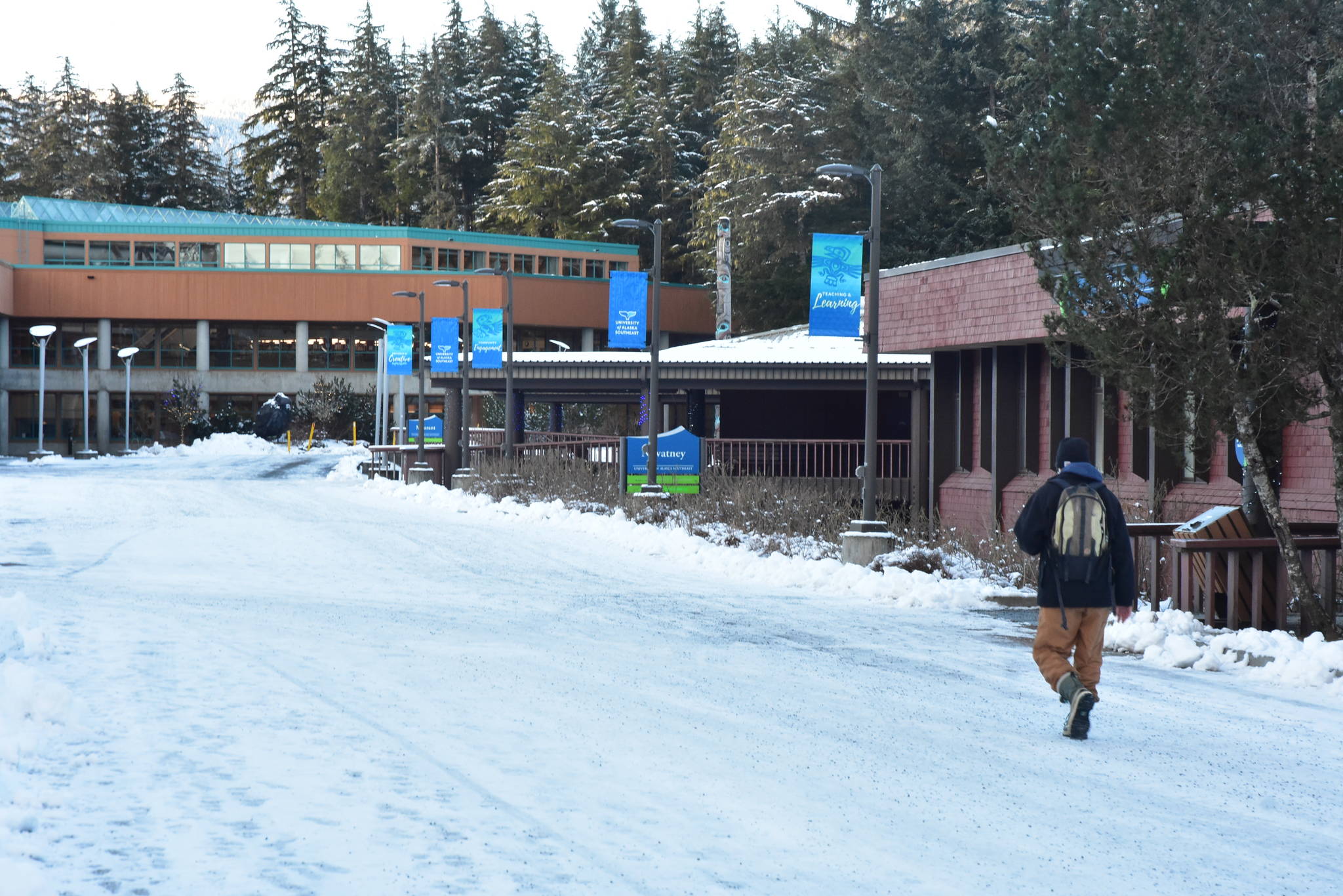
Laying out the University of Alaska’s current status to lawmakers, interim UA President Pat Pitney said Wednesday the state’s higher education system is an economic driver whose graduates are likely to remain in the state for years to come.
Speaking to the state Senate Education Committee, Pitney told lawmakers UA graduated students into professions that are used in the state such as teachers, health care workers and engineers. UA Fairbanks leads the world in Arctic research, she said, and had contracts with the U.S. Department of Defense and the National Oceanic and Atmospheric Administration.
Pitney said during her presentation that her position as interim president is looking to be a two- to three-year appointment. She will be speaking at the Juneau Chamber of Commerce luncheon Thursday, held virtually at noon. You can register for the luncheon at the chamber’s website: juneauchamber.com.
State budget cuts, made per an agreement with Gov. Mike Dunleavy, will have the university’s budget down by $120 million from where it was in 2014, Pitney said, with a 20% reduction in administrative personnel costs and 2,500 fewer employees. That coupled with disruptions caused by the COVID-19 pandemic have put the university on uneasy footing, but things were now more stable for the system.
“The University of Alaska is not a university. It is Alaska’s system for higher education,” Pitney said. “My primary goal in conjunction with the Board of Regents is to bring stability to the system. The programs we have are here to stay.”
The majority of UA’s graduates, 70-80%, went on to work in the state, Pitney said, which is what local employers say they’re looking for. Alaskan employers want graduates who are familiar with the state and are going to remain in the state, she said.
In an interview with the Empire, Pitney said the university was looking to better integrate its programs with workforce demands, pointing to the diesel mechanics classes at UA Southeast’s Ketchikan campus as an example of a regionally focused program. Many of the state’s engineering graduates go on to work in Alaska’s mining industry, which Pitney said is likely to grow in the future.
[University of Alaska looks to a post-pandemic future]
But not all the committee members were pleased with the University of Alaska’s performance. Sen. Shelley Hughes, R-Palmer, said the state’s low reading scores for elementary students showed the university needs to improve its teacher training program.
“You’re training a lot of those teachers, and yet, we’re having trouble teaching children to read. Based on the scores, I think the university has tremendous room for improvement,” Hughes said at the hearing. “We’re going to need (the university) to step up to the plate and do a better job training teachers how to teach children to read.”
Alaska’s students score below the national average for both reading and math in standardized testing, according to U.S. Department of Education data for 2019.
The university is working with the state to try and receive extra funding for COVID-19 relief, Pitney said, and looking at other ways the system might increase revenues such as partnering with private industry. Arctic and other research produced by the university was in high demand and the system’s competitive research had done well during the pandemic.
The state was able to maintain roughly $160 million for various research programs with grants, largely from the federal government, Pitney said. UA’s ability to maintain those grants, even through the pandemic, showed how nationally competitive the system’s research programs are, Pitney said.
Both the state and Alaska’s congressional delegation in Washington D.C. are working to get at least some of the land originally promised to the university under the school’s founding land grant but that process will take time. Also Wednesday, state Sen. Gary Stevens, R-Kodiak, submitted a resolution to the Senate urging the delegation, the U.S. Department of the Interior and the governor to facilitate the endowment. The congressional delegation submitted legislation to Congress with Dunleavy’s backing in September.
UA has sold 10 facilities and demolished another 13 aged facilities in 2019 and 2020, Pitney said, and is working toward a power sales agreement for its power plant at UAF. Preliminary application and admissions numbers from the spring 2021 semester are up, she said, but the overall student head count is below pre-pandemic numbers. UA is looking at long-term growth in engineering and health care to meet demand in the state, Pitney said.
“We are in the business of providing education for our industries and our communities, we’ve got the programs that we have and we’re focused on those programs,” Pitney said.
Contact reporter Peter Segall at psegall@juneauempire.com. Follow him on Twitter at @SegallJnuEmpire.

Pat Pitney
