
University of Alaska set to receive 360,000 acres of federal land

The transfer was set in motion by a clause included in the recently passed $1.7 trillion federal spending bill

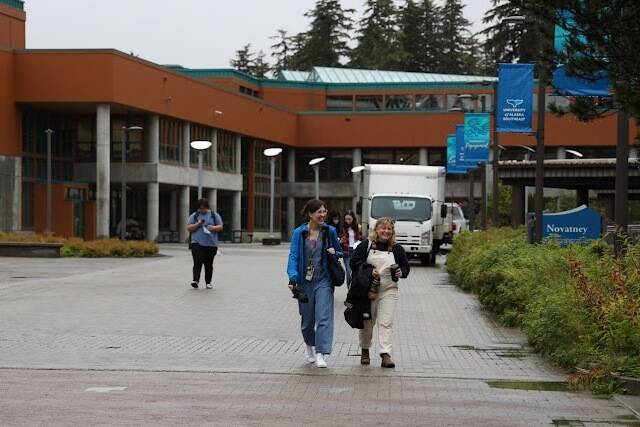
Students smile as they walk to their classes for the first day of fall semester at the University of Alaska Southeast. The University of Alaska is set to receive 360,000 acres of federal land within the next four years, set in motion by a clause included in the recently passed $1.7 trillion federal spending bill. (Clarise Larson / Juneau Empire)

Students smile as they walk to their classes for the first day of fall semester at the University of Alaska Southeast. The University of Alaska is set to receive 360,000 acres of federal land within the next four years, set in motion by a clause included in the recently passed $1.7 trillion federal spending bill. (Clarise Larson / Juneau Empire)

The University of Alaska is set to receive lands totaling about one-third of the size of Admiralty Island within the next four years.

Set in motion by a clause included in the recently passed $1.7 trillion federal spending bill, the university in conjunction with the state of Alaska are tasked with identifying and selecting 360,000 acres of federal land — Admiralty Island has a total of 1,664 square miles, according to the National Park Service — to be transferred via the U.S. Bureau of Land Management, which is jointly tasked with creating a program to conduct the transfer process during those four years.

Once fulfilled, the conveyance, which UA is congressionally entitled to because of its status as a land-grant university, will successfully lift the university out of its current land deficit.

The university has been attempting to remedy its deficit since Alaska’s statehood in 1959, but the issue didn’t pass then or in the multiple attempts by the Alaska Legislature since.

The clause which put the transfer process in motion was included in the omnibus bill via the “University of Alaska Fiscal Foundation Act,” which was drafted by Alaska Sen. Lisa Murkowski, a Republican, and supported by Sen. Dan Sullivan, a Republican, and Rep. Mary Peltola, a Democrat. Murkowski and Peltola also voted for the bill, but Sullivan ultimately voted against the omnibus bill citing insufficient time for lawmakers to analyze it.

“It’s great news,” said University of Alaska Southeast Chancellor Karen Carey. “It will bring money to the university, and I think it will provide additional resources for us which are greatly needed.”

Currently, the university system already owns around 150,000 acres of land — equivalent to 30% of what it is entitled to — which in the previous fiscal year earned the university around $8 million of revenue, according to the university’s annual land management report. The additional 360,000 acres are expected to add to that revenue significantly.

Lorraine Henry, director of communications and Public Information Officer for the Alaska Department of Natural Resources, said the department is encouraged to see the university “finally” receive the federal lands it is due and to begin working with UA to receive that land.

Adrienne Stolpe, director for UA Land Management, said that before the omnibus bill’s passing last week, the university had already identified 200,000 acres of federal land it is interested in selecting for transfer and the information was sent to the DNR for review last year. Of that land, Stolpe said it is a mix of short- and long-term income-generating land and is scattered in the Interior, and none of it is located in the Southeast.

“We’re looking for lands we can monetize in different ways and in relative time scales,” she said.

Stolpe said finding available federal land for transfer is notably more difficult in the Southeast region compared to the Interior, though she noted the selection process is still in its preliminary stages and said the university is interested in land available in the Southeast region.

Carey said she also hopes to see land in Southeast Alaska selected by the university, but emphasized that UAS will still benefit from the university system’s communal revenues from the lands.

The revenue generated from the university lands goes toward the campuses, the University Foundation, student recruitment and retention and system-based scholarship, according to a land management report.

Contact reporter Clarise Larson at clarise.larson@juneauempire.com or 651-528-1807. Follow her on Twitter at @clariselarson.

More in News

Retired Biologist and former manager of the Kenai National Wildlife Refuge will “Looking Back, Looking Forward,” a talk about his solo trip on the Yukon River, on Tuesday evening at the Refuge headquarters in Soldotna. The Homer-based nonprofit organization Friends of Alaska National Wildlife Refuges is hosting a virtual watch party in Homer. Photo courtesy of Friends of Alaska National Wildlife Refuges
Looking back, looking forward

Robin West will give a talk about his 30-year career Tuesday evening at the Kenai refuge headquarters and virtually.

A tsunami is not expected after a 4.4-magnitude earthquake northwest of Anchorage Wednesday, Feb. 4, 2026. (U.S. Geological Survey)
No tsunami expected after 4.4-magnitude earthquake in Alaska

U.S. Geological Survey says 179 people reported feeling the earthquake.

A young male ringed seal, rescued from an oilfield in Alaska’s Beaufort Sea on Dec. 17, 2025, is receiving care at the Alaska SeaLife Center in Seward, Alaska. Photo courtesy Kaiti Grant/Alaska SeaLife Center
Sealife center takes in ringed seal

This response is one of only 30 ringed seal cases in the Alaska SeaLife Center’s 28-year history.

Macelle Joseph, a member of the Juneau-Douglas High School: Yadaa.at Kalé chapter of Alaska Youth for Environmental Action, writes “It’s Native blood in the soil, not your oil” outside the Alaska State Capitol building on Jan. 24<ins>, 2026</ins>. Dozens of Juneauites participated in the student-led protest against the LNG pipeline.
Juneau activists speak out against Alaska LNG pipline on Capitol steps

“Alaska’s greatest resources aren’t just buried in the ground,” said protestor Atagan Hood.

A sample LiDAR meteorological assembly is seen. Photo courtesy of the State of Alaska
Matanuska Electric Association applies for land use permit to build meteorological stations

If approved, MEA would build three stations along the Seward Meridian.

Photo courtesy of Shea Nash
River City Academy teacher Donica Nash is pictured during her history class on Jan. 26.
Civic nonprofit names River City Academy teacher for award

Soldotna’s Donica Nash will use the award money to fund a field trip to Juneau.

Cooper Landing Fire and Emergency Medical Services respond to a trailer fire on Tuesday, April 26, 2022, near Mile 38 Seward Highway near Cooper Landing, Alaska. The fire destroyed the trailer carrying U.S. Mail from Anchorage to the Southern Kenai Peninsula. (Photo courtesy of Cooper Landing Fire and EMS)
Assembly asks legislature to increase exemptions for EMS, firefighters

The change would allow municipalities to increase property tax exemptions to “an amount deemed appropriate.”

Photo courtesy of Sargeant Truesdell
Kenai Peninsula Borough mayor Peter Micchiche (left) and assembly member Sargeant Truesdell, District 4, Soldotna (right), pose for a photo with the Soldotna High School girls’ wrestling team during an assembly meeting on Jan. 20. The Stars secured SoHi’s first three-peat title during the state championship tournament Dec. 19-20.
Assembly commends Soldotna High School girls’ wrestling team

The team secured the program’s first three-peat victory at the state tournament in December.

The Kenai Peninsula Borough School District logo.
Board of education considers school consolidations

Paul Banks Elementary in Homer and Seward Middle School are currently under consideration for closure in the next academic year.

Most Read