
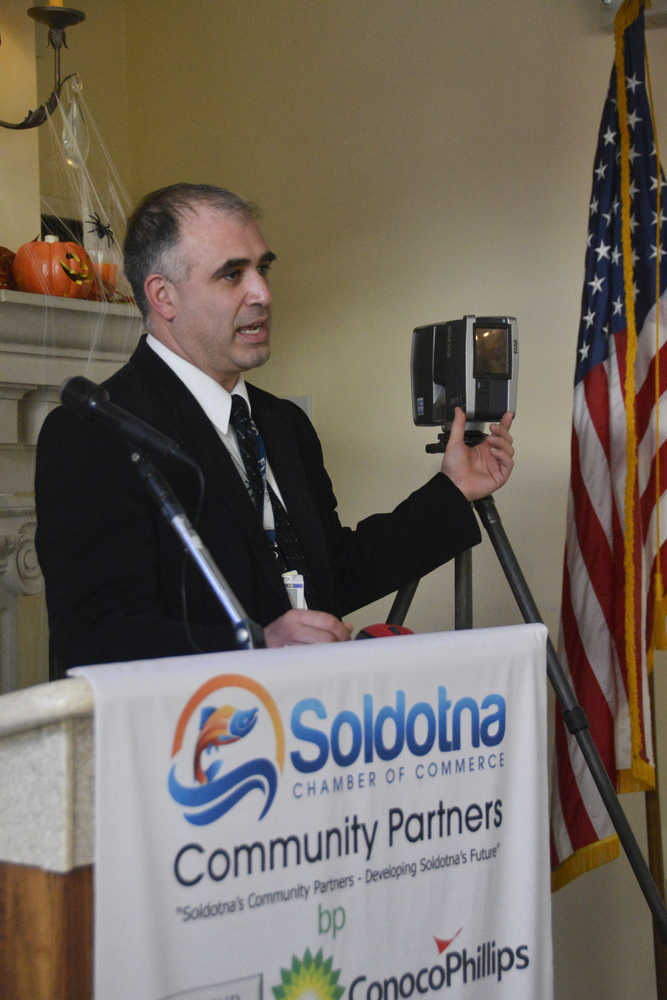
Time spent investigating criminal cases and highway fatalities stands to be significantly reduced in Alaska thanks to improved scene documenting technology used by troopers.
The Focus 3D laser scanner from FARO, a 3D technology company based in Florida, captures images from crime scenes in a more timely and detailed way than current systems used around the state. Alaska State Trooper Lt. Dane Gilmore and Investigator Ramin Dunford presented the benefits and limitations of the tool and its implications for crime scene investigation at a Soldotna Chamber of Commerce luncheon Tuesday afternoon at Froso’s Family Dining.
“It scans and creates a 3D cloud of your surroundings,” Dunford said. “So if we were to scan our surroundings here, it would create a point for every thing that it can see from this angle.”
The scanner rotates at the top of a tripod with about a 280 degree range of motion, and uses a laser that bounces out to surroundings and back into the device to get measurements for objects at a scene, Dunford said.
The state of Alaska has had two of the gadgets for about three years — one in Fairbanks and the other in Palmer. Dunford said one of the scanners was used to do scene documentation in the December 2013 Cooper Landing homicide case, in which Anchorage man Paul Vermillion has been accused of killing Genghis Muskox.
Unlike those in the Lower 48, many roads in Alaska do not have detour options for motorists in the event of accidents that shut the road down. Gilmore used one of the Seward Highway closures from this summer as an example of how the devices can cut down on road closure time.
The July closure, caused by the collision of a tour bus with a line of vehicles including two trailers, shut the highway down for 10 hours while troopers and others completed vehicle removal and scene documentation. Had troopers used the 3D scanner, the scene documentation process would have been reduced from six hours to one hour, Gilmore said.
Additionally, Gilmore and Dunford said it takes very little time to train someone to use the scanner, compared to a week-long, $3,000 course to learn how to use Total Station, the scene documentation system currently used throughout other areas of Alaska.
“I can train somebody to be an operator for this in about an hour,” Dunford said. “It doesn’t take much time. You just input the date of what you’re doing, and the settings for your area, whether there’s a lot of sunlight or if it’s an indoor setting, how much distance, the resolution you want to take the points at.”
The newer devices can be set up to capture a certain angle of a scene — the front of a car in the road, for example — and will capture image points at a range of about 250 feet, Dunford said. The laser picks up millions of individual points to compile the 3D image. Using the Total Station system, two troopers have to work together to collect points individually and turn them into a 2D image.
“Before, using Total Station … you’d have the operator standing in the street, taking up a single point at a time,” Dunford said.
At present, there are four investigators with the Alaska Bureau of Investigation in Soldotna trained to use the tools. However, there are no immediate plans to purchase more of them, Gilmore said. The price of a Focus 3D laser scanner has come down from $75,000 to about $65,000 since AST purchased the two it already has, and Dunford said the computer needed to process the image data costs around $6,000.
The computers required to process the data are also needed to use the Total Station system, so they are already in place in Soldotna, Girdwood and Crown Point, Gilmore said.
In deciding whether to acquire more scanners, the AST will evaluate whether that purchase would really be the best solution for a particular area. Until then, the scanners will be moved around to where they are needed on a case-by-case basis, Gilmore said.
“This might be something that we get another one of or another two of,” Gilmore said. “The department has to make the decision of whether this technology or another technology is the most productive way to proceed, and once that occurs, then it would be a matter of requesting the funding to support the procurement of the new products.”
The 3D scanners do have limitations. The lasers they use are not able to pick up reflective surfaces, like water or mirrors. A bottle of water or a puddle that happens to be at a scene will simply show up as a blank spot in the final images, Dunford said. It is unknown whether ice has the same effect on the scanners, he said. The device manufacturer also recommends that the they not be used in temperatures below 0 degrees Fahrenheit, Dunford said.
At the same time, the technology could have a slight impact on the way scene documentation data is used once it gets to court. While all evidence is subject to challenges or to being thrown out, Gilmore said the images created by using the 3D technology and the system used to navigate them are more user-friendly. That could help jurors and others analyze the data and understand the images better.
“There’s not a lot of criminal prosecutions associated with fatality crashes,” Gilmore said. “There is a fair amount of civil litigation that occurs from it, and this (technology) is probably more understandable by more of the people participating in that process … whereas Total Station is fairly technical for somebody to be able to use and manipulate themselves.”
Next month, the Soldotna Chamber of Commerce will host Leon Morgan with the Alaska Information Analysis Center, who will lead a workshop teaching people how to use CourtView and other information gathering tools.
Reach Megan Pacer at megan.pacer@peninsulaclarion.com.
