
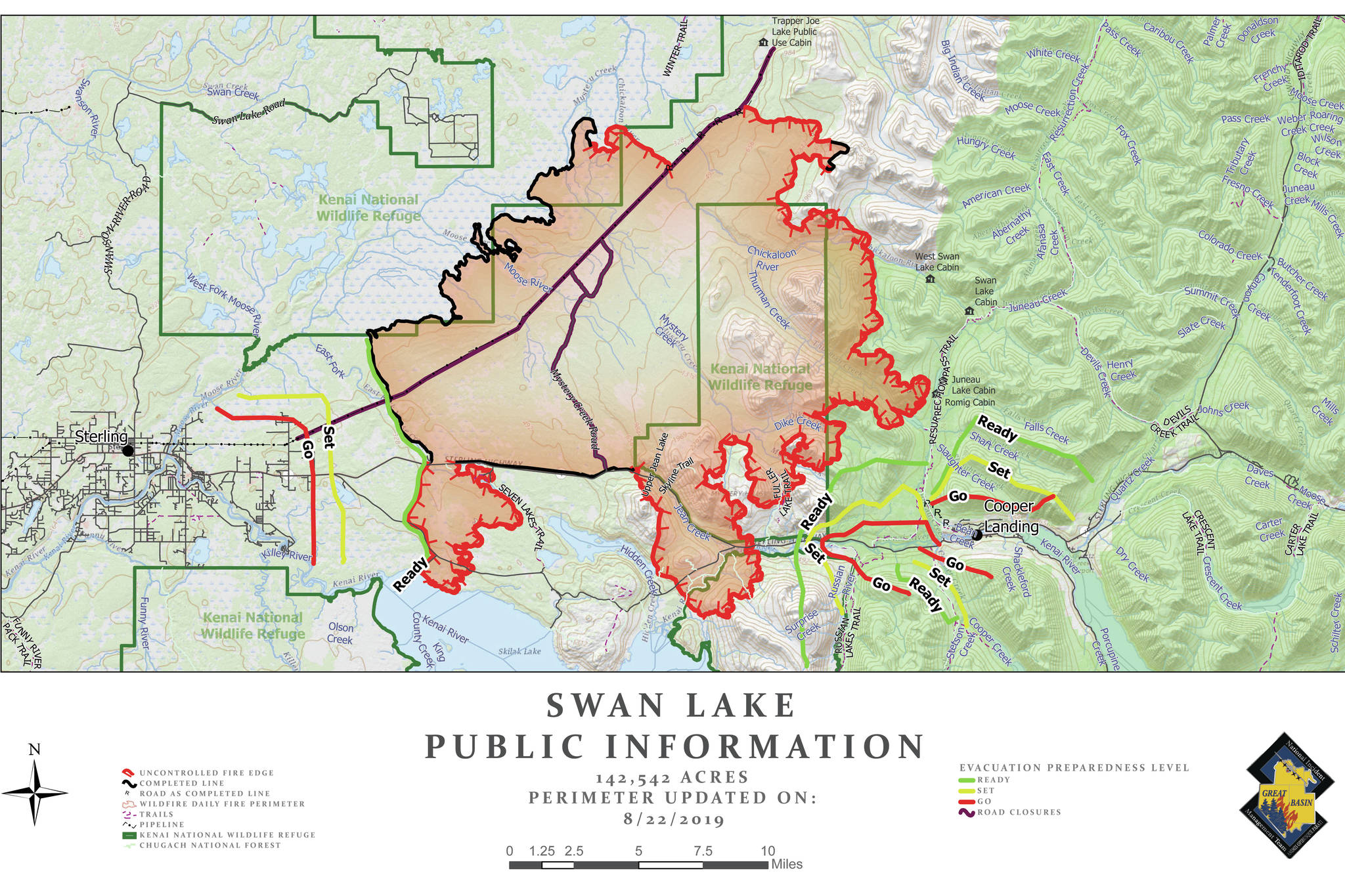
This map shows the Swan Lake Fire on the Kenai Peninsula in Alaska as of Aug. 22, 2019. (Photo courtesy Great Basin Incident Management Team 1)

This map shows the Swan Lake Fire on the Kenai Peninsula in Alaska as of Aug. 22, 2019. (Photo courtesy Great Basin Incident Management Team 1)

Swan Lake Fire shows little growth on Thursday

The latest infrared mapping puts the fire at 142,542 acres.

The Great Basin Incident Management Team reported clear air in Cooper Landing Thursday afternoon, which gave residents a break from the heavy smoke conditions and allowed aviation resources to be used in suppression efforts for the Swan Lake Fire.

The Sterling Highway didn’t experience any closures on Thursday, which is a change of pace from recent days. Most of the closures have been a result of heavy smoke conditions that impair visibility, especially when the smoke mixes with early morning fog. Highway conditions are still subject to change, and the latest information can be found at kpboem.com or 511.alaska.gov.

Helicopters spent Thursday dropping water on an area south of the Kenai River and west of Cooper Landing, according to the latest update from the incident management team. Public Information Officer Michael Davis said on Thursday that this area has been difficult to reach for crews on the ground due to recent flooding.

“All of the commercial fisherman are pulling their tours out of there, and they’re the experts around here so we’ve been following their lead,” Davis said.

Crews successfully crossed the river Thursday and begin establishing control lines in that area that will prevent the fire’s spread to the east on the south side of the river.

The control line on the western perimeter of the fire has been completed from the Sterling Highway south to Skilak Lake, and Davis said that crews are now bringing in miles of fire hose to “plumb” that line. Plumbing the line creates a junction every 50 to 100 feet that will allow firefighters to spray water anywhere up and down the line and defend it from fire growth.

Davis said that that wind has started to push to the west and will test this completed line. Meanwhile, the control line that was established weeks ago on the north side of the highway has been holding, and the latest monitoring has not shown any growth in that area.

Davis said that the incident management is not lacking for resources, personnel or equipment due to the high priority of the Swan Lake Fire.

“Basically the only fire activity in the U.S. is here in Alaska, and this is the number one fire in the nation, so we’re able to pull any resources we need from the Lower 48,” Davis said. Davis said that the incident management team has been conscious of the taxpayer money used to manage the fire. So far Swan Lake Fire operations have cost about $25.4 million, according to data from the National Interagency Coordination Center Incident Management Situation Report.

Because no big wind events are forecasted for the area, Davis said that the management team is confident that crews on the ground will be able to establish control lines without significant growth. The latest infrared mapping puts the fire at 142,542 acres.

Davis is from Colorado and has been a public information officer for nearly a decade as well as an EMT and firefighter in his hometown of Hotchkiss. Davis said that what makes managing the Swan Lake Fire unique is the number of high priority targets that require protection, such as the communities of Sterling and Cooper Landing, the Enstar gas line, the Moose research center and public use cabins in the area.

“Every square inch is worth fighting for,” Davis said.

More in News

The Challenger Learning Center is seen here in Kenai<ins>, Alaska,</ins> on Sept. 10, 2020. (Photo by Brian Mazurek/Peninsula Clarion)
Kenai City Council considers possible uses for Challenger Center

One option would assess the facility’s potential as the new public safety building.

A snowmachine rider takes advantage of 2 feet of fresh snow on a field down Murwood Avenue in Soldotna, Alaska, on Monday, Dec. 12, 2022. (Jake Dye/Peninsula Clarion)
Ice fishing opens on some Kenai National Wildlife Refuge lakes

Snowmachines are permitted for ice fishing access on Hidden, Kelly, Petersen, Engineer and Watson lakes.

The waters of Cook Inlet lap against Nikishka Beach in Nikiski, Alaska, where several local fish sites are located, on Friday, March 24, 2023. (Jake Dye/Peninsula Clarion)
Kenai asks for fishery economic disaster declaration

The Kenai City Council requested that Gov. Dunleavy declare a disaster and support a recovery plan for the Upper Cook Inlet East Side Set Net fishery.

The Kenai Peninsula Borough School District logo. (Photo courtesy of Kenai Peninsula Borough School District)
District superintendent dispels rumors about student construction

Superintendent Clayton Holland said student involvement in Seward High School construction is “based on rumor, not fact.”

Anchorage-based singer and songwriter Keeley Boyle is pictured in Anchorage<ins>, Alaska,</ins> on Sept. 26, 2023. Boyle, who was raised on the Kenai Peninsula, will use a $10,000 grant she received from the Rasmuson Foundation to create an album of songs about her grandparents’ home in Nikiski. Photo courtesy of Jovell Rennie
Musician hailing from Kenai receives Rasmuson grant

Keeley Boyle will record an album of songs about her grandparents’ Nikiski home.

Commercial fishing and recreational vessels are docked in the Homer harbor on Oct. 23, 2025. The commercial fishing industry endured a series of challenges over the year, some of them imposed by the new Trump administration. (Photo by Yereth Rosen/Alaska Beacon)
Alaska fisheries in 2025: turmoil, economic and environmental challenges and some bright spots

NOAA cuts, economic headwinds and invasive species pose problems, but there was some recovery in crab stocks and salmon harvests.

Cook Inlet near Clam Gulch is seen on Oct. 23, 2025. (Photo by Yereth Rosen/Alaska Beacon)
Disputed oil lease sale in Alaska’s Cook Inlet upheld in new Trump administration decision

After completing a court-ordered environmental study, the Bureau of Ocean Energy Management said no changes are needed for the 2022 sale that drew just one bid.

The Kenai Peninsula Borough School District logo.
School district projects $7.5 million budget deficit for fiscal year 2027

Decreased enrollment and increased property values mean less local and state funding.

The sign in front of the Homer Electric Association building in Kenai, Alaska as seen on April 1, 2020. (Photo by Brian Mazurek/Peninsula Clarion)
Homer Electric Association announces rate increase

The proposed increase, if approved by the Regulatory Commission of Alaska, will go into effect Jan. 1.

Most Read