
In his first address to the Alaska State Legislature in two years, Sen. Dan Sullivan, R-Alaska, described a guarded relationship with the new presidential administration that he said has taken an aggressive stance toward Alaska workers and families.
But, while cautious, Sullivan said he saw areas where he could work with the Biden administration.
“I’m calling for a cease-fire in the Biden administration’s war on Alaska,” Sullivan said, standing behind a lectern encased in plexiglass at the Alaska State Capitol.
Sullivan spoke to a joint session of the Legislature, the first since the beginning of the pandemic. Gov. Mike Dunleavy gave his State of the State address virtually in late January and Sen. Lisa Murkowksi, R-Alaska, met with lawmakers but did not address the body as a whole.
Alaska’s way of life is under attack by the Biden administration, Sullivan said, asserting that the administration’s environmental policies would cost hundreds of jobs in Alaska, particularly in the energy sector. But state resources, he said, could help make the U.S. more independent in its supply chains, which have become too dependent on foreign countries, particularly China.
Throughout his speech, Sullivan warned that Biden’s environmental agenda would force jobs abroad, particularly to China, which is expanding politically and militarily. Sullivan asserted that China has some of the worst environmental policies in the world, and criticized the country’s labor practices, particularly in regard to Uyghur Muslims in the Xinjiang region.
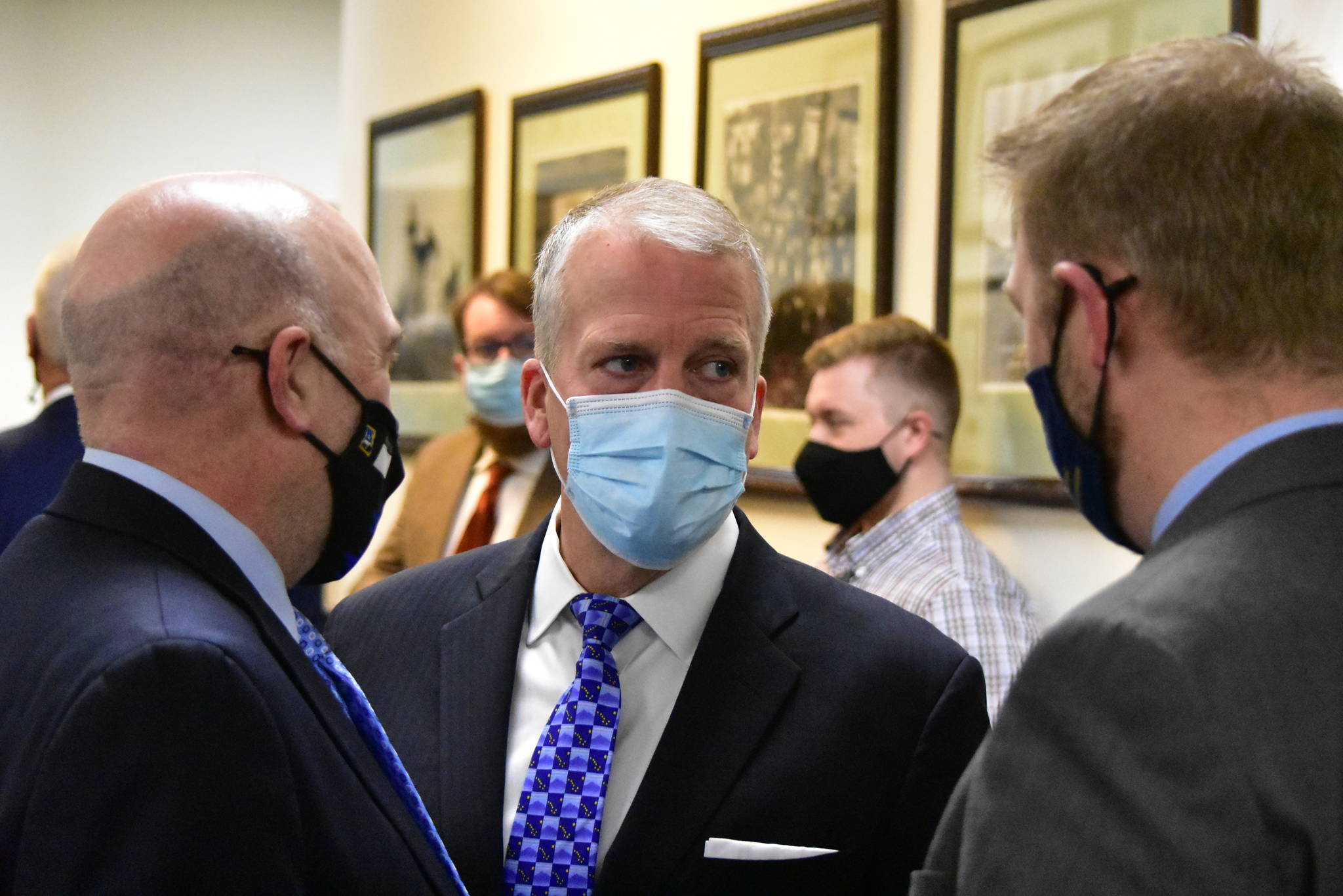
From left to right: Rep. Adam Wool, D-Fairbanks, U.S. Sen. Dan Sullivan, R-Alaska, and Alaska State Sen. Josh Revak, R-Anchorage, in the hallway of the Alaska State Capitol following Sullivan’s address to the Legislature. (Peter Segall / Juneau Empire)
But the COVID-19 pandemic highlighted America’s dependence of foreign countries for many resources, Sullivan said in a news conference with reporters following his speech. That caused an awakening among many of his colleagues in Washington, he said, asserting that there was increased bipartisan interest in the security of U.S. supply chains.
[Could rare earth minerals be Alaska’s edge?]
“The more we highlight that, the more I think American companies are going to come home,” Sullivan said in the news conference. “But I also think there’s an appetite in the Congress to incentivize that transformation to come back home, in a whole host of ways, and I think that’s a great bipartisan opportunity that could really benefit Alaskans.”
How to attract companies that have moved operations abroad back to the U.S. is an important question, but he’s seen increased interest in the issue on both sides of the aisle, Sullivan said. The private sector in America was becoming increasingly wary of working with China, Sullivan said, and has begun to reconsider supply chains.
“I think it’s starting to happen all over. I can’t give you an example of specific companies, but I know because I’ve cared about this issue for a long time, the (urge) for a bipartisan approach to making this happen with regard to supply chains is clearly shifted and is clearly happening,” he said.
In a handout provided to lawmakers, Sullivan laid out policy proposals he said were a more worker-oriented energy plan than the proposals put forth by the Biden administration. Sullivan’s proposals call for expanding the use of liquid natural gas, which the U.S. could export to other nations, as well as investments in infrastructure for resource projects.
One of the policy areas highlighted on the handout and mentioned by Sullivan is the permitting process for resource projects in America. The National Environmental Policy Act needs to be reformed to ensure environmental reviews are not used to unnecessarily delay projects, the handout says. That act was reformed by the Trump administration, which rolled back many of its environmental regulations.
[Dunleavy praises NEPA rollback at White House]
Increased incursions into American airspace by China and are a deep cause for concern, he said. Sullivan said in his speech that the era of great power competition was returning, and that Alaska was on the front line. Sullivan also called for additional military resources put into Alaska, saying the Arctic is an increasingly important strategic area. More cargo planes were coming to Alaska, as well as 100 advanced fighter jets, Sullivan told lawmakers, and he is advocating for more ice-breakers to be based in the state.
“Our state is becoming one of the most important centers for air combat power anywhere in the world. This is great for America’s national security but really great for Alaska’s economy,” Sullivan said, drawing applause from lawmakers.
